



AECOM's Report Focuses on Future of High-Speed Rail Delivery
The report, which is part of AECOM’s ongoing Future of Infrastructure thought leadership series, investigates the latest industry trends and outlines best practices for the successful delivery of HSR systems around the world.

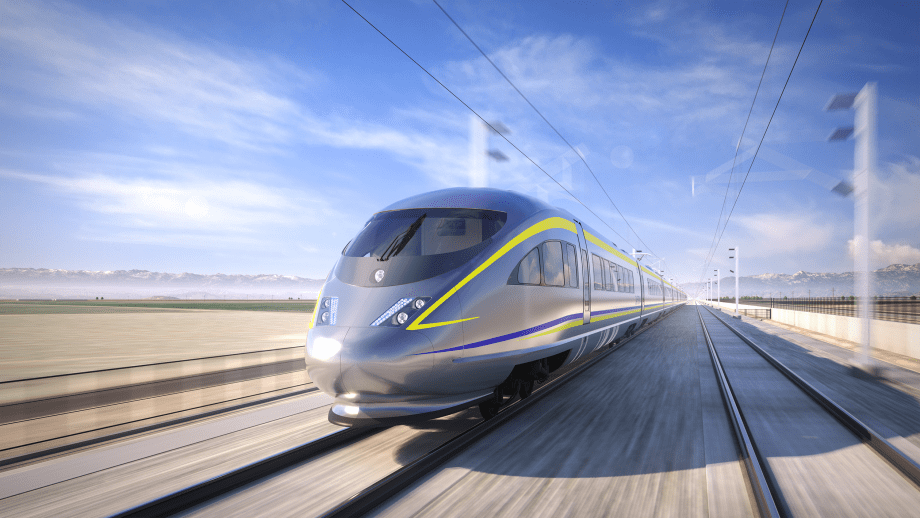
In North America, key success factors were regional economic growth, use of the latest technology, and passenger experience.
Photo: California High-Speed Rail Authority
Consultant firm AECOM released its new report, “From Vision to Reality: A New High-Speed Rail Playbook,” which presents original quantitative and qualitative research conducted with 112 senior decision-makers involved in high-speed rail (HSR) projects globally.
Informed by the firm’s 30-year expertise in HSR design and delivery, the report, which is part of AECOM’s ongoing Future of Infrastructure thought leadership series, investigates the latest industry trends and outlines best practices for the successful delivery of HSR systems around the world.
HSR Success Factors
Research presented in the report found that economic growth, technology, adaptability, and on-time completion prove the most critical success factors in the first year of HSR operation.
In the five-to-ten-year period post launch, top success factors shift to passenger experience and adaptability while the impact of project delays becomes less important.
Success factors also varied widely by region:
Europe’s primary success factors included a reduction in air/vehicle traffic, use of the latest technology, and future adaptability.
In North America, key success factors were regional economic growth, use of the latest technology, and passenger experience.
For the Asia and Pacific region, on-time completion, low environmental impact, and social benefits comprised the top key success factors.
“Through our extensive experience guiding clients across all stages of HSR delivery, we are finding that the global push toward the energy transition is propelling significant interest in this low-carbon mode of transportation,” said Troy Rudd, AECOM’s CEO. “With such unprecedented demand and new funding opportunities worldwide, we’re excited to present this first-of-its-kind playbook to provide a comprehensive view of best practices that can accelerate the growth of HSR globally.”
Global, Region Specific
The report takes both a global and region-specific approach to a spectrum of key HSR topics, including passenger experience, economic and social benefits, emissions reductions, regulatory and political factors, land use, and funding concerns.
Data is presented over immediate and five-to-10-year timeframes and is supported by interviews from leaders across major HSR organizations, including Adif, High Speed 1, Brightline, the California High-Speed Rail Authority, NEOM, and China Railway Construction Company International (CRCCI).
“Our integrated transportation networks continue to evolve rapidly, and high-speed rail has a crucial role to play in this ongoing transformation,” said Lara Poloni, AECOM’s president. “It’s our hope that, through better understanding of the opportunities and challenges attached to these mega projects, that existing networks can expand, and proposed networks can move from vision to reality, helping create thriving, connected communities.”
Best Practices to Streamline HSR Delivery and More
In response to industry headwinds, the report explores several best practices to streamline HSR delivery and facilitate the expansion of HSR networks globally:
Long-term decisive political leadership.
New funding models.
Greater trans-regional and international cooperation.
New design and construction.
Increased collaboration and industry outreach.
User-centric design and engagement.
Design to cost (DTC) and disciplined cost control.
AECOM is a trusted delivery partner on some of the world’s largest, most transformative rail projects, including California High-Speed Rail, HS1 in the UK, and Taiwan High-Speed Rail.
Click here to read the full report.
More Rail

New York MTA Advances Final Contract for Second Avenue Subway Expansion
Contract Four is the largest in the Second Avenue Subway Phase 2 project and includes construction of station infrastructure, tracks, and signals for the subway expansion, MTA officials said. Work on Contract Four will begin in 2027.
Read More →
San Diego MTS Breaks Monthly Trolley Ridership Record
Agency officials said July’s ridership indicates MTS’s continued recovery from the pandemic.
Read More →
Report Examines NJ TRANSIT Reliability, Funding Challenges
The Garden State Initiative analysis examines the roles of Amtrak infrastructure, fleet management, and agency operations while recommending a more performance-based approach to improving reliability.
Read More →
Stadler, CapMetro Sign Long-Term Rail Fleet Support Agreement
Beginning in 2027, Stadler will provide on-site technical expertise, spare parts support, training, and obsolescence management to help extend the reliability and longevity of CapMetro’s GTW fleet.
Read More →
Biz Briefs: Alstom Lands Canadian Contract, LYT to Supply California TSP, and More
In METRO's latest installment, we take a look at recent news from Complete Coach Works, Beep, FlixBus, and more partnerships making headlines across the transportation sector.
Read More →
CATS Gold Line Marks 5 Years of Service, 2.8M Passenger Trips
With a six-mile expansion planned, the Charlotte streetcar is positioned to connect more neighborhoods and major transit hubs across the region.
Read More →
Why Simulating Pedestrian Movement Has Become Essential for Modern Rail Stations
Pedestrian microsimulation is helping rail planners identify bottlenecks, test station designs, and prepare complex transit hubs for growing passenger volumes.
Read More →
Amtrak Begins Major Construction at New York’s Sunnyside Yard
The new maintenance facility will support Amtrak’s Airo trainsets while improving maintenance efficiency and turnaround times in New York.
Read More →
Chicago Leaders Unveil Plans for O’Hare Airport Express Train
The privately developed project would offer a 15-minute trip between downtown and O’Hare’s Terminal 2, with trains operating every 15 minutes on a dedicated track. The service would use battery-electric trains and three existing freight rail rights-of-way.
Read More →
OCTA Maps Out 30-Year Strategy to Protect Coastal Rail Corridor
The draft feasibility report identifies strategies to protect the coastal rail line for decades as the agency continues near-term stabilization and sand placement efforts.
Read More →