Brightline West Breaks Ground on High-Speed Rail Line
The 218-mile Las Vegas to California system will be constructed in the middle of the I-15 and is based on Brightline’s vision to connect city pairs that are too short to fly and too far to drive.
The project was recently awarded $3 billion in funding from President Biden’s Bipartisan Infrastructure Bill. The rest of the project will be privately funded and has received a total allocation of $3.5 billion in private activity bonds from USDOT.
Photo: Brightline West
5 min to read
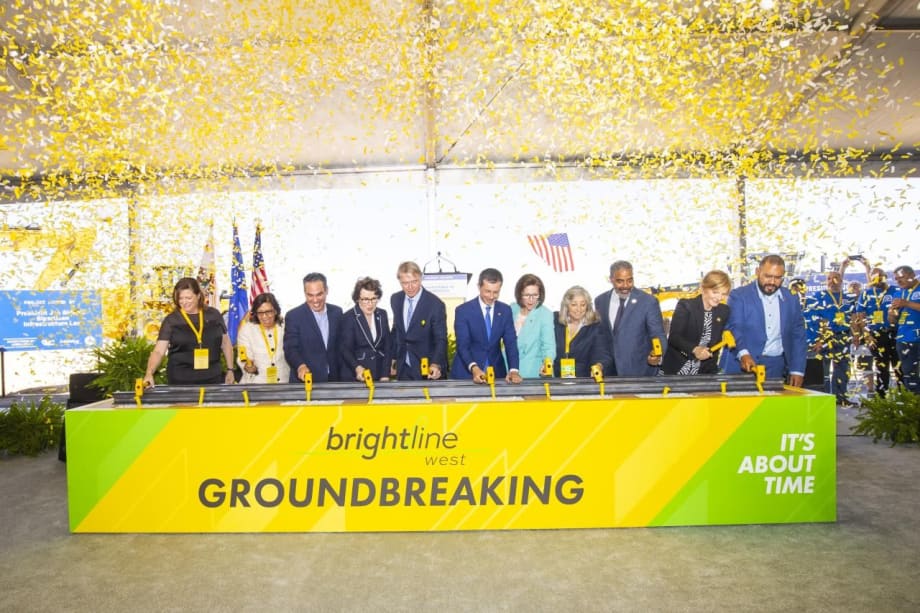
Brightline West officially broke ground on the nation's first true high-speed rail system, which will connect Las Vegas to Southern California.
The 218-mile system will be constructed in the middle of the I-15 and is based on Brightline’s vision to connect city pairs that are too short to fly and too far to drive.
Ad Loading...
The Brightline West Project
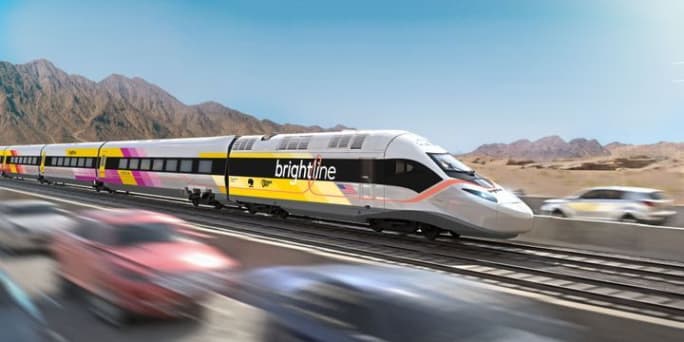
Hailed as the greenest form of transportation in the world, Brightline West will run zero-emission, fully-electric trains capable of speeds of 200 miles per hour.
The project is a watershed for high-speed rail in America and will establish the foundation for the creation of a new industry and supply chain, according to Brightline West officials.
The project was recently awarded $3 billion in funding from President Biden’s Bipartisan Infrastructure Bill. The rest of the project will be privately funded and has received a total allocation of $3.5 billion in private activity bonds from USDOT.
Brightline West Groundbreaking
The groundbreaking included remarks from U.S. Transportation Secretary Pete Buttigieg, Brightline Founder Wes Edens, Nevada Gov. Joe Lombardo, Sen. Catherine Cortez, Sen. Jacky Rosen, and more. Trades.
“People have been dreaming of high-speed rail in America for decades — and now, with billions of dollars of support made possible by President Biden’s historic infrastructure law, it’s finally happening,” said Secretary Buttigieg. “Partnering with state leaders and Brightline West, we’re writing a new chapter in our country’s transportation story that includes thousands of union jobs, new connections to better economic opportunity, less congestion on the roads, and less pollution in the air.”
Ad Loading...
Hailed as the greenest form of transportation in the world, Brightline West will run zero-emission, fully-electric trains capable of speeds of 200 miles per hour.
Photo: Brightline West
Construction of Brightline West
Brightline West's rail system will span 218 miles and reach speeds of 200 mph. The route, which has full environmental clearance, will run within the median of the I-15 highway with zero grade crossings. The system will have stops in Las Vegas, Nev., as well as Victor Valley, Hesperia, and Rancho Cucamonga, Calif.
The privately-led infrastructure project is one of the largest in the nation and will be constructed and operated by union labor.
It will use 700,000 concrete rail ties, 2.2 million tons of ballast, and 63,000 tons of 100% American steel rail during construction.
Upon completion, it will include 322 miles of overhead lines to power the trains and will include 3.4 million square feet of retaining walls. The project covers more than 160 structures including viaducts and bridges. Brightline West will also be fully Buy America Compliant.
Stations and Facilities
Brightline West will connect Southern California and Las Vegas in two hours, or almost half the time as driving. The Las Vegas Station will be located near the iconic Las Vegas Strip, on a 110-acre property north of Blue Diamond Road between I-15 and Las Vegas Boulevard.
Ad Loading...
The site provides convenient access to the Harry Reid International Airport, the Las Vegas Convention Center, and the Raiders’ Allegiant Stadium. The station is approximately 80,000 square feet plus parking.
The Victor Valley Station in Apple Valley will be located on a 300-acre parcel southeast of Dale Evans Parkway and the I-15 interchange. The station is intended to offer a future connection to the High Desert Corridor and California High Speed Rail. The Victor Valley Station is approximately 20,000 square feet plus parking.
The Rancho Cucamonga Station will be located on a five-acre property. The station will be co-located with existing multimodal transportation options, including California Metrolink, for seamless connectivity to Downtown Los Angeles and other locations in Los Angeles, Orange, San Bernardino, and Riverside Counties. The Rancho Cucamonga Station is approximately 80,000 square feet plus parking.
The Hesperia Station will be located within the I-15 median at the I-15/Joshua Street interchange and will function primarily as a local rail service for residents in the High Desert on select southbound morning and northbound evening weekday trains.
The Vehicle Maintenance Facility (VMF) is a 200,000-square-foot building located on 238 acres in Sloan, Nev., and will be the base for daily maintenance and staging of trains. This site will also serve as one of two hubs for the maintenance of way operations and the operations control center. More than 100 permanent employees will report on a daily basis once operations begin and will serve as train crews, corridor maintenance crews, or operations control center teammates. A second maintenance of way facility will be located adjacent to the Apple Valley station.
Ad Loading...
The Southern California/Las Vegas Travel Market
The Las Vegas and Southern California travel market is one of the nation’s most attractive corridors with over 50 million trips between the region each year.
Additionally, Las Vegas continues to attract visitors from around the world, with 4.7 million international travelers flying into the destination. The city dubs itself on being the world’s No. 1 meeting destination, welcoming nearly six million people to the Las Vegas Convention Center last year.
In California, approximately 17 million Southern California residents are within 25 miles of the Brightline West station sites. Studies show that one out of every three visits to Las Vegas come from Southern California.
Economic and Environmental Benefits of the Project
Brightline West's $12 billion infrastructure investment will create over $10 billion in economic impact for Nevada and California and will generate more than 35,000 jobs, including 10,000 direct union construction roles and 1,000 permanent operations and maintenance positions.
The investment also includes over $800 million in improvements to the I-15 corridor and involves agreements with several unions for skilled labor.
Ad Loading...
The project supports Nevada and California's climate goals by offering a no-emission mobility option that reduces greenhouse gasses by over 400,000 tons of CO2 annually — reducing vehicle miles traveled by more than 700 million each year and the equivalent of 16,000 short-haul flights.
The company will also construct three wildlife overpasses, in partnership with the California Department of Fish and Wildlife and Caltrans for the safe passage of native species, primarily the bighorn sheep.
Contract Four is the largest in the Second Avenue Subway Phase 2 project and includes construction of station infrastructure, tracks, and signals for the subway expansion, MTA officials said. Work on Contract Four will begin in 2027.
The Garden State Initiative analysis examines the roles of Amtrak infrastructure, fleet management, and agency operations while recommending a more performance-based approach to improving reliability.
Beginning in 2027, Stadler will provide on-site technical expertise, spare parts support, training, and obsolescence management to help extend the reliability and longevity of CapMetro’s GTW fleet.
In METRO's latest installment, we take a look at recent news from Complete Coach Works, Beep, FlixBus, and more partnerships making headlines across the transportation sector.
Pedestrian microsimulation is helping rail planners identify bottlenecks, test station designs, and prepare complex transit hubs for growing passenger volumes.
The privately developed project would offer a 15-minute trip between downtown and O’Hare’s Terminal 2, with trains operating every 15 minutes on a dedicated track. The service would use battery-electric trains and three existing freight rail rights-of-way.
The draft feasibility report identifies strategies to protect the coastal rail line for decades as the agency continues near-term stabilization and sand placement efforts.