



MTA Replaces First Segment of Park Avenue Viaduct Without Disrupting Metro-North Railroad Service
The replacement represents a major step toward ensuring this critical transportation infrastructure remains in a state of good repair and enables Metro-North to continue safely delivering record on-time performance.

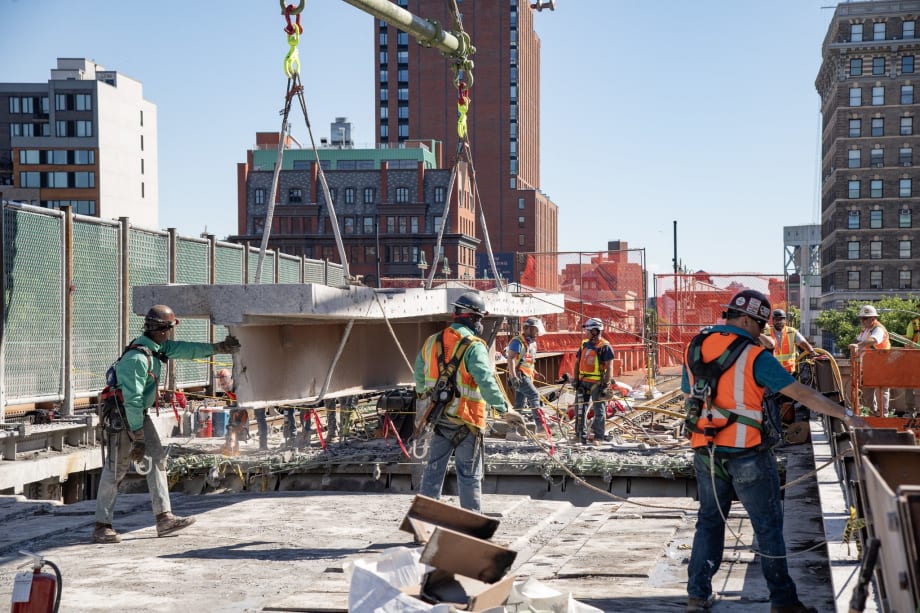
Phase 1 of the project, extending from East 115th Street to East 123rd Street along Park Avenue, includes replacement of the existing steel structure as well as new tracks, power, communications, and signal systems.
Photo: MTA/Trent Reeves
New York’s Metropolitan Transportation Authority (MTA) successfully replaced the first section of the aging 130-year-old Park Avenue Viaduct without disrupting Metro-North service.
The replacement represents a major step toward ensuring this critical transportation infrastructure remains in a state of good repair and enables Metro-North to continue safely delivering record on-time performance.
Metro-North’s Park Avenue Viaduct
The Park Avenue Viaduct is an elevated steel structure that carries four Metro-North Railroad tracks and serves all Metro-North trains traveling into and out of Grand Central Terminal, totaling 750 trains every weekday.
The recent operation utilized two gantry systems, which extend over the viaduct to remove and replace the existing concrete and steel bridge deck with new prefabricated bridge units, weighing around 190,000 pounds each.
The innovative approach helped MTA Construction & Development, in partnership with Metro-North Railroad, perform this work better, faster, and cheaper and without significant disruption for riders.
“All Metro-North trains to and from Grand Central Terminal pass over the Park Avenue Viaduct, which is more than 130 years old,” said Metro-North Railroad President Catherine Rinaldi. “Replacement of this structure is a priority state of good repair project that is critical to our ability to provide safe and reliable service. We are thrilled that this project is underway, and we will continue to work closely with MTA Construction & Development to minimize impacts to our service.”
Park Avenue Viaduct Phase 1
Phase 1 of the project, extending from East 115th Street to East 123rd Street along Park Avenue, includes replacement of the existing steel structure as well as new tracks, power, communications, and signal systems.
Substructure construction to replace the viaduct’s foundations and columns began in September 2023 and construction for Phase 1 will continue through 2026.
The first round of work is part of the $590 million earmarked for the first phase of the Park Avenue Viaduct Replacement project, of which $500.9 million is federally funded.
The entirety of the Park Avenue Viaduct runs from the entrance of the Park Avenue Tunnel at East 97th Street to the Harlem River, however, the Park Avenue Viaduct Replacement project focuses on the structural elements in need of repair dating from the 1890s between East 110th Street and the Harlem River Lift Bridge, spanning 1.8 miles.
The reconstruction of the viaduct will ensure the railroad continues to provide safe and reliable Metro-North train service.
For the first four months of this year, the railroad averaged an on-time performance of 98.7% — notably, February’s on-time performance was 99.3% — and the service-delivered rate, a service reliability measure, averaged 99.9% for the first four months.
More Rail

New York MTA Advances Final Contract for Second Avenue Subway Expansion
Contract Four is the largest in the Second Avenue Subway Phase 2 project and includes construction of station infrastructure, tracks, and signals for the subway expansion, MTA officials said. Work on Contract Four will begin in 2027.
Read More →
San Diego MTS Breaks Monthly Trolley Ridership Record
Agency officials said July’s ridership indicates MTS’s continued recovery from the pandemic.
Read More →
Report Examines NJ TRANSIT Reliability, Funding Challenges
The Garden State Initiative analysis examines the roles of Amtrak infrastructure, fleet management, and agency operations while recommending a more performance-based approach to improving reliability.
Read More →
Stadler, CapMetro Sign Long-Term Rail Fleet Support Agreement
Beginning in 2027, Stadler will provide on-site technical expertise, spare parts support, training, and obsolescence management to help extend the reliability and longevity of CapMetro’s GTW fleet.
Read More →
Biz Briefs: Alstom Lands Canadian Contract, LYT to Supply California TSP, and More
In METRO's latest installment, we take a look at recent news from Complete Coach Works, Beep, FlixBus, and more partnerships making headlines across the transportation sector.
Read More →
CATS Gold Line Marks 5 Years of Service, 2.8M Passenger Trips
With a six-mile expansion planned, the Charlotte streetcar is positioned to connect more neighborhoods and major transit hubs across the region.
Read More →
Why Simulating Pedestrian Movement Has Become Essential for Modern Rail Stations
Pedestrian microsimulation is helping rail planners identify bottlenecks, test station designs, and prepare complex transit hubs for growing passenger volumes.
Read More →
Amtrak Begins Major Construction at New York’s Sunnyside Yard
The new maintenance facility will support Amtrak’s Airo trainsets while improving maintenance efficiency and turnaround times in New York.
Read More →
Chicago Leaders Unveil Plans for O’Hare Airport Express Train
The privately developed project would offer a 15-minute trip between downtown and O’Hare’s Terminal 2, with trains operating every 15 minutes on a dedicated track. The service would use battery-electric trains and three existing freight rail rights-of-way.
Read More →
OCTA Maps Out 30-Year Strategy to Protect Coastal Rail Corridor
The draft feasibility report identifies strategies to protect the coastal rail line for decades as the agency continues near-term stabilization and sand placement efforts.
Read More →