With its mission to provide timely bus transportation that enables its customers to function comfortably away from their homes and maintain their freedom and independence, Ionia Dial-a-Ride’s services extend to Eastern Township, Berlin, Orange, and other outlying farming communities.
by David Hubbard
October 25, 2024
Collectively, the Ionia Dial-a-Ride buses and vans carry 3,000 upward to 5,000 passengers per month and travel 10,000 to 12,000 miles.
Photo: Ionia Dial-A-Ride
8 min to read
Residents in need of public transportation in the rural community of Ionia, Mich., situated 30 miles on either side of Lansing and Grand Rapids, rely on Ionia Dial-a-Ride, the demand-response bus operation that has served the general populace throughout this region for 44 years.
With its mission to provide timely bus transportation that enables its customers to function comfortably away from their homes and maintain their freedom and independence, Ionia Dial-a-Ride’s services extend to Eastern Township, Berlin, Orange, and other outlying farming communities.
With no fixed-route bus systems operating within these communities, Ionia Dial-a-Ride provides curb-to-curb transportation for those who call and request a ride with fares ranging from $1.50 to $3.00 per ride.
For the most part, its services are funded through a variety of grants and funding sources. The typical wait time for pick up is 15 to 30 minutes. However, many Dial-a-Ride regulars call ahead days, weeks, or month with their recurring schedules to always be assured of their seat on bus when they need to travel.
“We accommodate riders with any reason to take our buses if they don't drive or own a vehicle; particularly those requiring non-emergency medical transportation in their daily lives” says Heide Wenzel, Ionia Dial-a-Ride’s director, transportation. “Our passengers typically range from elderly people to younger people with disabilities, employees going to their jobs, school students living outside the yellow school bussing areas and distances too far to walk.”
Collectively, the Ionia Dial-a-Ride buses and vans carry 3,000 upward to 5,000 passengers per month, traveling 10,000 to 12,000 miles. During the school year as a larger number of students is added to the mix, the daily runs become even busier.
Ad Loading...
Wenzel notes that Ionia Dial-a-Ride does not reach the outlying host of smaller villages and townships nearer to Lansing and Grand Rapids — as yet.
“We are working steadily to increase our region of travel for individual passengers and have been assessing the transportation issues for people in these other communities for some time,” she says. “But we can only do so much with the limited funding we have available to serve those communities that support us.”
The Commission on Aging runs the only other public transportation service in this region, catering solely to the specialized senior population primarily for their shopping and non-emergency medical care.
The Commission requires passengers to first qualify as seniors to utilize its services. The only drawback is the limit this policy puts on the range and number of individuals it can serve.
Therefore, Ionia Dial-a-Ride works closely with the director of The Commission on Aging to help alleviate and duplication of services — such as accommodating older individuals who do not require additional assistance for transportation outside normal service areas.
Ad Loading...
“Because we strive every day to provide transportation for as many people as possible in the communities we serve,” says Wenzel, “we take pride in working with the Commission on Aging to assist those select riders who absolutely require its services.”
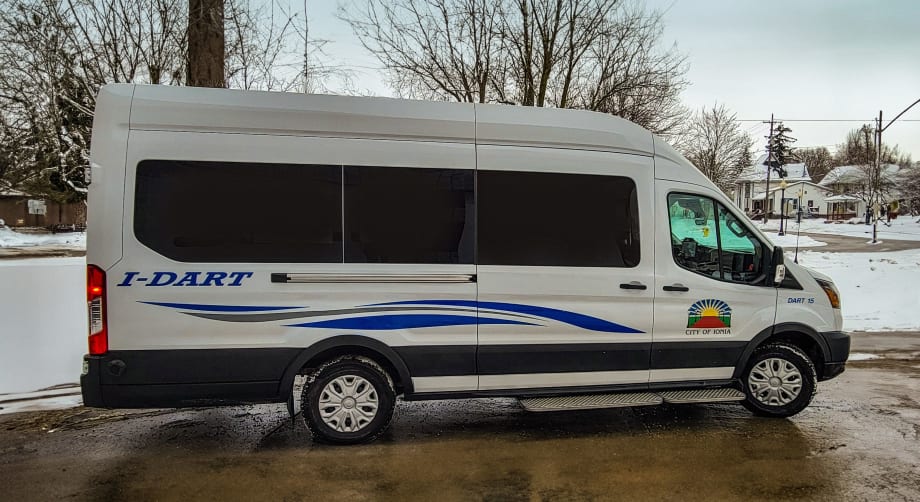
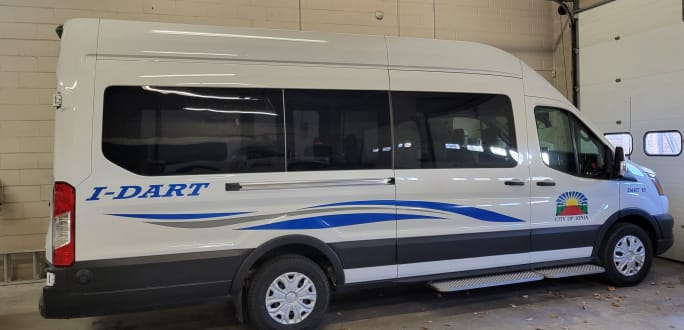
This year, Ionia Dial-a-Ride took a quantum leap, going all in on electrification when it procured its first electric-powered vehicles, two 2024 Ford Pro e-Transit electric vans.
Photo: Ionia Dial-A-Ride
The Ionia Dial-a-RideFleet
Nine heavy-duty cutaway buses serve as the backbone of Ionia Dial-a-Ride — eight ElDorado Advantage buses that feature the first fully-integrated steel-cage cutaway body, and one Champion Challenger. Both OEMs are built on the Ford 4500-Series G-Cut Chassis with fiberglass bodies configured to comfortably seat 14 to 19 passengers. These buses require drivers to have a CDL with a P endorsement.
The model-years of these buses range from 2013 to 2020. Typically, the useful life of these buses is approximately 100,000 miles. However, Ionia Dial-a-Ride notes that replacing a bus depends primarily on the availability of capital funding, which is why the agency speaks highly of its maintenance personnel who keep its buses rolling safely.
Ionia Dial-a-Ride goes electric
This year, Ionia Dial-a-Ride took a quantum leap, going all in on electrification when it procured its first electric-powered vehicles, two 2024 Ford Proe-Transit electric vans.
The first one is now in service, while the second is on order and awaiting delivery in December.
Ad Loading...
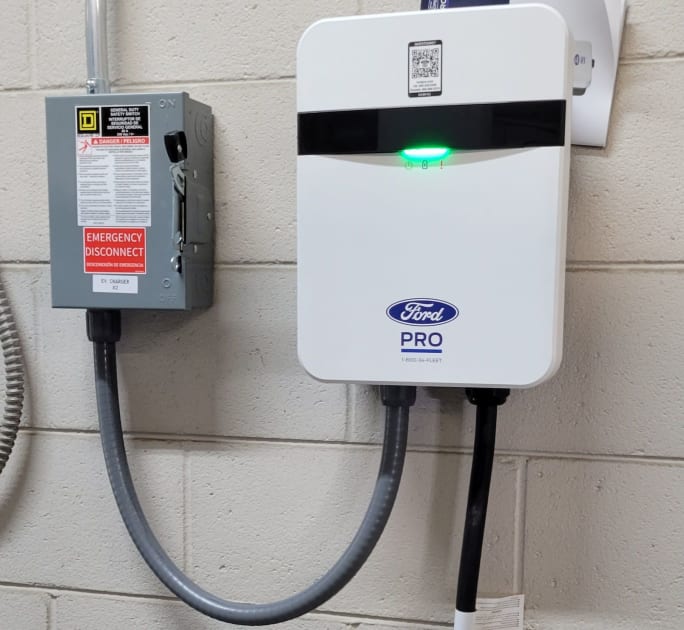
The order also included the two required Ford Pro AC charging stations, which the agency acquired through Powerlift, a grant program offered through Consumers Energy, a Michigan utilities provider.
Wenzel says the transition to the agency’s first e-Transit, getting it into service and setting up the charging stations, was a fairly seamless process, accomplished through a series of virtual orientations with the Ford team and following directions.
Once in service, the first e-Transit van family immediately began to prove itself by its smooth and silent handling and estimated travel distances ranging between 143 and 159 miles on one charge.
The e-Transit vans do not require drivers to have a CDL license. However, Ionia Dial-a-Ride insists all its drivers be CDL licensed and applies to these vans as well.
Ionia Dial-a-Ride does not foresee a large fleet of all-electric vehicles; saying the longer distances all its buses must cover throughout these rural regions on a daily basis does not warrant a move to an all-electric fleet.
Ad Loading...
“The longer mileages of the routes, as well as the variance in the electrical charge as temperatures fluctuate throughout the day dictate the necessity of fuel-powered buses,” says Wenzel. “Transitioning to an all-electric fleet for the most part is out of the question for our operations. We simply need our gas-fueled buses.”
While the initial investment for the Ford e-Transit vans is considerably more than for fuel-powered vehicles, Wenzel says even with the one e-Transit van in service at this one, the agency is already realizing their potential savings in operations and maintenance.
If and when the agency acquires a third electric bus the consensus is it should be one of the larger cutaway buses.
With only two e-Transit vans to manage for the near future, Wenzel says she does not have to keep constant watch on the metrics; mostly just ensure the van is plugged in and re-charging properly and delivering on the range and mileage after each charge; which can differ in every area depending on the weather and run times.
“Still, we can’t be too careful,” she says. “This is extremely important considering the distances we travel away from our base. We must always be ensuring these vans are operating as expected to carry out our service.”
Ad Loading...
Looking ahead, based the early performance and popularity of the Ford e-transit vans, Ionia Dial-a-Ride has established an electrification plan for consider more electric vans the future, which involves weighing their expense and funding complexities against how the e-vans mesh in the overall operations.
While it is not on the drawing board at this time, one solution Ionia Dial-a-Ride may consider implementing at some point would be to station additional e-Transit vans in the rural communities outside Ionia.
Meantime, the heavy lifting is left to the heftier ElDorado and Champion cutaway buses.
From all accounts, “going electric” seems to have created somewhat of a buzz, given Ionia citizens’ overall reaction to the single e-Transit van.
“When we first introduced our electric van, many of the passengers approached it as a bit of a novelty,” Wenzel says. “But once on board and rolling, they discover its wide aisle and openness, how the ride is closer to that of their automobile. It doesn’t have the shifting a heavier cutaway with a larger fiberglass body.”
Ad Loading...
While people in Ionia were first taking notice of the new e-Transit van in town, Wenzel says it seemed to strike them as a novelty. But a few rides she said she began to gain their approval.
Additionally, she said these opportunities to visit one-on-one also provided a chance to explain and answer questions on the agency’s services and other aspects of Ionia Dial-A-Ride’s operations.
With no fixed-route bus systems operating within these communities, Ionia Dial-a-Ride provides curb-to-curb transportation for those who call and request a ride with fares ranging from $1.50 to $3.00 per ride.
Photo: Ionia Dial-A-Ride
The State of Michigan is on Board
Ionia-Dial-a-Ride is well positioned to ride the wake of electric propulsion in public transit.
The agency certainly has the support of State of Michigan, which has emerged as a frontrunner in the transition to electric vehicles (EVs); offering various grants and developing initiatives aimed at supporting it cities, towns, and communities in adopting cleaner transportation alternatives as they become available.
Michigan Gov. Gretchen Whitmer voiced her enthusiasm for Michigan’s electric transportation future, noting the benefits of converting to electric-powered vehicles.
Ad Loading...
She surmises families saving thousands of dollars over the lifetime of an electric vehicle; and providing support for “tens of thousands” of good-paying transportation and automotive auto jobs in Michigan; and helping maintain clean air and water for future generations.
Saying Michigan has taken significant strides in incentivizing and supporting the adoption of electric transportation through a wide array of grants the lead the state toward a greener future, she recently announced the $125 million grant, which she says will further accelerate Michigan’s transition to electric buses and facilitate the gradual replacement of conventional buses with clean and sustainable electric alternatives.
Hoekstra Transportation, a Michigan Icon
Ionia Dial-a-Ride has always purchased its buses and vans through the 90-year-oid Michigan bus dealership, Hoekstra Transportation, based in Grand Rapids.
During the early 1900’s John F. Hoekstra worked on the assembly line at Ford Motor Company as a technician. He later decided to move to Grand Rapids and began doing mechanical work on the side.
As interest in his work grew, he decided to turn his hobby into “real work.” As demand for his work grew steadily local farmers started requesting him to build equipment made to their specifications. It wasn’t long before his hobby blossomed into Hoekstra Truck Equipment that includes parts, service, and sales.
Ad Loading...
The company has since morphed and evolved in keeping with growth and evolution within the industry as its leadership has passed on to sons, grandsons, and great-grandsons.
See how three Gillig battery-electric buses powered festival stages while the agency’s new Park & Ride service carried approximately 1,000 attendees, demonstrating another potential use for transit agencies’ electric fleets.
The new name represents a renewed vision for the nonprofit focused on advancing clean, equitable, and affordable transportation solutions that move people and goods.
John Hroncich discusses BAE Systems’ modular and scalable approach, lessons learned from decades of real-world operations, and how agencies can identify electrification strategies that fit their fleets.
UB, transportation solutions provider WeDriveU, and fleet electrification specialist Zenobē marked the deployment in the presence of students, university administrators, and local officials.
From manufacturers and suppliers to transit agencies and motorcoach operators, these updates offer a snapshot of the projects, partnerships and business moves driving the industry forward.
The agency’s maintenance chief discusses leadership, workforce development, zero-emission technology, and preparing technicians for the future of public transportation.
The firm will work with CTDOT and RVT to define the facility layout, operational requirements, and long-term flexibility for RVT’s growing electric fleet.
The fast-charging infrastructure will help extend electric bus range, improve fleet utilization, and support DASH's goal of transitioning to a fully zero-emission fleet.