



Report: Transit Bus Manufacturing Supports 34,100 Jobs, $5.1B in GDP
The “Buses Mean Business” report examines the transit bus manufacturing industry’s economic footprint, supply chain, and rising demand for vehicle replacements.

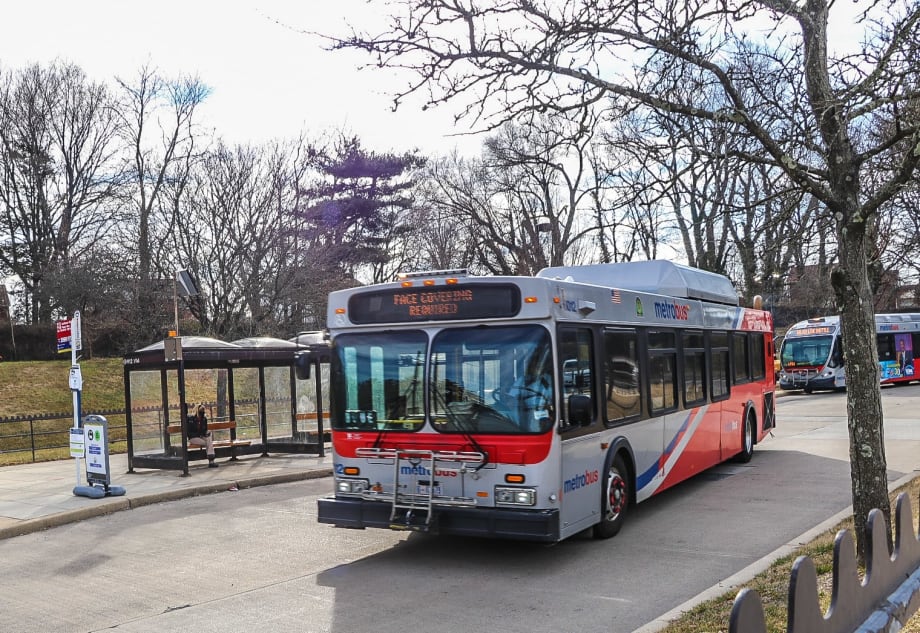
U.S. transit agencies operate approximately 65,300 heavy-duty transit buses. Those vehicles accounted for about 3.8 billion passenger trips in 2025, or more than 10 million trips per day, representing roughly half of all public transit trips nationwide.
Larry Levine/WMATA
- The transit bus manufacturing industry supports 34,100 jobs nationwide.
- This industry contributes $5.1 billion to the Gross Domestic Product (GDP).
- The report highlights increasing demand for vehicle replacements within the sector.
*Summarized by AI
A new report, “Buses Mean Business,” finds that the U.S. transit bus manufacturing industry supported about 34,100 jobs and contributed $5.1 billion to the nation’s gross domestic product (GDP) in 2025.
According to the report, which was conducted by Oxford Economics and sponsored by the American Public Transportation Association’s (APTA) Business Members Board of Governors, the industry also generated an estimated $1.1 billion in federal, state, and local tax revenue, with its economic impact extending beyond vehicle assembly plants into a broad domestic supply chain.
Aging Fleet Drives Replacement Demand
The report also highlights the size and age of the nation’s transit bus fleet as agencies face growing vehicle replacement needs.
U.S. transit agencies operate approximately 65,300 heavy-duty transit buses. Those vehicles accounted for about 3.8 billion passenger trips in 2025, or more than 10 million trips per day, representing roughly half of all public transit trips nationwide.
According to the report, 54% of the transit bus fleet already exceeds or will reach the Federal Transit Administration’s 12-year useful-life benchmark within five years. In 2024, about 13,700 buses were more than 12 years old, while another 21,500 were between eight and 12 years old.
At the same time, new bus deliveries remain below pre-pandemic levels. Approximately 4,700 transit buses were delivered in the U.S. and Canada in 2025, compared with more than 6,300 in 2019.
The report also identifies changes in the propulsion mix of new transit buses. Battery-electric buses represented approximately 20% of transit bus deliveries in 2023 and 2024, compared with about 4% of the existing fleet. Diesel buses remained the largest category of recent deliveries, accounting for roughly half of vehicles delivered during the period.
Supply Chain Extends Economic Impact
Beyond vehicle production, the report found that the industry’s economic impact reached all 50 states through supplier purchases and household spending.
While the largest impacts were concentrated in states with major assembly facilities and supplier networks, transit bus manufacturing generated economic activity nationwide.
Of the industry’s $5.1 billion contribution to GDP in 2025, $817 million represented direct value added by manufacturers, while $2.6 billion came from domestic supplier purchases and $1.8 billion resulted from household spending by workers whose incomes depended directly or indirectly on the industry.
The industry’s approximately $1.1 billion in tax revenue included $749 million in federal taxes, $216 million in state taxes, and $159 million in local taxes.
How the Study Was Conducted
To estimate the industry’s 2025 economic footprint, Oxford Economics used company information, public data sources, and economic impact modeling.
The analysis covered standard transit buses, articulated buses, commuter coaches, and other heavy-duty transit buses used in public transportation, while excluding school buses, most intercity motorcoaches, and other vehicle types outside the report’s definition.
The report emphasizes that its findings measure the economic activity supported by transit bus manufacturing and its supply chain, rather than the broader economic benefits associated with public transportation investment, transit operations, or improvements in transportation performance.
Quick Answers
The report examines the economic footprint, supply chain, and rising demand for vehicle replacements in the transit bus manufacturing industry.
*Summarized by AI
More Bus
Biz Briefs: New Flyer Delivers in Columbus, Houston, Beep and Freebee Merge, and More
In this edition of Biz Briefs, we spotlight the latest developments shaping the future of mobility.
Read More →
People Movement: Dan Dipert Coaches Adds Third-Generation Leader, Keolis Names New Valley Metro VP/GM, and More
In this edition, we also cover recent appointments and announcements at the Wabtec, SilverRide, HNTB, and more, showcasing the individuals helping to shape the future of transportation.
Read More →
New York MTA Plans Largest Bus Fleet Upgrade in More Than a Decade
The agency is seeking manufacturers for 650 new CNG buses to replace aging vehicles, improve reliability, and advance its broader fleet modernization strategy.
Read More →
Building a Flexible Path to Transit Electrification
John Hroncich discusses BAE Systems’ modular and scalable approach, lessons learned from decades of real-world operations, and how agencies can identify electrification strategies that fit their fleets.
Read More →
Bus Tech Talk: Keeping Transit Technicians Ahead of the Technology Curve
LA Metro’s Obed Mejia discusses technician training, evolving maintenance technology, fleet replacement, and strategies for getting the most out of today’s transit fleets.
Read More →
Biz Briefs: RIPTA Unveils New Frontrunners, Clevland RTA Adds New Siemens, and More
In METRO's latest installment, we take a look at recent news from Siemens, Prevost, Dodge, and more partnerships making headlines across the transportation sector.
Read More →
People Movement: Holly Arnold Joins Transdev and More
In this edition, we also cover recent appointments and announcements at Pace, CamTran, MCI, and more, showcasing the individuals helping to shape the future of transportation.
Read More →
The High Cost of Transit Buses: Industry Leaders Look to Procurement Reform
Transit leaders and policymakers examine how standardized bus designs, streamlined procurement, and predictable funding could help agencies stretch budgets and deliver better service.
Read More →
The Business Voice Behind Public Transportation
As chair of APTA’s Business Members Board of Governors, Ray Melleady explains how more than 850 business members are partnering with transit agencies to advance funding, innovation, and industry-wide collaboration.
Read More →
From Surviving to Thriving: Building Stronger Transportation Organizations
Bus Business Consultants founder Brian Dickson shares lessons on leadership, organizational health, and creating options for long-term success in a changing transportation industry.
Read More →