



IndyGo Awards 3 Contracts for Blue Line BRT Project
The firms were among multiple companies that bid on three separate construction packages.

IndyGo will host a series of public open house meetings in mid-February along the Blue Line corridor to share the latest information regarding the anticipated construction schedule, planned detours, and other relevant information.
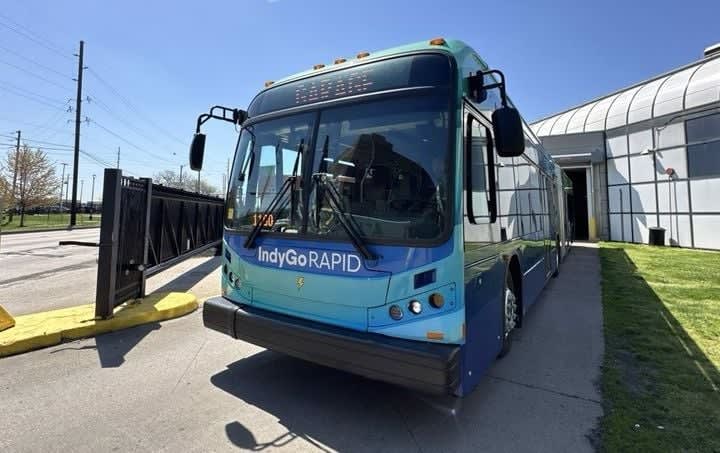
Photo: IndyGo/RIDE
The board at Indianapolis’ IndyGo awarded contracts to three companies to build the city’s third and largest bus rapid transit (BRT) line, the Blue Line, with construction starting early next year and continuing through 2028.
Central Indiana contractors Gradex Inc., F.A. Wilhelm Construction Co., and R.L. Turner Co. were awarded nearly $250 million in contracts to build the Blue Line, which will connect the Indianapolis International Airport to the town of Cumberland.
The firms were among multiple companies that bid on three separate construction packages.
“These contract approvals represent a critically important milestone in the development of the Blue Line, which will be the largest and most ambitious of the three BRT projects in our city,” said IndyGo President/CEO Jennifer Pyrz. “We look forward to working closely with these local contractors to successfully execute and deliver this important project.”
The Winning Bids
Gradex Inc. was awarded Package A, with a bid of approximately $208 million.
Package A contains the roadway elements of the project, including stormwater and drainage improvements, pavement resurfacing, pedestrian facilities, traffic signal upgrades, and sanitary sewer relocations.
F.A. Wilhelm was awarded Package B for the construction of Blue Line stations, with a bid of approximately $34 million.
Wilhelm successfully constructed IndyGo’s Red Line and Purple Line BRT stations previously.
R.L. Turner was awarded Package C, with a bid of approximately $6 million.
Package C includes the East Side Mobility Hub, which is an offsite facility at the east end of the project, providing comfortable transfer opportunities between the Blue Line and other local routes.
Funding and Next Steps
The Blue Line project is funded through a combination of local and federal sources, including a $150 million Small Starts Grant from the Federal Transit Administration and nearly $22 million from the Rebuilding American Infrastructure with Sustainability and Equity (RAISE) grant through the U.S. Department of Transportation.
Activities have already begun in preparation for Blue Line construction. Earlier this fall, utility companies were given notices to begin relocating facilities determined to be in conflict with the new design.
IndyGo will host a series of public open house meetings in mid-February along the Blue Line corridor to share the latest information regarding the anticipated construction schedule, planned detours, and other relevant information.
Additionally, a groundbreaking event is anticipated in late-February.
More Bus

New York MTA Plans Largest Bus Fleet Upgrade in More Than a Decade
The agency is seeking manufacturers for 650 new CNG buses to replace aging vehicles, improve reliability, and advance its broader fleet modernization strategy.
Read More →
Building a Flexible Path to Transit Electrification
John Hroncich discusses BAE Systems’ modular and scalable approach, lessons learned from decades of real-world operations, and how agencies can identify electrification strategies that fit their fleets.
Read More →
Bus Tech Talk: Keeping Transit Technicians Ahead of the Technology Curve
LA Metro’s Obed Mejia discusses technician training, evolving maintenance technology, fleet replacement, and strategies for getting the most out of today’s transit fleets.
Read More →
Biz Briefs: RIPTA Unveils New Frontrunners, Clevland RTA Adds New Siemens, and More
In METRO's latest installment, we take a look at recent news from Siemens, Prevost, Dodge, and more partnerships making headlines across the transportation sector.
Read More →
People Movement: Holly Arnold Joins Transdev and More
In this edition, we also cover recent appointments and announcements at Pace, CamTran, MCI, and more, showcasing the individuals helping to shape the future of transportation.
Read More →
The High Cost of Transit Buses: Industry Leaders Look to Procurement Reform
Transit leaders and policymakers examine how standardized bus designs, streamlined procurement, and predictable funding could help agencies stretch budgets and deliver better service.
Read More →
The Business Voice Behind Public Transportation
As chair of APTA’s Business Members Board of Governors, Ray Melleady explains how more than 850 business members are partnering with transit agencies to advance funding, innovation, and industry-wide collaboration.
Read More →
From Surviving to Thriving: Building Stronger Transportation Organizations
Bus Business Consultants founder Brian Dickson shares lessons on leadership, organizational health, and creating options for long-term success in a changing transportation industry.
Read More →
Finding the ‘Happy Medium’: Optimizing Maintenance Without Sacrificing Reliability
The key to maintenance optimization isn’t doing less work—it’s doing the right work at the right time on the right assets.
Read More →
LA Metro, City of West Hollywood, and Partners Advance Smarter Bus Lane Enforcement
The award-winning partnership combines AI-powered detection with human oversight to improve bus reliability, accessibility, and enforcement efficiency.
Read More →