



Southern California's OCTA Authorizes Emergency Rail Stabilization Work
The board unanimously approved a resolution authorizing OCTA CEO Darrell E. Johnson to take all necessary steps to protect a vital stretch of track through San Clemente, where recent landslides, beach erosion, and degrading riprap pose a serious threat to the rail line.

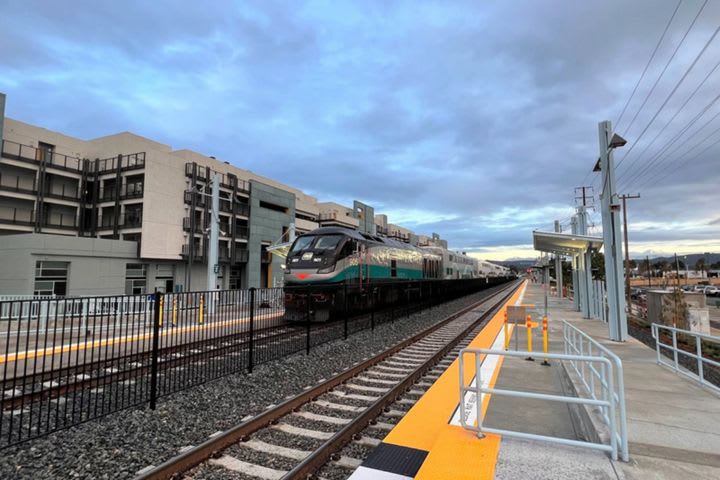
OCTA, which owns the rail line, will continue to work with Metrolink and Amtrak Pacific-Surfliner to keep passengers informed as the schedule is solidified.
Photo: OCTA
California’s Orange County Transportation Authority (OCTA) authorized emergency actions to stabilize sections of railroad track threatened by coastal erosion and landslides in San Clemente, moving forward with urgent work to ensure continued passenger and freight rail operations through South Orange County.
The board unanimously approved a resolution authorizing OCTA CEO Darrell E. Johnson to take all necessary steps to protect a vital stretch of track through San Clemente, where recent landslides, beach erosion, and degrading riprap pose a serious threat to the rail line.
The rail is a vital connection between San Diego County and Orange County — and destinations further north — for passengers and freight and the movement of military assets.
“This action enables OCTA to act quickly and decisively to protect our coastal rail line,” said OCTA Chair Doug Chaffee. “By advancing this emergency work, we are helping to preserve a critical transportation link for Southern California, the region and beyond.”
Stabilizing Passenger Rail in Southern California
The stabilization effort addresses four areas of vulnerability, including the area near Mariposa Point, where debris from recent landslides is nearing the top of the 12-foot-high temporary catchment wall installed last year to prevent slope failure.
The California Coastal Commission reviewed OCTA’s submission for a permit and issued a partial emergency Coastal Development Permit to stabilize the coastal rail corridor.
While this action is a positive development, it does not include approval for all the elements OCTA has identified as critical to protecting the corridor. OCTA staff and legal counsel are thoroughly reviewing the permit to determine the best path forward.
“Our priority remains clear: to move quickly, make the most of the state and federal funding we’ve already secured, and deliver as much of the needed work as possible, as soon as possible,” said Johnson. “We appreciate the Coastal Commission affirming what we have long recognized — that an emergency exists along this corridor.”
Construction work will require a shutdown of passenger rail so the work can be performed safely and efficiently. When work will begin and the length of a necessary closure has yet to be scheduled.
OCTA, which owns the rail line, will continue to work with Metrolink and Amtrak Pacific-Surfliner to keep passengers informed as the schedule is solidified.
Focusing Its Approach
OCTA’s emergency action reflects months of engineering analysis, environmental planning, and collaboration with regulatory agencies. Four priority areas were identified, each requiring tailored responses to protect the rail corridor from progressive and unpredictable coastal hazards.
Overall, the work will include approximately 95% sand and 5% riprap where needed to stabilize the slope and protect the track.
OCTA’s effort is the largest volume of sand ever placed on San Clemente beaches in a single effort to protect the rail line and stabilize the coastline.
The complete work OCTA has proposed includes:
Placing up to 540,000 cubic yards of sand — approximately 95% of total materials — to restore beaches and absorb wave energy.
Repairing approximately 9,000 tons of riprap only where necessary to stabilize embankments and prevent bluff failure.
Installing a 1,400-foot catchment wall to retain debris from active landslides and restoring a pedestrian trail at Mariposa Point.
Constructing a 1,200-foot shoreline protection structure near San Clemente State Beach.
Catchment wall and shoreline protection structure work is anticipated to take up to eight months to complete.
The Coastal Commission approved the emergency Coastal Development Permit for Areas 1 and 2, portions of work in Area 3, and Coastal Commission staff has requested more information as to why an emergency exists in Area 4.

OCTA’s effort is the largest volume of sand ever placed on San Clemente beaches in a single effort to protect the rail line and stabilize the coastline.
Photo: OCTA
Responding to Coastal Concerns
In response to community and environmental stakeholder feedback, OCTA emphasized:
Minimal and strategic use of armoring: Riprap will only be used where absolutely necessary and designed to be functional, limited in scope, and potentially temporary.
Environmental accountability: While the emergency permit allows construction to begin more quickly, OCTA remains fully subject to the California Coastal Act and will comply with environmental mitigation and monitoring requirements.
Proactive emergency action: While trains are still operating, the slope conditions continue to deteriorate. OCTA is acting to prevent a catastrophic failure, not waiting for one to occur.
Transparency and engagement:OCTA is committed to providing timely updates, public outreach, and collaboration with community stakeholders as work progresses.
Most of the stabilization activities will occur within the rail right-of-way, minimizing impacts to adjacent coastal areas.
Funding for the Project
The emergency stabilization effort builds on more than $313 million in secured state and federal funding, including grants from the Transit and Intercity Rail Capital Program, the SB 1 Trade Corridor Enhancement Program, and the federal CRISI program.
The OCTA board also amended its FY 2024-25 budget to allocate an additional $135 million to advance this work.
Sand nourishment, while starting with emergency actions, is part of a long-term coastal resilience strategy.
OCTA has issued a Request for Information to identify qualified sand dredging contractors and is advancing environmental clearance for offshore sand sourcing.
Construction for sand placement is anticipated to begin as early as 2026, while staff is continuing to identify ways to streamline the procurement, permitting, and environmental processes.
The Need to Act
Since 2021, rail closures due to bluff failures in San Clemente have severed Southern California’s only coastal rail connection between San Diego and Orange counties more than once, disrupting passenger service, delaying freight shipments, and threatening more than $1 billion in annual economic activity.
The LOSSAN corridor is also part of the Strategic Rail Corridor Network, supporting the movement of military assets between installations along the West Coast.
As OCTA advances this emergency work, the agency remains committed to public safety, environmental responsibility, and long-term resilience.
More Rail

New York MTA Advances Final Contract for Second Avenue Subway Expansion
Contract Four is the largest in the Second Avenue Subway Phase 2 project and includes construction of station infrastructure, tracks, and signals for the subway expansion, MTA officials said. Work on Contract Four will begin in 2027.
Read More →
San Diego MTS Breaks Monthly Trolley Ridership Record
Agency officials said July’s ridership indicates MTS’s continued recovery from the pandemic.
Read More →
Report Examines NJ TRANSIT Reliability, Funding Challenges
The Garden State Initiative analysis examines the roles of Amtrak infrastructure, fleet management, and agency operations while recommending a more performance-based approach to improving reliability.
Read More →
Stadler, CapMetro Sign Long-Term Rail Fleet Support Agreement
Beginning in 2027, Stadler will provide on-site technical expertise, spare parts support, training, and obsolescence management to help extend the reliability and longevity of CapMetro’s GTW fleet.
Read More →
Biz Briefs: Alstom Lands Canadian Contract, LYT to Supply California TSP, and More
In METRO's latest installment, we take a look at recent news from Complete Coach Works, Beep, FlixBus, and more partnerships making headlines across the transportation sector.
Read More →
CATS Gold Line Marks 5 Years of Service, 2.8M Passenger Trips
With a six-mile expansion planned, the Charlotte streetcar is positioned to connect more neighborhoods and major transit hubs across the region.
Read More →
Why Simulating Pedestrian Movement Has Become Essential for Modern Rail Stations
Pedestrian microsimulation is helping rail planners identify bottlenecks, test station designs, and prepare complex transit hubs for growing passenger volumes.
Read More →
Amtrak Begins Major Construction at New York’s Sunnyside Yard
The new maintenance facility will support Amtrak’s Airo trainsets while improving maintenance efficiency and turnaround times in New York.
Read More →
Chicago Leaders Unveil Plans for O’Hare Airport Express Train
The privately developed project would offer a 15-minute trip between downtown and O’Hare’s Terminal 2, with trains operating every 15 minutes on a dedicated track. The service would use battery-electric trains and three existing freight rail rights-of-way.
Read More →
OCTA Maps Out 30-Year Strategy to Protect Coastal Rail Corridor
The draft feasibility report identifies strategies to protect the coastal rail line for decades as the agency continues near-term stabilization and sand placement efforts.
Read More →