Researchers Identify Top Risk Factors for Pedestrian-vehicle Crashes at Massachusetts Bus Stops
While their comprehensive analysis of bus stops focused on Massachusetts, the researchers are excited about the generalizability of the findings and application to other locations.
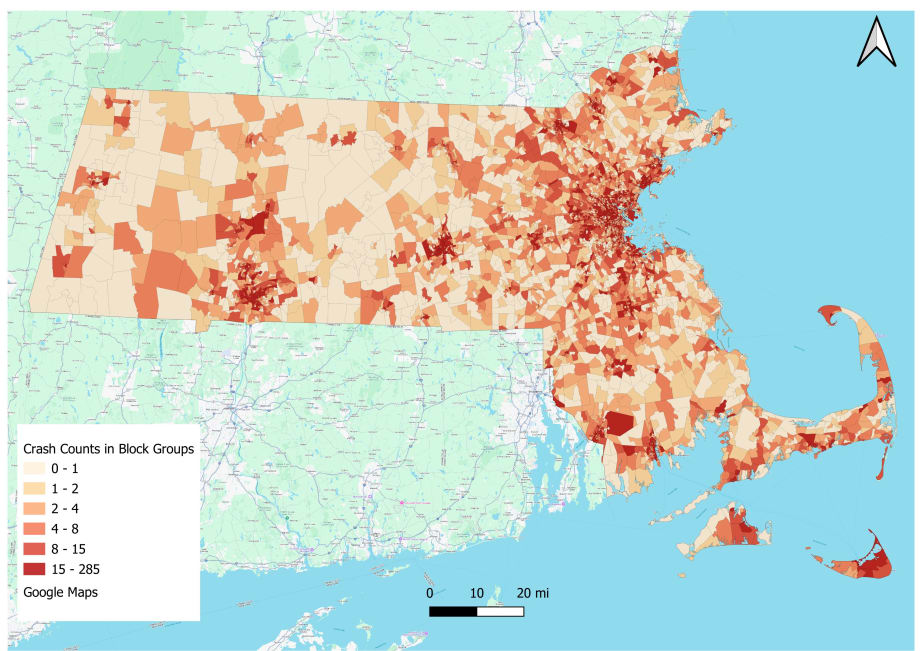
Pedestrian-vehicle crashes A 300-foot view from a bus stop in Massachusetts from 2016-2024.
Credit: University of Massachusetts Amherst
3 min to read
With pedestrian fatalities, particularly in public transit areas, continuing to rise across the country, researchers at the University of Massachusetts Amherst have determined the top risk factors of pedestrian-vehicle crashes at bus stops to recommend potential solutions.
While their comprehensive analysis of bus stops focused on Massachusetts, the researchers are excited about the generalizability of the findings and application to other locations.
Ad Loading...
“Despite significant advances in road design over the past decade to enhance safety, we are still seeing safety issues that are disproportionately impacting pedestrians,” said Tolu Oke, lead study author and a Ph.D. candidate in transportation engineering at UMass Amherst.
Study Overview
Since the pandemic, bus ridership across the U.S. has recovered more significantly than other forms of public transit, reaching 86% of pre-pandemic levels by 2025. Previous research shows that 46% of pedestrian crashes in Massachusetts occur near bus stops.
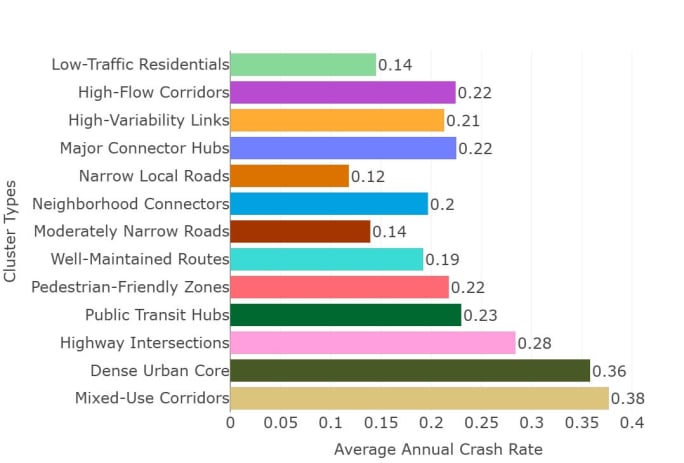
Average annual crash rate by bus stop type.
Credit: University of Massachusetts Amherst
“Is this the chicken or the egg?” said Michael Knodler, the William W. Boyer Endowed Professor of Engineering in the Riccio College of Engineering at UMass Amherst, director of the UMass Transportation Center, and one of the authors of the paper. “Are the crashes happening there because that’s where the pedestrians are, or is there something about the particular aspects of bus stop design or placement contributing to the pedestrian risk?”
Oke and her team used machine learning-based factor analysis to examine 1,773 such stops, ultimately determining 13 crash-relevant characteristics that cluster into 13 distinct bus stop types ranging from stops on remote rural roads to densely packed urban streets.
The 13 characteristics can be organized into three categories: first, the immediate-environment factors. This includes bus stop infrastructure, road condition, road width, crossing difficulty, or crossing safety. Second are network integration and connectivity factors: Interstate highways, principal or minor arterials, or major or minor connectors.
Ad Loading...
And finally, there are sociodemographic and land-use contexts that describe the characteristics of the community and area the stop serves, such as core density and social advantage or social equity. Unique clusters of these factors make up the 13 distinct bus stop types.
U. of Amherst Findings
The two bus stop types with the highest crash prevalence across all clusters are in “mixed-use arterial corridors” and “dense urban cores.”
While slightly different in their makeup, both are complex environments characterized by high traffic volumes, multiple modes of transportation, and a mix of properties, including apartments, stores, and parks.
“All the activity in these areas just provides more opportunity for conflict,” said Oke.
Based on the mix of characteristics, the researchers proposed recommendations specific to each bus stop type. “We can’t apply the same safety solution everywhere,” said Oke. “Our research shows that different areas have different crash problems. In one area, the solution might be the addition of a crosswalk, while on a dense, multimodal corridor, we may need protective features to separate and calm the complex interaction of pedestrians, cyclists, cars, and buses.”
Ad Loading...
Some countermeasures aim to slow drivers down, not because they will reduce the number of crashes, but because they will make those that occur less deadly.
“The overwhelming countermeasure is speed,” Knodler added. “Whenever you have these potential conflicts, managing the speeds across the different modes is the key. If a pedestrian is hit by a driver in a car going over 40 miles an hour, there’s an 80% probability that that pedestrian is seriously injured or killed. If that speed is 20 miles an hour, it’s less than 20% chance that that pedestrian is seriously injured or killed.”
The full list of the UMass Amherst study’s characteristics, bus stop types descriptions, and proposed countermeasures can be found at Data Science for Transportation.
The Plan is CTA's formal response to an FTA Special Directive issued in December and details how the agency will significantly expand the law enforcement surge it launched.
On a recent episode of METROspectives, METRO Magazine’s Executive Editor Alex Roman sat down with Ana-Maria Tomlinson, Director of Strategic & Cross-Sector Programs at the CSA Group, to explore a bold initiative aimed at addressing those challenges: the development of a National Code for Transit and Passenger Rail Systems in Canada.
During a safety blitz, Metra employees will visit one of the railroad’s 243 stations during the morning rush hour, distributing educational materials on train and grade-crossing safety, answering questions, and listening to riders’ safety concerns.
Operated in partnership with Tech Valley Security, trained CDTA Ambassadors will be on select routes and will rotate throughout CDTA’s route network. Their presence is intended to provide customers with an approachable, visible resource focused on assistance and engagement.
Customers have always been able to report concerns through the CATS Customer Service line or the “Report a Problem to CATS” feature in the CATS-Pass mobile app; however, CATS has also integrated a Text-a-Tip line, giving riders multiple, easy-to-use channels to get support.
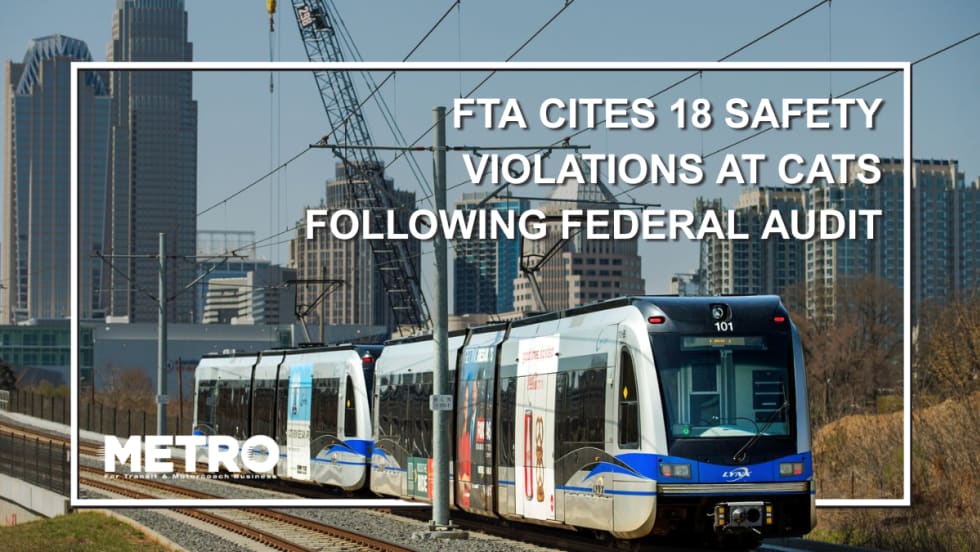
The audit found multiple safety compliance failures at the Charlotte agency, citing elevated assault risks and ordering corrective action within 30 days.
The new filters include substantially more activated carbon than traditional HVAC filters, which is especially helpful in providing a better transit riding experience for vulnerable populations, particularly children, seniors, and people with chronic illnesses, according to the CTA.