



10 steps for transit agencies starting travel training programs
Programs help build confidence and independence, and improve access to the community, and health and wellness opportunities.
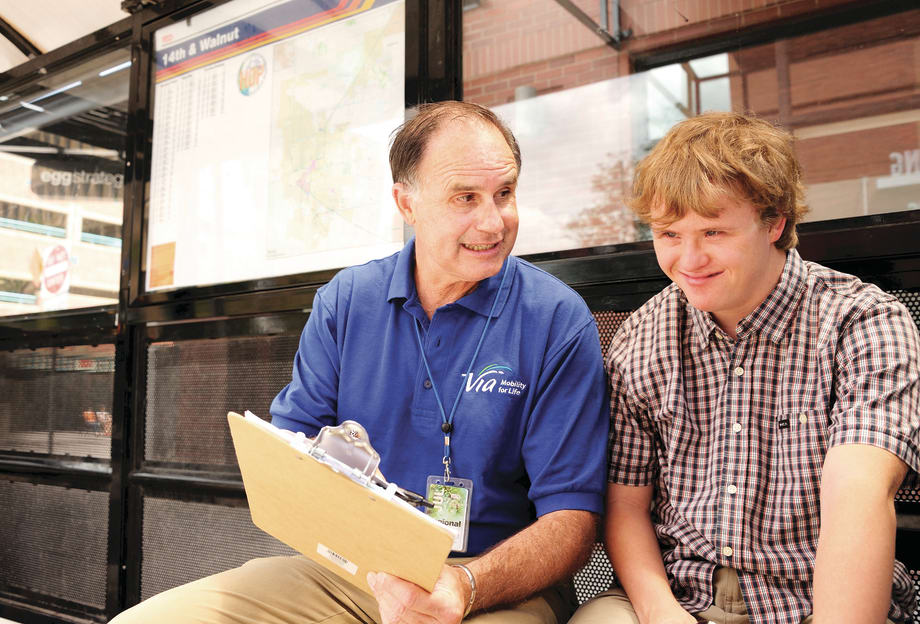
VIA Mobility Services
VIA Mobility Services
(This article was originally published September 11, 2017)
Travel training is the professional practice of teaching people to travel independently on public transportation. Travel training is offered one-to-one or as part of designed instruction for a group and is most often provided for older adults or for people who have cognitive or physical disabilities other than blindness or low vision. Although traditionally offered through public transportation agencies, schools, senior service agencies, non-profit organizations and mobility managers may also conduct professional travel training.
RELATED: How to get rider input to make transit more accessible
Common approaches to travel training are: (a) system orientation — a presentation of a transit agency’s services and how to use them; (b) familiarization — an individual or group trip on local transit accompanied by a travel trainer; (c) one-to-one training in the field — the travel trainer walks the trainee through the steps of taking a particular trip; and (d) train-the-trainer — the training of staff from various local human service organizations to provide travel training to their consumers.
With emphasis on safety, wayfinding and system orientation, travel training is a way to build confidence and independence, increase socialization, improve access to the community, increase access to health and wellness opportunities, and encourage use of fixed-route transit over paratransit services when possible. Many transportation systems in larger U.S cities have long-established travel training programs; however, systems in many other communities are in the process of developing and/or implementing travel training.
Travel training is a way to build confidence and independence, increase socialization, improve access to the community, increase access to health and wellness opportunities, and encourage use of fixed-route transit over paratransit services when possible.
To help agencies better understand the process of getting a travel training program off the ground, Easterseals Project Action Consulting has identified 10 important steps to establishing a travel training program:
1) Identify needs: Determine the travel area and types of transportation modes that will be included in your agency’s program.
Define the parameters of your program. Will your program focus only on people with disabilities or older adults or will it be open to the general public?
Finally, what partnerships do you need to establish to offer a travel training program? Check to see if mobility management programs or services that have the same goals and mission as yours exist in your community.
2) Take Inventory: Your agency should assess its capabilities and resources — both financial and human — to offer a travel training program.
Stakeholder input from potential partners, the trainee community, and local decision makers is important for buy-in and identifying the training program that would be most useful.
If it’s too soon to launch a full-fledged program, consider conducting a pilot program or contract with an established trainer to offer training in your community on an interim basis.
3) Identify and Recruit Stakeholders: Find your partners, customers and champions.
Stakeholders include local officials, public transit staff, school systems, human service agencies, disability organizations and older adult organizations.
Get involved in the community by attending meetings, presentations and forums, and serve on advisory committees.
Conduct presentations on the benefits of travel training and make the case as to why your agency wants to provide travel training.
Research and determine the best way to make the case for how travel training affects local job access, first-mile/last-mile connections to housing, increased independence and paratransit cost savings.
RELATED: Cost-cutting strategies for your paratransit program
4) Program Administration: Set a plan for identifying how many staff members are needed to accomplish your goals and whether they should be full- or part-time, remembering that the role of a travel trainer goes beyond riding the bus with an individual.
Travel trainers are also involved in creating instruction tools, conducting research, scouting routes, outreach, and program administration and assessment.
Consider the different talents and strengths your program will need, keeping in mind that supervisors should also take some travel-training instructor courses to understand the daily activities of a travel trainer.
5) Find Funding: Once your program plan is in place, pursue funding through local, state and federal programs; non-profit or foundation funding.
Travel training is a form of mobility management and is an eligible activity for Federal Transit Administration Section 5310 and Section 5311 funding.
Partner with stakeholders on grants or request support letters from stakeholders.
Diversify funding sources and think of in-kind support (e.g., office space, technology, transit fare, printing or design costs) as options to strengthen your budget.
6) Recruit Travel Trainers: Hire qualified trainers to ensure program development, growth and success.
Use accurate job descriptions, conduct in-depth interviews and provide an orientation program.
7) Train Travel Trainers: Seek out training and credential opportunities.
A travel trainer must possess the skills to work with people with disabilities and older adults in varying conditions — indoors and outdoors.
8) Develop Program Materials: Travel training materials should be tailored to the local public transportation environment.
One-on-one training tools will be different than group training materials.
Additional documentation (e.g., progress reports, release forms, applications) are also important.
Set up safety-related policies and procedures.
9) Market Your Program: Get the word out.
In addition to brochures, business cards and flyers, consider the importance of social media and conference presentations.
Active web pages and a blog are great ways to keep your stakeholders informed.
Also, never underestimate the power of word-of-mouth advertising.
10) Conduct Training: Be prepared — know your trainees; conduct training using safety procedures; and document training dates, sessions, routes and ADA-eligibility status of trainees.
Develop a survey or other means to measure and assess your program.
RELATED: St. Cloud training center bolsters paratransit process
Establishing or expanding a travel training program is a process that takes time, consideration and nurturing, but the rewards are many. Travel trainers make a difference in individual lives every day. For more information on travel training resources, training and professional certification, visit
www.projectaction.com.
Rachel Beyerle is the communications director for Easterseals Transportation Group, National Aging and Disability Transportation Center.
.
More Paratransit

Scenes from APTA TRANSform & EXPO 2026
Transit leaders, manufacturers, and industry professionals gathered in Chicago to explore new technologies, share ideas, and discuss the future of public transportation.
Read More →
Indian River Transit’s Community-Focused Approach Earns National Recognition
Named APTA’s 2026 Outstanding Public Transportation System in its size category, Florida’s Indian River County transit system continues to grow ridership through fare-free service and a focus on evolving community needs.
Read More →
Everett Transit, Community Transit Outline Consolidation Agreement
The proposed agreement calls for a 50% increase in bus service in Everett, a new microtransit zone, continued paratransit service, and the transfer of Everett Transit operations to Community Transit.
Read More →
Driving Smarter Paratransit
John Hanlon shares how AlphaRoute is leveraging AI-powered technology to help paratransit providers optimize operations, support frontline staff, and enhance the rider experience.
Read More →
People Movement: Dan Dipert Coaches Adds Third-Generation Leader, Keolis Names New Valley Metro VP/GM, and More
In this edition, we also cover recent appointments and announcements at the Wabtec, SilverRide, HNTB, and more, showcasing the individuals helping to shape the future of transportation.
Read More →
Biz Briefs: RIPTA Unveils New Frontrunners, Clevland RTA Adds New Siemens, and More
In METRO's latest installment, we take a look at recent news from Siemens, Prevost, Dodge, and more partnerships making headlines across the transportation sector.
Read More →
King County Metro Makes ADA Paratransit Easier to Navigate
METRO's Innovative Solutions Award winner replaces complex service-area descriptions with an accessible, interactive map that puts paratransit information directly in customers’ hands.
Read More →
Jacksonville’s NAVI Project Charts a New Course for Autonomous Public Transportation
Through its NAVI program, JTA is showing how autonomous vehicles, intelligent infrastructure, and coordinated operations can work together to deliver everyday public transportation.
Read More →
Driving Smarter Paratransit
John Hanlon shares how AlphaRoute is leveraging AI-powered technology to help paratransit providers optimize operations, support frontline staff, and enhance the rider experience.
Read More →
METRO Magazine Announces 2026 Innovative Solutions Awards Winners
Projects Recognized for Advancing Mobility Through Technology, Accessibility, Workforce Innovation, and Operational Excellence
Read More →