



Best (and Worst) Cities for Commuting on Public Transportation in the U.S.
2018 Top 100 Transit Bus Fleets Survey
As ridership is decreasing nationwide, many agencies are concentrating on developing a multimodal approach to better tie in first, last-mile options with bus services serving as the backbone.
by Alex Roman, Managing Editor
September 25, 2018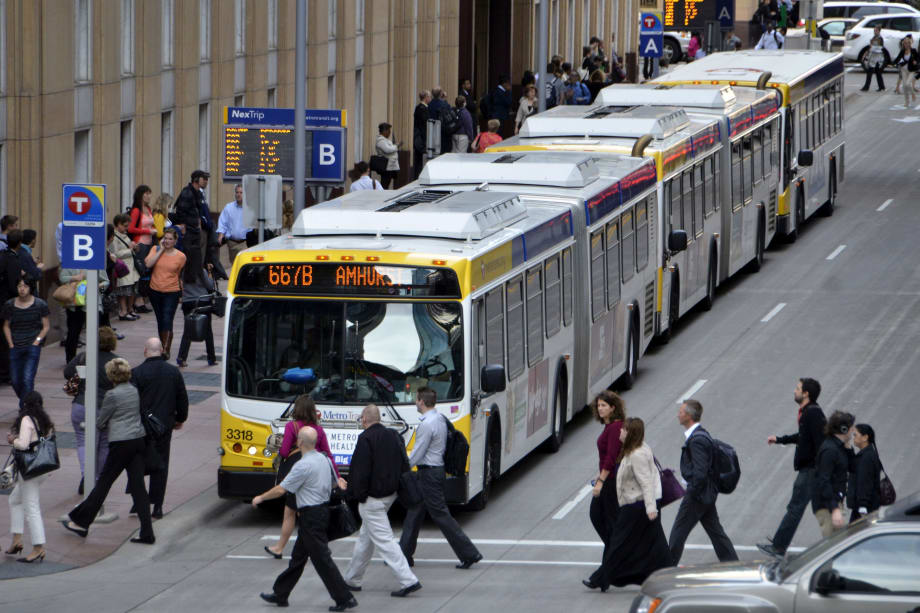
In addition to looking at other modes of transportation, transit agencies are also revamping their services to reduce redundancies and better serve new or emerging business centers.
Photo: Metro Transit
6 min to read
With ridership dipping across the nation, METRO’s Top 100 Bus Fleets are looking at new technologies and ways to make bus transit the backbone of a larger multimodal system that also includes bike-share, TNCs, ride-share, and autonomous shuttles as first-, last-mile solutions.
Several agencies reported they have begun to partner with TNCs, such as Lyft and Uber, to both serve as a first-, last-mile solution and to alleviate strain on their paratransit systems, while also giving ADA passengers more freedom to travel on-demand without the need to schedule rides 24 hours in advance.
Meanwhile, agencies such as Sacramento Regional Transit (No. 88), have taken the TNC model to create new on-demand microtransit services to serve both lower demand areas and the ADA community.
Similar to ride-hailing services, Sacramento’s SmaRT Ride relies on a smartphone app to schedule customized trips. The app, known as Microtransit by TransLoc, is connected to proprietary software that allows bus operators to pick up and drop off passengers in an efficient manner. The service relies on small, neighborhood-friendly shuttle buses to easily maneuver on residential streets, and they conveniently accommodate people with disabilities.
The cost to ride is $2.75 per trip, $1.35 for those eligible for discount fares; or, riders can use their SacRT monthly pass. The low cost makes SmaRT Ride more affordable than a traditional ride-hailing service, which could cost riders more than five times the amount for a similar trip.
After launching a pilot in February, the agency expanded the program to two new cities within six weeks and recently received a $12 million discretionary state grant to again expand the system.
Many transit agencies are also looking at partnering with bike-share, ride-share, and car-share providers and using cloud-based technologies to include these modes as options on their mobile trip-planning apps, as well as integrating them into their fare media.
Los Angeles DOT (No. 58) is one of the partners in a new car-sharing program, BlueLA, which uses 100% electric vehicles aimed at benefiting underserved communities.
BlueLA has set competitive rates to ensure the service is accessible to all Angelenos, including lower-income families. By the end of 2018, 100 self-service electric vehicles will be available in 40 locations, and the program should triple in size by the end of 2021, according to the partners involved.
Also while autonomous vehicle usage, currently in the form of shuttles, is being explored by several transit agencies, including Fla.’s Jacksonville Transportation Authority (No. 71), there are still some questions about what the technologies’ impact on the industry will eventually be.
“Current research indicates the rise of autonomous vehicles would exponentially increase traffic in our region, creating an even more significant challenge than what we currently face,” said one respondent. “Further study is needed before anyone can confidently predict outcomes.”
The need to retrain bus operators for a new customer service-oriented role and IT and maintenance staff to perform higher proficiencies, were also mentioned as possible negatives as AV usage grows.
Still, other agencies see it as a great first-, last-mile solution that will help get riders to and from transit stations and bus hubs.
“Autonomous vehicles are clearly the future of transit,” said Capital Metro (No. 41) officials. “We are gearing up to pilot autonomous vehicles in downtown Austin. The pilot will provide circulator service, connecting our transit stations with locations like City Hall, the convention center, and the new Central Library. For the future, AVs could work for neighborhood circulator routes that connect to primary fixed-route services and, eventually, as the vehicles operating those mainline transit services as well.”
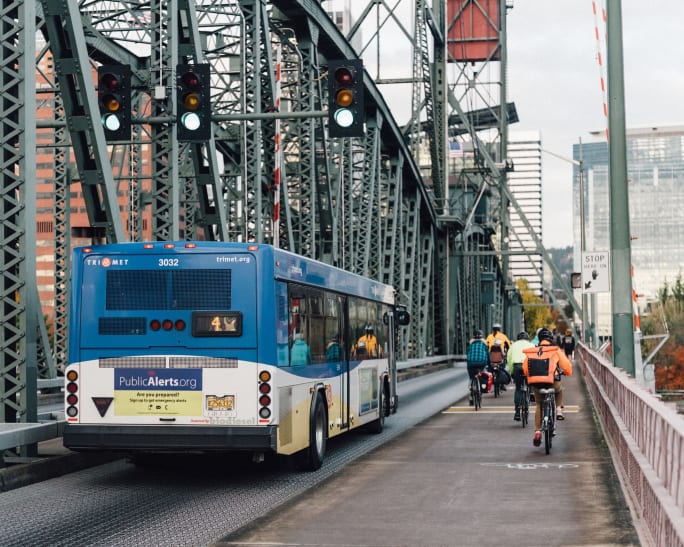
Many transit agencies are also looking at partnering with bike-share, ride-share, and car-share providers and using cloud-based technologies to include these modes as options on their mobile trip-planning apps, as well as integrating them into their fare media.
Photo: TriMet
Tackling Transit Challenges
In addition to trying to build a more multimodal approach, many transit agencies are also looking to revamp their bus services to increase ridership, better serve new job centers in their service areas, and decrease redundancies.
In January, the Los Angeles County Metropolitan Transportation Authority (No. 3) launched its NextGen Bus Study, which is designed to create a new bus network that is more relevant, reflective of, and attractive to the residents of Los Angeles County when it launches in the fall of 2019. The effort will improve service to current customers, attract new customers, and win back past customers, according to the agency.
In Philadelphia, the Southeastern Pennsylvania Transportation Authority (No. 11) is beginning a Comprehensive Bus Network Redesign process to look for ways to maximize benefits for riders and residents. A recently completed study by Jarrett Walker + Associates presented choices for SEPTA and its stakeholders, and SEPTA will now move forward with considering proposals for a network redesign. This process is expected to take approximately three years.
Outside of ridership, this year’s Top 100 reports they are increasingly experiencing issues attracting, recruiting, and retaining talent, particularly for skilled labor positions such as maintenance and bus operators, as well as for key management positions.
To remedy the shortage, transit agencies have stepped up recruiting efforts, fine-tuned their workforce development programs to keep existing employees moving up the ladder, and implemented apprenticeship programs.
Additional challenges mentioned included identifying which types of technologies will work for their transit agency, overcoming the public’s perception of transit, and continuing to build a system that will evolve with population growth.
While the question posed was “Outside of funding, what is your biggest challenge?” several agencies simply responded “funding is everything.”
Transit by the Numbers
The Metropolitan Transportation Authority’s (MTA) New York City Transit/MTA Bus Co. tops this year’s list with 5,811 total vehicles. The agency also announced several new vehicle purchases in 2018, including the addition of 108 New Flyer Xcelsior 60-foot buses and 400 Collins Bus Corp. vehicles for its paratransit services. In addition, the MTA also launched an electric bus pilot program with both New Flyer and Proterra in January, beginning with 10 buses, with the agency planning to order an additional 60 all-electric buses down the road.
Showing some movement this year, New Jersey Transit (3,382), L.A. Metro (2,320), Chicago’s Pace Suburban Bus (2,164), and Coast Mountain Bus Co. (1,943) round out this year’s top five, which collectively totals 15,620 vehicles, or 22.5% of this year’s overall 69, 281 vehicles.
A closer look at the numbers reveals 48, 496 buses are 35 feet or longer, making up 70% of the total vehicles reported, with 13,628, or 20%, of vehicles 35 feet and under.
Nearly 87% of the vehicles reported are fixed-route, with 13% of that number contracted, while demand response vehicles make up nearly 13% of the total.
Overall, this year’s respondents report that they intend to, or have on order 4,177 vehicles in the next year. A good number of those planned purchases include electric buses, though on a small scale. When asked who those new purchases will be with, New Flyer, Gillig, BYD, and Proterra were the suppliers most mentioned.
Subscribe to Our Newsletter
More Bus
Biz Briefs: New Flyer Delivers in Columbus, Houston, Beep and Freebee Merge, and More
In this edition of Biz Briefs, we spotlight the latest developments shaping the future of mobility.
Read More →
People Movement: Dan Dipert Coaches Adds Third-Generation Leader, Keolis Names New Valley Metro VP/GM, and More
In this edition, we also cover recent appointments and announcements at the Wabtec, SilverRide, HNTB, and more, showcasing the individuals helping to shape the future of transportation.
Read More →
New York MTA Plans Largest Bus Fleet Upgrade in More Than a Decade
The agency is seeking manufacturers for 650 new CNG buses to replace aging vehicles, improve reliability, and advance its broader fleet modernization strategy.
Read More →
Building a Flexible Path to Transit Electrification
John Hroncich discusses BAE Systems’ modular and scalable approach, lessons learned from decades of real-world operations, and how agencies can identify electrification strategies that fit their fleets.
Read More →
Bus Tech Talk: Keeping Transit Technicians Ahead of the Technology Curve
LA Metro’s Obed Mejia discusses technician training, evolving maintenance technology, fleet replacement, and strategies for getting the most out of today’s transit fleets.
Read More →
Biz Briefs: RIPTA Unveils New Frontrunners, Clevland RTA Adds New Siemens, and More
In METRO's latest installment, we take a look at recent news from Siemens, Prevost, Dodge, and more partnerships making headlines across the transportation sector.
Read More →
People Movement: Holly Arnold Joins Transdev and More
In this edition, we also cover recent appointments and announcements at Pace, CamTran, MCI, and more, showcasing the individuals helping to shape the future of transportation.
Read More →
The High Cost of Transit Buses: Industry Leaders Look to Procurement Reform
Transit leaders and policymakers examine how standardized bus designs, streamlined procurement, and predictable funding could help agencies stretch budgets and deliver better service.
Read More →
The Business Voice Behind Public Transportation
As chair of APTA’s Business Members Board of Governors, Ray Melleady explains how more than 850 business members are partnering with transit agencies to advance funding, innovation, and industry-wide collaboration.
Read More →
From Surviving to Thriving: Building Stronger Transportation Organizations
Bus Business Consultants founder Brian Dickson shares lessons on leadership, organizational health, and creating options for long-term success in a changing transportation industry.
Read More →