



4 Ways Metrolinx is Making Transit Easier for People with Vision Loss
Metrolinx’s wayfinding team, in charge of signage and other information systems, has put a major focus on ensuring that transit is accessible for everyone. Learn more about the systems they’ve implemented.
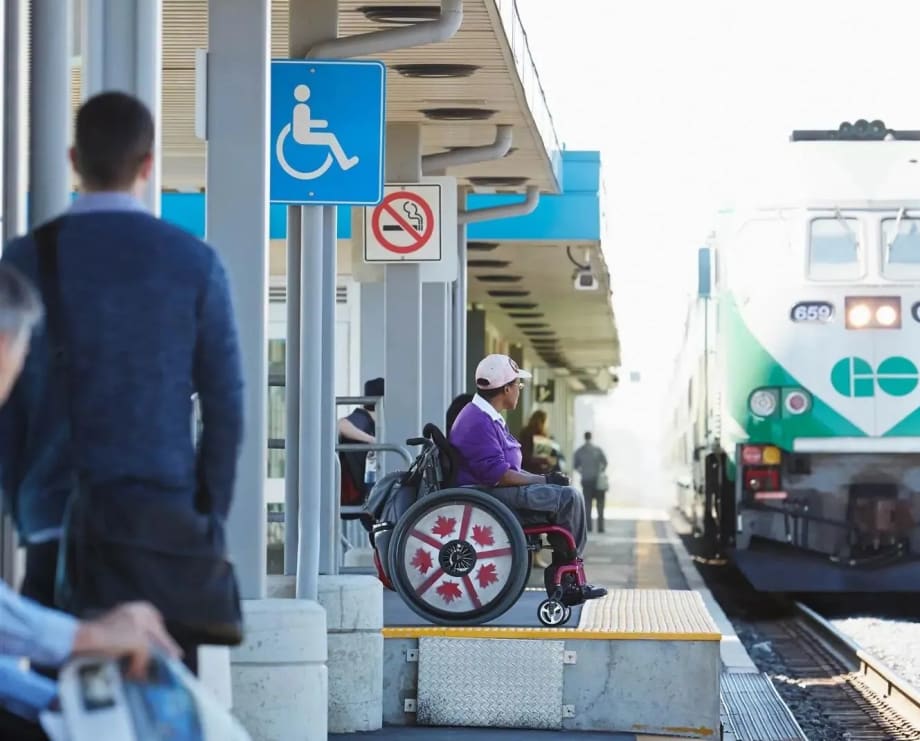
A wheelchair user waiting for the train on an elevated platform.
Metrolinx
It’s not always easy to navigate transit — especially for people with disabilities.
That’s why the wayfinding team at Metrolinx is taking major steps to make travel accessible for all passengers.
With signage being a visual medium and the frequency of staircases and escalators in stations, maximizing accessibility isn’t a simple task.
Recently, Metrolinx News spoke to Toban Allison, Metrolinx wayfinding manager, to discover some of the ways the team is making transit easier for everyone and they were kind enough to share it with METRO Magazine's readers.
1. Philosophy of Universal Design - When creating navigation and information systems, Metrolinx applies the principles of Universal Design.
What is Universal Design? Well, it’s all about treating all customers as equals — instead of singling out people based on their needs. It’s a fundamental condition of good design that reflects the diversity of people who use it and does not impose barriers of any kind.
“We don’t treat the path that a customer in a wheelchair uses as separate from the path that anyone else would take — and equally, we don’t sign it that way,” says Allison.
When it comes to signage, Metrolinx’s rule is to reference the amenity, not the person. “We always talk about what the amenity is — such as an elevator — making it a little less about a person’s disability and more about the amenity that’s there.”
In alignment with this belief, the wayfinding team is currently working on complementing the International Symbol of Access with references to the amenity — such as elevators and ramps — in their signage.
In doing so, the systems are also more inclusive of other people who may need an elevator or ramp — like someone with a stroller or someone using a cane.
“We try to broaden the lens that we use around how we design and sign our facilities, to accommodate a larger group of people — and in doing so, I think we treat everybody in a much more egalitarian fashion,” Allison says.
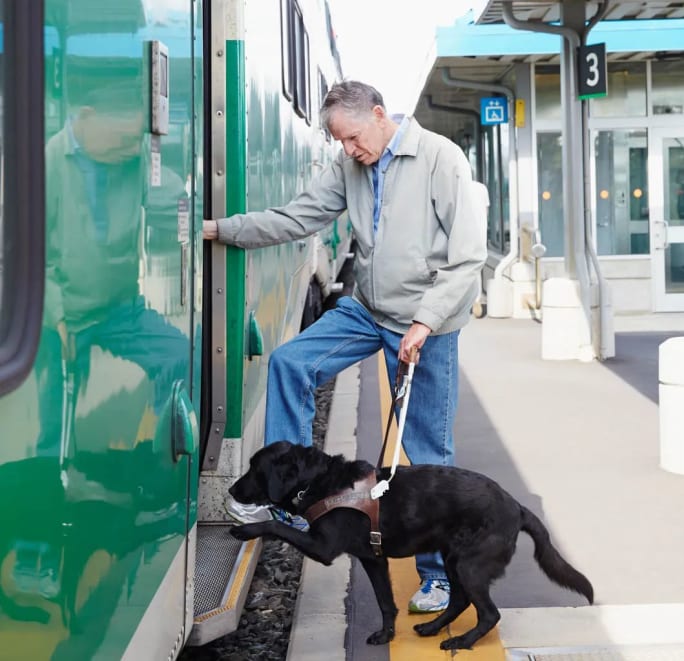
A passenger and his guide dog boarding the GO Train.
Metrolinx
2. Bus stop poles with distinct sounds - Metrolinx is working with municipalities throughout the region to implement special bus stop poles that make a distinct sound when tapped, in efforts to accommodate people with vision loss.
Allison explains the idea came from feedback given by a member of the Metrolinx Accessibility Advisory Committee (AAC), who has vision loss and uses a white cane. “The challenge they articulated to us is that they struggled to identify which of the many poles their cane touched was the bus stop pole that they should be waiting at,” he says. “What we’ve developed as a response is a distinct base, intended to go up on bus stop poles, that is meant to be easily recognizable — if you tap it, it will make a distinct noise. So, a person using a cane will be able to recognize what it is that they’ve just tapped.”
The team proposed this solution to the AAC through a dedicated site visit, to review this feature as well as new signage in person.
“This allowed us to account for factors that we couldn’t necessarily account for in a meeting room setting. For example, it was cold and damp, which impacted how long an individual was willing to keep their hands out of their pockets to read a sign,” Allison says.
In the future, Metrolinx aims to use more digital technologies to make stations more accessible by, for example, implementing audio features on cell phones.
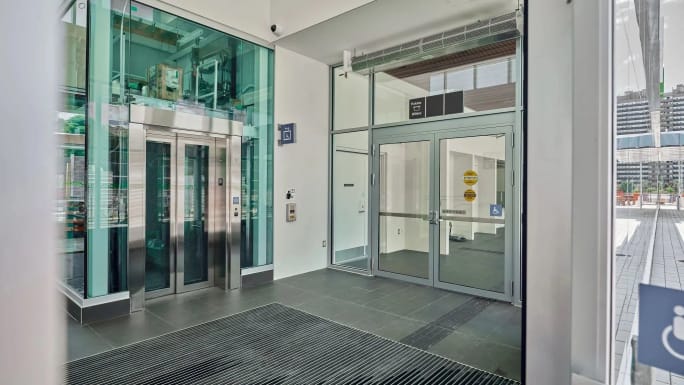
An elevator located at Rutherford Station.
Metrolinx
3. Signage in multiple languages - To make stations more accessible in places where text is needed, Metrolinx will be installing new signage with messages in multiple formats.
“We do raised text in English and French, and braille in English and French — so we provide information in four formats,” Allison says.
The team not only aims to give context about where the customer is, but also what’s on each floor. “We’re continuing to iterate around this, but it’s going to be super useful — it’s more information than we’ve ever provided for elevators,” adds Allison.
However, the team tends to be judicious when implementing features for people with vision loss.
“The reason for that is not because we don’t want to inform those individuals how to navigate a station — but because providing the information in that way is not representative of how they actually experience travel,” says Allison. “In other words, they’re often not feeling the wall trying to find the braille — they have a number of different means of travelling, and we design toward those because those are much more dignified.”
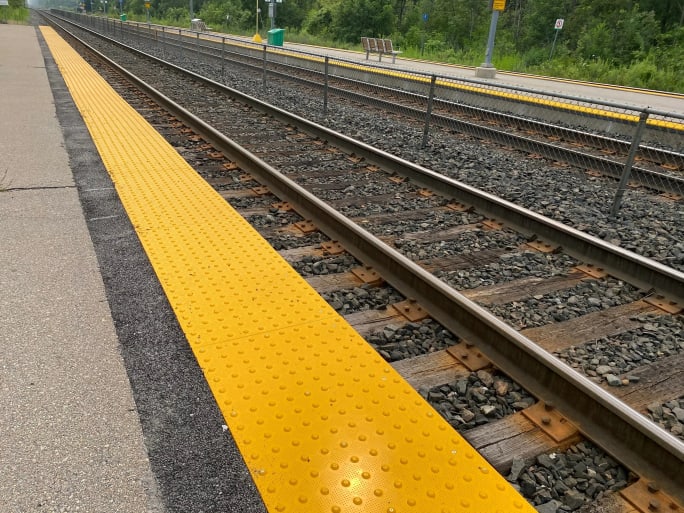
These tactile warning tiles indicate the area passengers should not cross when waiting for their train.
Metrolinx
4. Tactile floor tiles - Instead of focusing only on elements such as braille signs, Metrolinx is working to implement features that may be more practical for people with vision loss.
“We are looking at providing tactile directional wayfinding tiles — which is less about braille and raised text,” says Allison.
An initiative by the Metrolinx Universal Design team, tactile directional wayfinding tiles are made up of a different tiling pattern than the yellow tactile warning tiles used along the edges of higher transit platforms. The wayfinding tiles are installed into the ground surface to facilitate wayfinding in open areas and indicate a direct route that may be taken by cane users.
“We’re trying to make the ideal solution for independent access of people with vision loss — it’s something we’re continuing to work on,” Allison says.
In general, the wayfinding team at Metrolinx is all about advocating for people with disabilities – and never assuming they know the answer.
“If I could emphasize one thing about accessibility and wayfinding at Metrolinx, it’s that we really want to have people with disabilities shape whatever we do,” Allison says. “We want to design in a way that is responsive to their needs, and in the best-case scenario, anticipating their needs. We want to obtain feedback from people with disabilities and involve them in user testing before implementing across all stations. We’ll continue to get better at that, but they’re the drivers of what we do — and we’ll just try to keep improving.”
Story by Abby Zinman, Metrolinx editorial co-op student
More Paratransit

Biz Briefs: RIPTA Unveils New Frontrunners, Clevland RTA Adds New Siemens, and More
In METRO's latest installment, we take a look at recent news from Siemens, Prevost, Dodge, and more partnerships making headlines across the transportation sector.
Read More →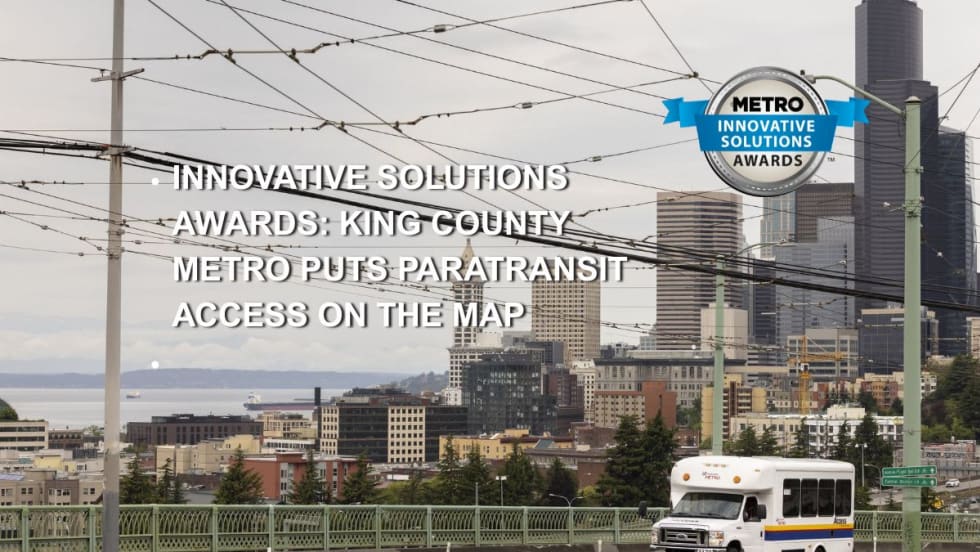
King County Metro Makes ADA Paratransit Easier to Navigate
METRO's Innovative Solutions Award winner replaces complex service-area descriptions with an accessible, interactive map that puts paratransit information directly in customers’ hands.
Read More →
Jacksonville’s NAVI Project Charts a New Course for Autonomous Public Transportation
Through its NAVI program, JTA is showing how autonomous vehicles, intelligent infrastructure, and coordinated operations can work together to deliver everyday public transportation.
Read More →
Driving Smarter Paratransit
John Hanlon shares how AlphaRoute is leveraging AI-powered technology to help paratransit providers optimize operations, support frontline staff, and enhance the rider experience.
Read More →
METRO Magazine Announces 2026 Innovative Solutions Awards Winners
Projects Recognized for Advancing Mobility Through Technology, Accessibility, Workforce Innovation, and Operational Excellence
Read More →
Biz Briefs: STV teams with Amtrak, Motorcoach Operators Boost Fleet and Land Contracts, and More
From manufacturers and suppliers to transit agencies and motorcoach operators, these updates offer a snapshot of the projects, partnerships and business moves driving the industry forward.
Read More →
Biz Briefs: Masabi Teams with St. Louis Metro and More
In METRO's latest installment, we take a look at recent news from Transdev, Hitachi, and more partnerships making headlines across the transportation sector.
Read More →
New York MTA Leverages Zoning Program to Advance Station Accessibility
Accessibility enhancements at Nevins St Station will be financed through a development agreement tied to the MTA's Zoning for Accessibility initiative.
Read More →
Reinventing Fleet Maintenance with Real-time Visibility and AI
Transit leaders need to know what needs fixing, where to look, who is responsible, when work is completed, and what it costs without having to chase information across disconnected systems.
Read More →
SamTrans Sets Priorities for Potential Connect Bay Area Revenue
The board-approved framework allocates future funding to maintaining service, rider improvements, equity initiatives, and infrastructure repairs.
Read More →