



Design-Build Creates New R.I. Links
Commuters from the new Wickford Junction station, a $24.5 million multimodal facility consisting of a single-side commuter rail platform on a restored siding track, can now reach Providence in 35 minutes and Boston in less than two hours.

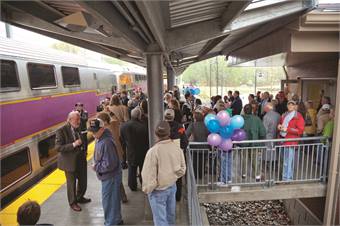
In 1988, the Rhode Island Department of Transportation (RIDOT) and the Massachusetts Bay Transportation Authority (MBTA) signed the Pilgrim Partnership, dedicating both agencies to developing efficient commuter rail service between Providence, R.I., and Boston. Since then, the number of commuters between both cities has increased from 200 to 2,000 riders per day.
In December 2010, the MBTA’s Providence/Stoughton commuter rail line was extended south of Providence to a new station in Warwick serving T.F. Green Airport. In April, the line was extended further south to the new Wickford Junction train station in North Kingstown. Both stations are part of RIDOT’s South County Rail Project, which extends the Providence commuter rail line 18 miles south of Providence.
Commuters from the Wickford Junction station can now reach Providence in 35 minutes and Boston in less than two hours. Travelers can also journey by rail to T.F. Green Airport and — via a connection to the MBTA’s Silver Line at Boston’s South Station — to Boston Logan International Airport. Last but not least, the new rail service alleviates peak-hour congestion by getting vehicles off the highway, especially in the Route 4/I-95 corridor.
Public Meets Private
The plan to restore train service to North Kingstown coincided with the vision of local developer Bob Cioe, who had opened a major shopping plaza in North Kingstown adjacent to Amtrak’s Northeast Corridor in 1997 with the long-term plan of making it part of a mixed-use, transit-oriented development. In support of this goal, Cioe’s master development plan reserved the parcel adjacent to the railroad tracks for a commuter rail station and parking garage.
In 2010, site development contractors Manafort Brothers was awarded a contract to design and build a train station on behalf of RIDOT. The result of this public-private partnership is a multimodal facility consisting of a single-side commuter rail platform on a restored siding track; a four-story, 1,100-car parking garage; drop-off/pick-up area for cars and buses; bicycle parking; new roadways, including new access drive off Ten Rod Road (Route 102); storm water management facilities; new utility services; site lighting and new landscaping — all completed in a 20-month period and without budget overruns. The $24.5 million station opened in April during a ceremony attended by U.S. Secretary of Transportation Ray LaHood, Rhode Island Gov. Lincoln Chafee, Sen. Jack Reed (D-RI), RIDOT Director Michael Lewis and other dignitaries. [PAGEBREAK]
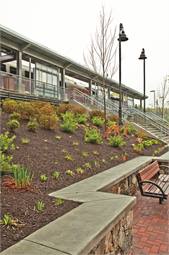
The design-build approach saved about 12 months of construction time, and the final cost is approximately equal to the engineer’s estimate prior to the preliminary designs and 25% below the engineer’s estimate at the preliminary (30%) design stage.
A Question of Alternatives
The successful result can in no small part be attributed to the design-build delivery approach, the first time this method of project delivery was used by RIDOT.
Experienced design-build teams have learned to think of design and construction as one continuous process. They are able to approach a project in a way that allows designers to understand how logistics, means and method contribute toward the best design approach. Contractors familiar with design-build understand that good design ideas enhance a project, and are not always “too costly.” For the owner, this holistic approach eliminates the risk of signing off on a design that is not constructible and reduces the likelihood of design errors and omissions.
In the case of the Wickford Junction station, collaboration within the team led to the development of no less than 20 so-called alternative technical concepts, or ATCs. All of them addressed cost savings, reduced accident risk and increased capacity for expansion. In several cases, the team even made suggestions that enhanced the project’s architectural design. Of the 13 ATCs submitted to RIDOT, 11 were accepted, saving more than $1 million in construction costs altogether. Some of the highlights include:
• Modifications in the preliminary design of a 1,300-foot-long retaining wall bordering on wetlands generated a significant reduction of both cost and risk. The original design had called for a soldier pile with precast lagging wall and a cantilevered safety walkway and railing. Instead, geotechnical engineers proposed a gravity precast retaining wall that did not require a large drill rig and crane but could be constructed with conventional earth moving equipment. Not only did this solution drive down equipment costs, it also increased the safety of the construction crew since construction equipment could be placed further from one of Amtrak’s high-speed tracks.
• The preliminary design for the passenger platform also called for pre-cast T-sections on mini-piles. The team, however, felt that a single-pour pier foundation with platform slabs precast on site would be a better solution, allowing the contractor to control the work on site (and eliminate the specialty contractor) while reducing the risk to Amtrak service, since construction equipment could be placed farther from the tracks. Revisiting the platform design from a design-build perspective also resulted in a simplified platform design made of flat slabs cast in beds on the site. Once cured to sufficient strength, the slabs could be lifted in place, eliminating the need for expensive and time consuming falsework. [PAGEBREAK]
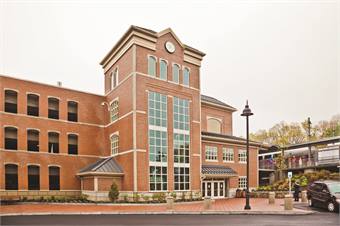
Cost-saving alternatives on the construction freed up funds for greater architectural creativity, resulting in a station that resembles a traditional New England textile mill rather than a nondescript rail depot.
Blend not Bland
Wickford Junction is a great example that cost savings do not have to translate into cookie-cutter results. In fact, cost-saving alternatives on the construction freed up funds for greater architectural creativity, resulting in a station that resembles a traditional New England textile mill rather than a nondescript rail depot.
To reflect Rhode Island’s industrial past, intricate detailing was added to the precast panels intended for use on the principal façade. Raising and scoring the façade and using the elevator towers as key vertical elements meant that a generic “big box” look could be avoided. Instead, the structure blends with the existing architectural environment so well, in fact, that a number of phone calls were received from individuals asking to rent office space in a building that is actually a garage.
Adding amenities, such as pavers for the sidewalks and pedestrian areas, a stone seat wall along the track embankment, grand stairs that lead directly from short-term parking to the train platform, period lighting fixtures along the roadway and uplighting for the clock tower, have created a pedestrian plaza that makes for a welcoming and aesthetically pleasing commuter experience.
Collaboration among team members did not end at the proposal and design stage, but continued into the construction phase. For example, when a simple ramp failed to meet the requirements of the Americans with Disabilities Act after the track grade had been adjusted, team members quickly considered the options, settling on a ramp and stair alternative. Even though the issue arose late in the design stage, when the precast concrete structure was in fact already in fabrication, the problem was solved without delays or budget overruns.
The design-build approach saved about 12 months of construction time, and the final cost is approximately equal to the engineer’s estimate prior to the preliminary designs and 25% below the engineer’s estimate at the preliminary (30%) design stage. Convinced of the advantages of the design-build approach, not only from a financial but also from an aesthetic perspective, RIDOT has begun to consider this method of project delivery for future projects.
Rachel Burckardt is a sr. supervising civil engineer in the Boston office of Parsons Brinckerhoff. Parsons Brinckerhoff served as the lead design firm for the rail station as part of the Manafort Brothers design-build team.
More New Mobility

From Hardware to Digital Partner: Luminator Charts Its Next Chapter
CEO Magnus Friberg discusses Luminator’s shift toward becoming a digital partner, the growing importance of software and interoperability, and how AI can help agencies improve operations and passenger experience.
Read More →
Biz Briefs: Alstom Lands Canadian Contract, LYT to Supply California TSP, and More
In METRO's latest installment, we take a look at recent news from Complete Coach Works, Beep, FlixBus, and more partnerships making headlines across the transportation sector.
Read More →
CharterUP’s Armir Harris on Technology, AI, and the Future of Group Mobility
In a recent episode of METROspectives, CharterUP Founder/CEO Armir Harris discussed the company’s evolution from an online charter bus marketplace into a technology platform supporting public- and private-sector mobility and much more.
Read More →
Jacksonville’s NAVI Project Charts a New Course for Autonomous Public Transportation
Through its NAVI program, JTA is showing how autonomous vehicles, intelligent infrastructure, and coordinated operations can work together to deliver everyday public transportation.
Read More →
Biz Briefs: Luminator Marks Milestone and More
From manufacturers and suppliers to transit agencies and motorcoach operators, these updates offer a snapshot of the projects, partnerships and business moves driving the industry forward.
Read More →
New Tricks for Old Bureaucracies: Joshua Schank on Making Transit Innovation Stick
Former LA Metro Chief Innovation Officer Joshua Schank discusses why good ideas aren't enough, how transit agencies can overcome resistance to change, and why today's challenges demand more innovation.
Read More →
How DART's GoPass Is Redefining Regional Mobility
Serving 14 transit agencies, GoPass simplifies multimodal travel by allowing riders to plan, pay for, and manage an entire trip through one app.
Read More →
Biz Briefs: OCTA Taps Clean Energy for Hydrogen Station, Stadler to Supply Via Rail Vehicles, and More
From manufacturers and suppliers to transit agencies and motorcoach operators, these updates offer a snapshot of the projects, partnerships and business moves driving the industry forward.
Read More →CharterUP Expands Into New Mobility and Autonomous Transportation
Vice President of New Mobility Stephen Joos discusses how CharterUP is leveraging its nationwide transportation network, technology platform, and autonomous vehicle partnerships to expand into workforce mobility, campus shuttles, and transit solutions.
Read More →
METRO Magazine Announces 2026 Innovative Solutions Awards Winners
Projects Recognized for Advancing Mobility Through Technology, Accessibility, Workforce Innovation, and Operational Excellence
Read More →