



Diverse Vehicle Lift Designs Fit Variety of Needs
Significant technological improvements have reduced the negative environmental impact of in-ground lifts. Types of lift designs available include multi-post runway, mobile, parallelogram, scissor, in-ground and surface-mounted.
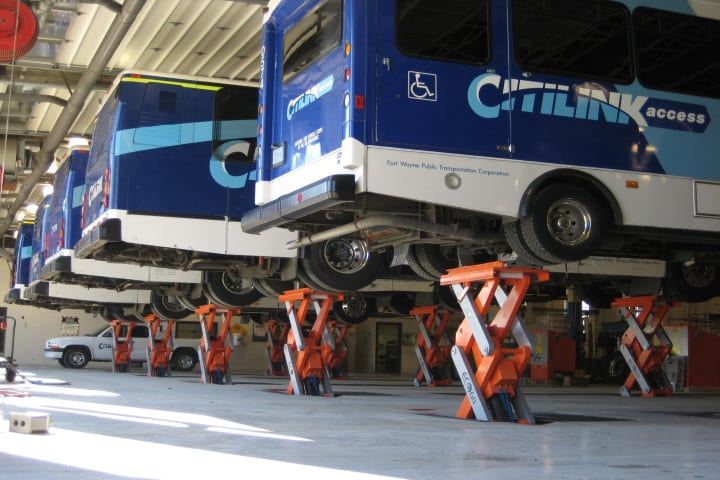
[IMAGE]MET11Lifts.jpg[/IMAGE]Vehicle lifts enable service technicians or mechanics to work under vehicles with ease. There are many types of lifts available, but due to restrictive environmental laws and new technologies, the popularity of lift types has swung from one side of the spectrum to the other and, perhaps, back again.
The first types of vehicle lifts, designed for cars, were in-ground, single-post lifts that required excavation and significant investment to install. These lifts use hydraulic oil and attach to the axle of the car, leaving the wheels free.
In-ground lifts were the most popular types of lifts for about half a century, but with increasing environmental awareness in the 1980s, they were attacked as being harmful to the environment, as hydraulic oil buried underground sometimes leaked into the water supply. According to Roger Perlstein, director of heavy-duty lifts for Rotary Lift Inc., in Madison, Ind., "The EPA was being aggressive about the impact of petroleum products on the environment and on ground water. People who had lifts in the ground found they were contaminating the ground and potentially the drinking supplies of surrounding neighborhoods."
Significant technological improvements have been made in recent years that have reduced the negative environmental impact of in-ground lifts. Today, many types of lifts are available, including multi-post runway, mobile, parallelogram, scissor, in-ground and surface-mounted.
Environmental factors
Steve Perlstein, sales and marketing manager for Mohawk Lifts, based in Amsterdam, N.Y., emphasizes that having the right type of lift makes a big impact on the safety and productivity of technicians as well as the safety of the vehicles being lifted. Each type of lift has its advantages and disadvantages, and Mohawk offers both in-ground and surface-level lifts. However, Perlstein says the wide variety of styles, types and capacities of surface-mounted lifts make them more popular for Mohawk transit clients.
One of the reasons surface-mounted lifts are popular is the environmental factor. While above-ground lifts also use hydraulic oil, leaks above ground are more easily detected and taken care of. Perlstein says if an underground leak results in contaminating the ground soil, the agency is then responsible for cleaning it up, a costly process. "In an above-ground lift, if any oil that was in a lift ever leaked, it's on top of the concrete floor," he says, which is easy to see and clean. In addition, being able to fix the leak is much easier if it is easier to access. "There's no tearing up of concrete to diagnose what the problem might be," he adds.
Perlstein explains that surface-mounted lifts may last longer because of possible complications with ground water seeping into the steel of the hydraulic cylinders buried in-ground.
Also, price estimates for an in-ground lift are always significantly more expensive than above-ground lifts, usually due to the installation process involved for an in-ground lift. Perlstein says above-ground lifts do not require a compressor, but instead run on an electric motor.
Mohawk's mobile column lifts are the least expensive option in its lift offerings and, according to Perlstein, an MP-18 would be sufficient for most transit vehicles. The columns sit above ground, require little to no installation and lift the vehicle from its wheels. Adjustable, long lifting forks grab both the inner and outer tire and can accommodate a wide range of wheel sizes. An MP-18 column has the lifting capacity of 18,000 pounds.
A simple control system, with just the necessary options (up, down, park), make controlling the lift easy.
MP-18 safety features include 19 safety lock positions spaced every three inches starting at 12 inches, locking pins that prevent the movement of the adjustable lifting forks and low-mounted power units for easier-to-move columns. A manual safety override allows columns to be lowered in a power outage without using hand cranks. A weight gauge reads how much weight the hydraulic pressure is holding, which helps ensure that mechanics use the safety locks.
For smaller paratransit vehicles, Perlstein recommends the TP-16, a two-post lift with 16,000-pound capacity. Unlike the mobile columns, this surface-mounted lift is attached to the ground. Hydraulic fluid is pumped between the two cylinders through the overhead steel hydraulic lines, which are synchronized and can be set at any height to accommodate for tall vehicles. Five-inch low-profile swing arms fit under most cars. According to Mohawk, the self lubricating steel ball bearing rollers that it uses last longer than plastic slide blocks.
The cost of four MP-18 mobile column lifts is about $30,000, while the TP-16 is about $13,000
Technological advances
Rotary Lift's Roger Perlstein says in the last five years, he has seen resurgence in the popularity of in-ground lifts due to improving technology that has taken away the environmental risks of in-ground hydraulic lifts.
One of the advantages of the in-ground lift is its physical footprint. With the hydraulic system buried underground, only a piston rises that clamps to the axle of the vehicle. According to Perlstein, the railroad-like track or runways of most above-ground lifts require more space to store and operate, meaning that an agency could be using a 15-foot-wide bay to pick up a vehicle that is only eight feet wide.
"The carbon footprint of a transit facility is impacted by the size of its service bays," says Perlstein. The smaller the bay needed, the less heating, lighting, air conditioning and space required for the same service, an important factor to consider in green building design.
Rotary Lift's in-ground MOD30 lift uses the same technology as tanks at modern gas stations. For its in-ground, Rotary uses inert materials that don't react with corrosives and don't conduct electrical current, taking away the environmental hazards. The underground portion is encased in containment housing so that in case of a leak, the fluids are contained. Monitoring and alarm systems also let technicians know if there are leaks. "Now, what we're seeing is a tremendous swing from the alternative design to the in-ground, because they save a whole lot of space, are environmentally more progressive than even the above-ground designs and reduce the carbon footprint," says Perlstein.
The MOD30 can also save technician labor. The fact that in-ground lifts raise vehicles by its axles means that the tires are accessible at all times, important when dealing with vehicles that drive in urban environments with more road hazards. With the MOD30, everything can be easily accessed and serviced quickly.
Its most popular mobile column lift, the MACH4, is faster to use and easier to install, but does lift the vehicle by its wheels. Its ease of use makes it convenient for some maintenance procedures but, to do work on tires, a technician would need to put a jack stand underneath the bus and lower it onto the jack stand to take off the tires and pull the columns out of the way, a process that could add up to significant loss of employee time, according to Perlstein.
However, it takes more time to position the in-ground pistons to match the axles of a vehicle than it does to use simple, drive-in mobile columns. In order to maximize technician time, the type of lift used should be based on the type of service being performed.
Perlstein says many agencies choose a combination of lift types for their various needs. "There isn't a single design out there that's perfect," he says. "Every one of them, to some degree, forces its user to make some sacrifice." A smaller transit facility may choose only mobile columns, but usually larger agencies will have both, and other designs as well.
Rotary's MOD30 is estimated at $100,000 to $160,000 installed and $30,000 for a four-column MACH4 set.
[PAGEBREAK]
Varied design options
Atlanta-based Railquip Inc. offers a ball screw design on its mobile vehicle lifts, eliminating the need for hydraulic fluid. Its standard, electrically powered and heavy-duty mobile lift systems come in sets of four and can be equipped with a remote control feature that allows the technician to move around while controlling the system. The columns can lift loads up to 72,000 pounds with a four-column set and 108,000 pounds with a six-column set.
According to Paul Wojcik, director of sales, the newly developed battery-powered mobile lifts "can be charged from standard single-phase house current, and the power supply cables are virtually eliminated." Each column is equipped with its own built-in charger.
For the rail industry, mobile heavy-duty rail/transit lifts have a lifting capacity of 10 tons to 50 tons per column, and can lift single or coupled rail or rail transit vehicles. Wojcik says this may be ideal for "a facility operator who wants to upgrade his lifting capabilities and shop throughput, but does not want to spend the capital required for the reconstruction of the facility." Heavy-duty support stands are used to support the lifted vehicles for undercarriage maintenance.
In addition to mobile lifts, Railquip also offers complete design and installation services for in-ground lift systems. Wojcik emphasizes that "while initial installation costs of permanent in-ground lift systems appear high when compared to the mobile vehicle lifts, the ROI is exceptionally good because of the performance, reliability and high shop throughput."
Railquip's response to potential in-ground oil contamination is that its screw-type design uses rotating - threaded spindles with safety nuts for lifting instead of hydraulic systems. In Railquip's in-ground lift systems, the lifting spindles are automatically lubricated rather than being immersed in oil-filled caissons. This eliminates possible environmental problems from the lubricating oil leaking into the environment.
In-ground lift
Sales Manager Jean DellAmore of Stevensville, Md.-based Stertil-Koni, says the company offers the customer freedom of choice by providing them with a wide range of available lifts. "Many customers are using a variety of heavy-duty lifts in the shop," he says.
One of Stertil-Koni's most popular lifts for the transit industry is the ECO series environmentally compliant lift. Unlike older hydraulic lift models that require between 50 gallons and 100 gallons of oil per piston, the in-ground scissor lift uses only seven gallons of hydraulic fluid and is capable of lifting up to 30,000 pounds per axle.
The ECO lift also has an ultra-shallow pit, measuring 34 inches, while traditional low-pressure, high-volume in-ground lifts measure 95 inches deep, according to DellAmore. "The shallow design is ideal for high water tables or high bedrock situations," he says. Shallower excavation also saves time and money during installation. The lift has a lifting height of 70 inches and lifting time of 80 seconds. Double-acting cylinders have internal main seals for better accuracy and reliability. With no concrete-embedded components, the lift can be removed and relocated in another facility.
The ECO lift's safety mechanisms include a mechanical locking system with lock-jaws made of high-strength T-1 steel and teeth that engage as the lift ascends.
Maintenance and safety
Manufacturers agree that lifts need to meet the safety standards of the Automotive Lift Institute and have a seal proving certification.
According to American National Standards Institute (ANSI) codes, lifts should be inspected annually, usually done by a contracted agency, to ensure its upkeep and safety. In addition, Roger Perlstein says between yearly inspections, "it is an obligation of the operator to make sure that the safety locks are working." This can be simple as listening for the locking devices to engage to make sure they're clicking in.
Each manufacturer has its own warranty policies, and the life span of vehicle lifts range from 15 years to 30 years, depending on usage, wear, maintenance and environmental conditions.
Installation times vary as well, depending on factors such as type of lift, how much excavation is required, electrical installation and demolition of an existing lift. Installation for above-ground lifts are minimal, while below-ground lifts embedded in concrete may take days or weeks, and the cost of labor can vary widely. According to Roger Perlstein, the cost of labor between the coasts and the heartland can vary greatly and labor can significantly drive up the cost of installing a lift for the coastal areas.
More Bus

ENC Lands MATA Contract and More in Biz Briefs
In this edition of Biz Briefs, we spotlight the latest developments shaping the future of mobility.
Read More →
From Surviving to Thriving: Building Stronger Transportation Organizations
Bus Business Consultants founder Brian Dickson shares lessons on leadership, organizational health, and creating options for long-term success in a changing transportation industry.
Read More →
Everett Transit, Community Transit Outline Consolidation Agreement
The proposed agreement calls for a 50% increase in bus service in Everett, a new microtransit zone, continued paratransit service, and the transfer of Everett Transit operations to Community Transit.
Read More →
SEPTA Details Accelerate Vision for Transit System
The plan outlines investments in trolley modernization, new Metro and Regional Rail vehicles, accessible stations, and more frequent bus and rail service.
Read More →
Report: Transit Bus Manufacturing Supports 34,100 Jobs, $5.1B in GDP
The “Buses Mean Business” report examines the transit bus manufacturing industry’s economic footprint, supply chain, and rising demand for vehicle replacements.
Read More →
Biz Briefs: New Flyer Delivers in Columbus, Houston, Beep and Freebee Merge, and More
In this edition of Biz Briefs, we spotlight the latest developments shaping the future of mobility.
Read More →
People Movement: Dan Dipert Coaches Adds Third-Generation Leader, Keolis Names New Valley Metro VP/GM, and More
In this edition, we also cover recent appointments and announcements at the Wabtec, SilverRide, HNTB, and more, showcasing the individuals helping to shape the future of transportation.
Read More →
New York MTA Plans Largest Bus Fleet Upgrade in More Than a Decade
The agency is seeking manufacturers for 650 new CNG buses to replace aging vehicles, improve reliability, and advance its broader fleet modernization strategy.
Read More →
Building a Flexible Path to Transit Electrification
John Hroncich discusses BAE Systems’ modular and scalable approach, lessons learned from decades of real-world operations, and how agencies can identify electrification strategies that fit their fleets.
Read More →
Bus Tech Talk: Keeping Transit Technicians Ahead of the Technology Curve
LA Metro’s Obed Mejia discusses technician training, evolving maintenance technology, fleet replacement, and strategies for getting the most out of today’s transit fleets.
Read More →