



Everett Transit, Community Transit Approve Consolidation of Services
The agreement will bring Everett Transit into Community Transit’s network in April 2027, with plans to increase bus service by 50% by 2031 and expand regional connections.

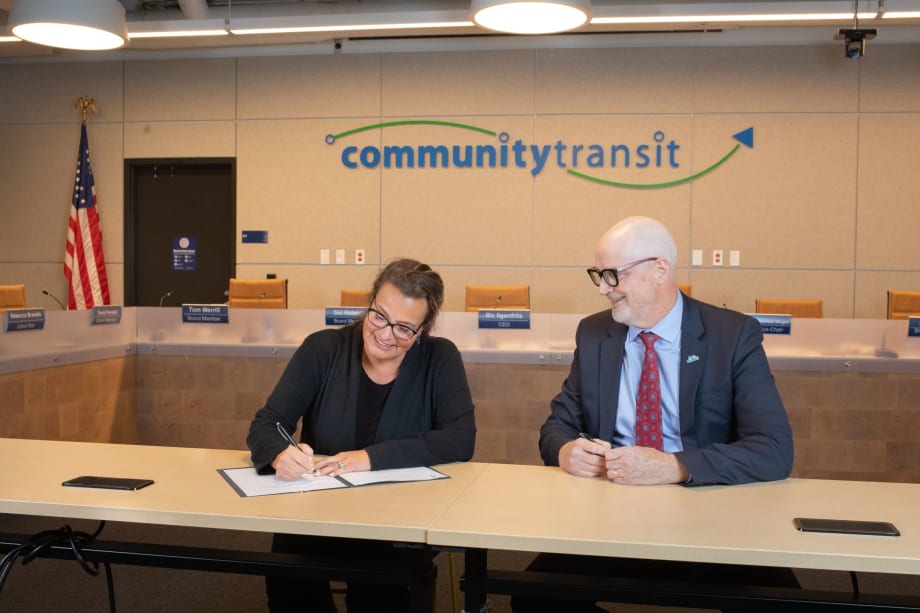
Evertt Mayor Cassie Franklin signs the Interlocal Agreement to consolidate transit service with Community Transit CEO Ric Ilgenfritz looking on.
Community Transit
- Everett Transit will integrate into Community Transit's network in April 2027.
- Plans are in place to increase bus service by 50% by the year 2031.
- The consolidation aims to enhance regional transportation connections.
*Summarized by AI
Everett Transit will become part of Community Transit following approval by the Everett City Council and Community Transit Board of Directors, creating a unified transit network serving Snohomish County, Washington.
The consolidation, approved through an interlocal agreement (ILA), will bring Everett into Community Transit’s service area, with the agency assuming responsibility for transit operations in the city on April 1, 2027.
Under the agreement, transit service in Everett is expected to increase by 50% by 2031, with more frequent buses, expanded early morning and evening service, and fewer transfers between routes.
“Everett residents deserve the same higher level of transit service as residents of so many other Snohomish County cities,” said Everett Mayor Cassie Franklin. “One seamless system will help our residents reach destinations both inside and outside of Everett more quickly and easily.”
Community Transit CEO Ric Ilgenfritz said the integration will also help the agency prepare for the future arrival of Sound Transit’s Link light rail service in Everett.
“We are excited to welcome Everett into the Community Transit network and especially pleased to welcome Everett Transit employees as we work to deliver more bus service to Everett,” he said.
Service Expansion, Workforce Transition
The agreement outlines several service and operational changes, including:
- Increasing transit service in Everett by 50% by 2031, including more frequent buses and expanded service hours.
- Introducing an on-demand Zip Shuttle rideshare zone in Everett by spring 2028.
- Maintaining existing paratransit eligibility and service areas for current Everett paratransit customers.
- Offering Everett Transit employees positions with Community Transit or the City of Everett while honoring existing collective bargaining agreements.
Community Transit will begin gathering public input in January 2027 to help develop the integrated network. Service expansions are scheduled to begin in 2028.
Existing Everett bus routes and schedules are expected to remain largely unchanged during the initial transition.
Community Transit Board Chair and Mukilteo Mayor Joe Marine said the consolidation reflects travel patterns that extend beyond individual city boundaries.
“This consolidation of transit service recognizes the fact that people from throughout Snohomish County travel into and out of Everett every day,” Marine said.
Funding the Expanded Network
The consolidation will also change how Everett funds transit service.
Beginning April 1, 2027, Community Transit’s 1.2% transit sales tax will replace Everett’s existing 0.6% transit sales tax, bringing the city in line with the transit tax rate applied in other Snohomish County communities.
The change adds six cents in sales tax on a $10 taxable purchase.
The additional revenue will support planned service increases, expanded operating hours, and improved regional transit connections, officials said.
Quick Answers
The main purpose of the consolidation is to integrate Everett Transit into Community Transit's network, thereby enhancing transit services and expanding regional connections.
*Summarized by AI
More Management

NITA Proposes $5B Operating Budget, $9.7B Capital Program for 2027
The proposed budget includes funding for expanded transit service, safety initiatives, fleet upgrades, and infrastructure improvements across CTA, Metra, and Pace.
Read More →
Financing, Fleet Replacement Requires a More Strategic Approach
Executives from ABC Companies and MCI discuss how rising costs, changing market conditions, and post-pandemic challenges are prompting motorcoach operators to rethink financing strategies, fleet replacement cycles, and long-term planning.
Read More →
Bringing Austin’s First Light Rail System to Life
Austin Transit Partnership CEO Greg Canally discusses the city's nearly 10-mile light rail project, its collaborative approach to project delivery, the importance of community engagement, and the milestones ahead as construction approaches in 2027.
Read More →
ETA CEO John Maglio on Transit Technology, Innovation, and Building Agency Trust
ETA founder and CEO John Maglio explores the evolution of transit technology, the importance of reliable systems, and how stronger partnerships can help agencies improve operations and the passenger experience.
Read More →
Metra Draft Plan Outlines Costs, Service Improvements for Regional Rail
The Systemwide Network Plan identifies infrastructure needs and potential investments to expand all-day, bidirectional rail service across the Chicago region.
Read More →
New Orleans RTA Names Augustine III as New CEO
In this edition, we also spotlight recent personnel moves at HDR, PATH, STV, and more, highlighting the people taking on new roles across the transportation industry.
Read More →
How Transit Agencies Are Using Free Rides to Improve Voting Access
Transit agencies are using fare-free service, trip-planning tools, and targeted rides to improve voting access. See what other agencies can learn from these efforts.
Read More →
Caltrain’s Electrification Drives a New Era of Ridership Growth
The railroad’s shift to electric service has brought more frequent trains, stronger customer satisfaction, and increased ridership, earning it APTA’s Outstanding Public Transportation System award.
Read More →
Chicago, Charlotte Transit Agencies Expand Rider Support Programs
CTA launched crisis intervention teams as CATS prepares to deploy fare ambassadors, expanding customer assistance and security efforts across both systems.
Read More →
New York MTA Launches Historic $1.9B Signal, Track Modernization Project
Funded in part by congestion pricing revenue, the project will replace nearly century-old signals along the A and C lines in Brooklyn and Queens.
Read More →