



Electrification Enhances Bay Area Commuter Rail, Sets High-Speed Stage
The new system will be equipped with high-performance, multiple-unit electric trains that operate from overhead catenary.
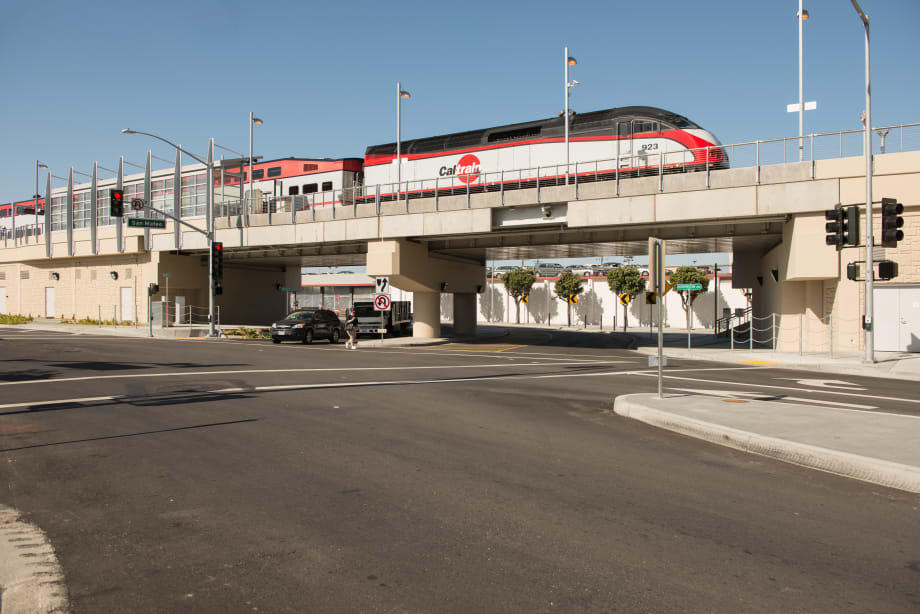
Caltrain
Caltrain
Two-thirds of Americans would use high-speed trains if they were available today, according to a 2015 survey released by the American Public Transportation Association.
Many metropolitan transit organizations are already seeing an increased demand for mass transit services, especially as commuters and travelers look for additional transportation options. However, in order to meet this demand and prepare for high-speed rail, transit organizations need to begin modernizing their current systems now.
Ridership growth
One area of the U.S. seeing substantial ridership growth is the California Bay Area. For more than 150 years, residents and visitors have used passenger rail to travel between San Francisco and San Jose. In a region that has become the epicenter of modern technology and innovation, the Caltrain system now handles 60,000 daily riders along a 77-mile route with 32 stations. After years of significant increases in ridership, demand has outgrown system capacity.
“The California Department of Finance has identified the Bay Area as the fastest-growing region of the state,” explains Eric Olson, PE, West Region director of Gannett Fleming Transit & Rail Systems (GFT&RS). “In 2013, San Jose surpassed one million residents and continues to see an increase in population and transit needs.”
As owner/operator of Caltrain, the Peninsula Corridor Joint Powers Board is implementing a $1.7 billion modernization program, which has gained tremendous support among the ridership, residents and major business interests in the region. Funded through a nine-party agreement that leverages local, regional and federal funding to match $705 million in voter-approved high-speed rail bond revenues, the Caltrain Modernization Program includes the electrification of the existing San Francisco to San Jose corridor.
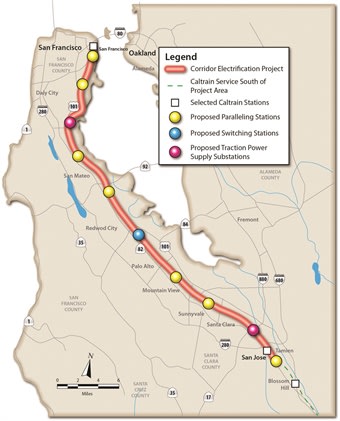
Caltrain provides commuter rail service along the San Francisco Peninsula, through the South Bay to San Jose and Gilroy.
Accommodate high-speed rail
Electrification has been part of Caltrain’s long-term plan for years and is a step toward preparations to accommodate California’s statewide high-speed rail service, planned for 2029. When complete, the modernization project will not only electrify the system, but upgrade the performance, operating efficiency, capacity, safety and reliability of commuter service.
GFT&RS is serving as the owner’s representative on the Peninsula Corridor electrification project, which will transform the system from a diesel-locomotive-based service to an electrified system. The new system will be equipped with high-performance, multiple-unit electric trains that operate from overhead catenary. The new trains enhance capacity to an 111,000 daily ridership, with improved service frequency and faster trips.
By 2040, the modernization project is expected to reduce greenhouse gases by 176,000 metric tons of carbon dioxide annually, reducing the agency’s emissions by up to 97% and helping to meet California’s emission reduction goals. Additional capacity reduces daily traffic congestion by 619,000 vehicle miles. The project also helps with noise pollution, by reducing engine noise from the trains, as noise from electrified train engines are measurably less than diesel train engines.
Fleet conversion
GFT&R is overseeing the new electrification system of nearly 52 miles of Caltrain right-of-way. Caltrain is converting their current diesel push/pull service on this route to a 25 kilovolt/60 hertz electrification system. A new fleet of electric multiple-unit trains is being sourced for the system and is scheduled to be in service by 2020 or 2021.
“Significant modifications have already been made to the signal and positive train control systems,” shares Bryan Mulqueen, PE, director, GFT&RS. “This communications-based overlay signal system equips the corridor with federally-mandated safety technology to monitor and control train movements and improve system performance.”
Caltrain installed conduit and fiber optic cable for the upgrade, which was operational by the end of 2015.
When complete, the modernization project will not only electrify the system, but upgrade the performance, operating efficiency, capacity, safety and reliability of commuter service.
The electrified Caltrain system sets the stage for an enhanced, modern commuter rail service and future blended high-speed rail service. The current project does not include all of the necessary infrastructure to implement high-speed service, but the electrical infrastructure will be compatible.
While the electrification will allow for the eventual move to high-speed rail service, that is not the only reason Caltrain elected to move forward with the project. They had done research for decades and determined that the overhead contact system being used was a logical choice, given its standard proven design, which is used in the U.S.’ Northeast Corridor and multiple European services.
The Caltrain Modernization and Electrification Project is on track and on budget to reach completion in late 2020 or early 2021. When the project is complete, Caltrain will have a solid foundation for the next step to high-speed rail service for its riders.
Charles R. Lynch, PE, is VP, Gannett Fleming Transit & Rail Systems. (www.gfnet.com)
This article originally ran in Sept/Oct. 2016.
More Rail

New York MTA Advances Final Contract for Second Avenue Subway Expansion
Contract Four is the largest in the Second Avenue Subway Phase 2 project and includes construction of station infrastructure, tracks, and signals for the subway expansion, MTA officials said. Work on Contract Four will begin in 2027.
Read More →
San Diego MTS Breaks Monthly Trolley Ridership Record
Agency officials said July’s ridership indicates MTS’s continued recovery from the pandemic.
Read More →
Report Examines NJ TRANSIT Reliability, Funding Challenges
The Garden State Initiative analysis examines the roles of Amtrak infrastructure, fleet management, and agency operations while recommending a more performance-based approach to improving reliability.
Read More →
Stadler, CapMetro Sign Long-Term Rail Fleet Support Agreement
Beginning in 2027, Stadler will provide on-site technical expertise, spare parts support, training, and obsolescence management to help extend the reliability and longevity of CapMetro’s GTW fleet.
Read More →
Biz Briefs: Alstom Lands Canadian Contract, LYT to Supply California TSP, and More
In METRO's latest installment, we take a look at recent news from Complete Coach Works, Beep, FlixBus, and more partnerships making headlines across the transportation sector.
Read More →
CATS Gold Line Marks 5 Years of Service, 2.8M Passenger Trips
With a six-mile expansion planned, the Charlotte streetcar is positioned to connect more neighborhoods and major transit hubs across the region.
Read More →
Why Simulating Pedestrian Movement Has Become Essential for Modern Rail Stations
Pedestrian microsimulation is helping rail planners identify bottlenecks, test station designs, and prepare complex transit hubs for growing passenger volumes.
Read More →
Amtrak Begins Major Construction at New York’s Sunnyside Yard
The new maintenance facility will support Amtrak’s Airo trainsets while improving maintenance efficiency and turnaround times in New York.
Read More →
Chicago Leaders Unveil Plans for O’Hare Airport Express Train
The privately developed project would offer a 15-minute trip between downtown and O’Hare’s Terminal 2, with trains operating every 15 minutes on a dedicated track. The service would use battery-electric trains and three existing freight rail rights-of-way.
Read More →
OCTA Maps Out 30-Year Strategy to Protect Coastal Rail Corridor
The draft feasibility report identifies strategies to protect the coastal rail line for decades as the agency continues near-term stabilization and sand placement efforts.
Read More →