



Innovative Operator Profile: Engineering Advantage
Brown Coach Vice President Stephen B. Brown, P.E., has a unique education that makes him stand out from most coach operators.
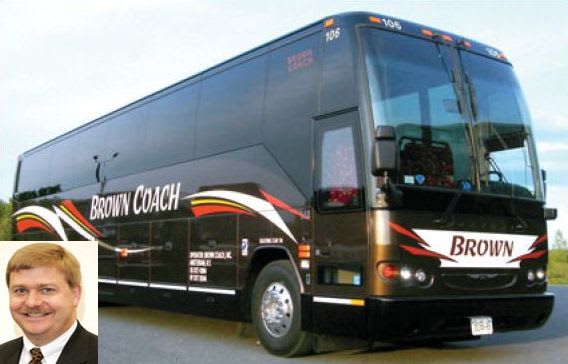
Brown Coach Vice President Stephen B. Brown, P.E., has a unique education that makes him stand out from most coach operators. “I have a Mechanical Engineering degree and received my professional engineering license,” Brown explains. “I’m one of the few people that run a motorcoach operation with a P.E.”
Brown says that his background makes him a “stuff” guy, meaning that he spends much time examining problems with the operation’s existing fleet and trying to find new technology or products that will help minimize those problems.
Brown has “Stephenized” — what employees call his changes and updates — his coaches by specifying or retrofitting emerging technology to improve reliability and reduce ongoing maintenance. Recent items include: tire pressure monitoring systems; seal-less, brushless coolant pumps; and brushless evaporator and condenser motors.
He also added LED lighting, DriveCams and DirecTV.
“We look at technology in the three industries we touch — school, transit and charter — and will take a product that is proven in transit, for example, and implement it in our charter and school vehicles if it’s cost effective,” says Brown.
The operation is also taking part in a project for the New York State Energy Research and Development Authority that enlisted the help of a university and automation company to create a computerized engine block heater control system. This prototype system looks at vehicle schedules, the outside temperature and how much energy is used at a given time, and takes all those factors into account to manage the heaters so they are not on any longer than necessary or don’t all turn on at once.
Brown says that the system has helped the operation save about 91 percent of the total electric bill that it would be paying if the block heaters, which are 1,500 watts each and total more than 90,000 watts when multiplied by the number of vehicles, were left on from the early evening until the next morning.
Six years ago, Brown and his brother Robert, company president and founder, designed and built a 27,000 square-foot facility in Amsterdam, N.Y., that houses administrative offices and repair facilities for both the motorcoach and school bus operations.
As far as the equipment side of the operation, Brown Coach took delivery of two Prevost H345’s this past summer, featuring a new paint scheme and graphics, as well as stuff “the customer would not even think twice about” under the hood that helps ensure a trouble-free trip.
With five busy months a year, Brown says that his operation is increasing its marketing push to create a more visible presence and opportunities during the slower months, including increased advertising and actively partnering with convention and visitor bureaus, as well as, trade and marketing associations in the area.
“Motorcoach operations tend to have very small advertising and marketing budgets and we’re looking to make a conscious decision in 2008 to put a lot more resources into making ourselves more visible,” he explains. “We’re also trying to find niche markets, such as corporate travel, that have been under explored in the past.”
At a Glance
Motorcoaches: 18, 2 midsize and 1 Sprinter
Fleet mix: MCI, Prevost
Employees: 55
Drivers: 15 full time, 26 part time
Service area: Northeast
Services offered: charter, tours, and commuter
Year started: 1980
Average annual mileage: 1.2 million
President: Robert E. Brown
Vice President: Stephen B. Brown
More Management

LIT Marks 10-Year Milestone at Annual Summit
Hosted by the COTA from September 10 to 13, the Summit carried the theme “Celebrating 10 Years of Excellence, Leadership, and Impact,” with every part of the program honoring the people, agencies, and partners who built LIT over its first decade.
Read More →
People Movement: Dan Dipert Coaches Adds Third-Generation Leader, Keolis Names New Valley Metro VP/GM, and More
In this edition, we also cover recent appointments and announcements at the Wabtec, SilverRide, HNTB, and more, showcasing the individuals helping to shape the future of transportation.
Read More →
METRO Opens Submissions for 2026 Motorcoach Awards
Nominations are now being accepted for METRO Magazine’s Operator of the Year and Innovative Operator of the Year awards.
Read More →

New York MTA Advances Final Contract for Second Avenue Subway Expansion
Contract Four is the largest in the Second Avenue Subway Phase 2 project and includes construction of station infrastructure, tracks, and signals for the subway expansion, MTA officials said. Work on Contract Four will begin in 2027.
Read More →
Transit Agencies Highlight Safety Gains at National Summit
Leaders from 15 major transit systems shared crime-reduction results and safety initiatives while discussing the role of continued federal support.
Read More →
NITA Names New Leadership, Expands Reduced-Fare Program at First Board Meeting
The new regional transit authority appointed its first board chair and interim executive director while extending reduced fares across CTA, Metra, and Pace for eligible riders.
Read More →
Beyond the Checklist: A Structured Approach to Transit Maintenance
Reliability-Centered Maintenance helps transit agencies move beyond routine checklists to focus limited resources on the assets and failures that have the greatest impact on safety, reliability, and service.
Read More →
APTA 2026 Nominating Committee Selects Leadership Slate, Names Chair and Vice Chair Nominees
Leadership changes will help shape the association’s priorities and its representation of the transportation industry during the 2026–2027 term.
Read More →
DART Launches Major Security, Fare Enforcement Initiative
The 90-day demonstration will deploy coordinated security teams at five light rail stations while testing controlled access and gathering data to guide future investments.
Read More →
Advancing Fare Collection Through Technology and Innovation
Learn about delivering 1300 gates at 91 stations while managing fare evasion. Explore the large scale deployment, solution customization and real-world results that affect the region. Prepare for deployment in your region now.
Read More →