



Innovative Operator Profile: Eye-Catching Coaches Bring in Business
As a Cuban exile arriving in the U.S. in 1961, Raul Espinosa had nothing but his family, $10 in his pocket and a watch, as well as a minimal ability to speak English.


As a Cuban exile arriving in the U.S. in 1961, Raul Espinosa had nothing but his family, $10 in his pocket and a watch, as well as a minimal ability to speak English. More than 40 years later, his hard work has left an indelible mark on the Latin community in the form of Miami-based coach company La Cubana.
“The man was amazing. He was somebody who would not give up,” says Espinosa’s daughter, Rosa Alvarez of her late father. “To be honest with you, I do not know if I would have persevered the way he did.”
Alvarez, who took over as vice president after her father passed away, explains that it was a long trip for her father to get La Cubana off the ground. In 1965, Espinosa started transporting people in his station wagon from Miami to New York. He gradually increased the size of his vehicles and purchased his first bus around 1974. However, at the time, only Greyhound and Trailways had the authority to move passengers via interstate travel, so Espinosa had to prove to the Interstate Commerce Commission that his services were necessary.
“He basically said that there were too many Hispanics and that they needed a Hispanic bus company,” says Alvarez. “He had worked like a dog to that point, and getting authorization to provide interstate travel allowed him to be legitimate.”
Alvarez began working for her father in New Jersey in 1989, and then moved to Florida in 1990. When her father passed away in 1994, she began running the operation herself and made many changes, including hiring a “better class” of drivers, purchasing new motorcoaches and updating the look of the coaches.
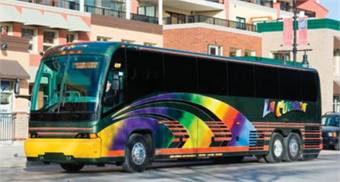
“My father had always had coaches that were red, white and blue. When I took over, we switched to all these crazy rainbow colors and changed our logo to help catch people’s attention,” says Alvarez. The switch to the rainbow colored coaches happened accidentally, though, when a salesman told her that all he had in stock was a yellow and black bus.
“He insisted that it was beautiful and that I should go to New Jersey to look at it. When I got there, the bus wasn’t yellow and black; it was actually hot pink pearl with a yellow rainbow and a black front. It was wild,” laughs Alvarez. “I thought to myself ‘my god this is really something different, it would definitely catch somebody’s eye,’ so I took it.”
With La Cubana and its 800-number written prominently across the back, the coaches serve as a rolling billboard for the operation. Alvarez also runs TV, radio, magazine and newspaper advertisements to help increase business in several markets, including New York; New Jersey; Washington, D.C.; Miami and West Palm Beach, Fla., and uses the easily identifiable coaches to hammer home to her drivers the importance of good etiquette on the road.
“I tell them if they mess up on the road, people are going to call, because our coaches are so recognizable,” says Alvarez. “Knowing that, I think, keeps them sharp.”
Alvarez credits her loyal customer base to La Cubana’s ability to outdo its competitors and always updating its fleet with new and improved coaches. She plans on adding five new MCI coaches this year and updates the fleet every two-and-a-half to three years.
The operation also celebrated its 30th anniversary in August. For Alvarez, it was a time to reflect on the hard work of her father.
“He unfortunately wasn’t there, but he was definitely remembered,” says Alvarez. “What he did was very influential. He started from scratch and built what has become a household name for many people.”
MOTORCOACHES: 11
FLEET MIX: MCI J4500s
EMPLOYEES: 16
DRIVERS: 19 full time, 22 part time
SERVICE AREA: East coast
SERVICES OFFERED: charter
YEAR STARTED: 1978
AVERAGE ANNUAL MILEAGE: 42,000
VICE PRESIDENT: Rosa Alvarez
More Management

LIT Marks 10-Year Milestone at Annual Summit
Hosted by the COTA from September 10 to 13, the Summit carried the theme “Celebrating 10 Years of Excellence, Leadership, and Impact,” with every part of the program honoring the people, agencies, and partners who built LIT over its first decade.
Read More →
People Movement: Dan Dipert Coaches Adds Third-Generation Leader, Keolis Names New Valley Metro VP/GM, and More
In this edition, we also cover recent appointments and announcements at the Wabtec, SilverRide, HNTB, and more, showcasing the individuals helping to shape the future of transportation.
Read More →
METRO Opens Submissions for 2026 Motorcoach Awards
Nominations are now being accepted for METRO Magazine’s Operator of the Year and Innovative Operator of the Year awards.
Read More →

New York MTA Advances Final Contract for Second Avenue Subway Expansion
Contract Four is the largest in the Second Avenue Subway Phase 2 project and includes construction of station infrastructure, tracks, and signals for the subway expansion, MTA officials said. Work on Contract Four will begin in 2027.
Read More →
Transit Agencies Highlight Safety Gains at National Summit
Leaders from 15 major transit systems shared crime-reduction results and safety initiatives while discussing the role of continued federal support.
Read More →
NITA Names New Leadership, Expands Reduced-Fare Program at First Board Meeting
The new regional transit authority appointed its first board chair and interim executive director while extending reduced fares across CTA, Metra, and Pace for eligible riders.
Read More →
Beyond the Checklist: A Structured Approach to Transit Maintenance
Reliability-Centered Maintenance helps transit agencies move beyond routine checklists to focus limited resources on the assets and failures that have the greatest impact on safety, reliability, and service.
Read More →
APTA 2026 Nominating Committee Selects Leadership Slate, Names Chair and Vice Chair Nominees
Leadership changes will help shape the association’s priorities and its representation of the transportation industry during the 2026–2027 term.
Read More →
DART Launches Major Security, Fare Enforcement Initiative
The 90-day demonstration will deploy coordinated security teams at five light rail stations while testing controlled access and gathering data to guide future investments.
Read More →
Advancing Fare Collection Through Technology and Innovation
Learn about delivering 1300 gates at 91 stations while managing fare evasion. Explore the large scale deployment, solution customization and real-world results that affect the region. Prepare for deployment in your region now.
Read More →