Inside the Opening of Honolulu's Skyline Rail System
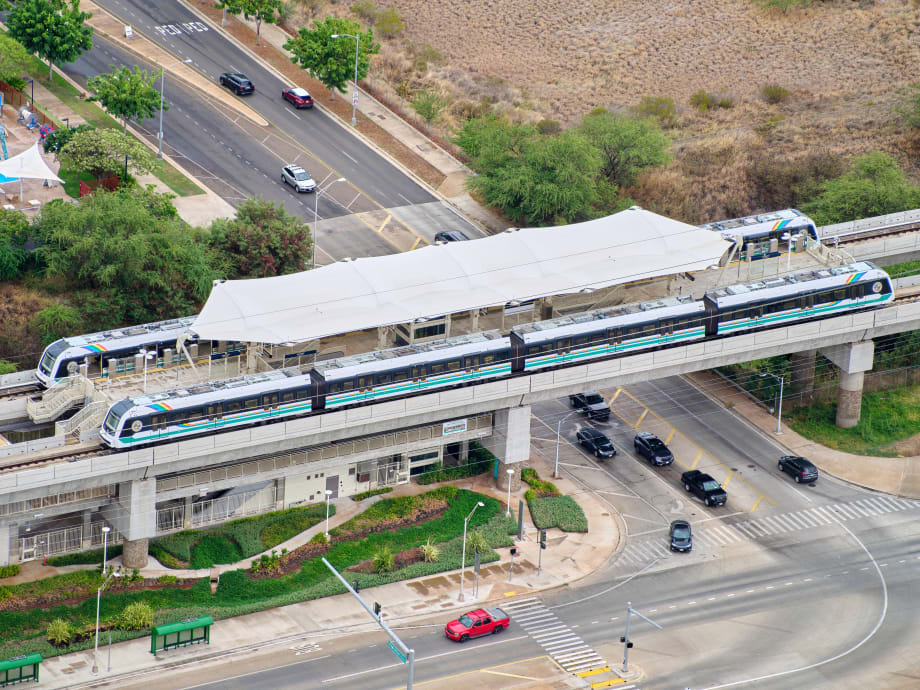
The initial 10-mile phase will serve nine stations between Kualakaʻi and Hālawa, with the full line due to connect 19 stations along a 19-mile corridor on the south shore of O‘ahu.
The full Skyline system is due to connect 19 stations along a 19-mile corridor on the south shore of O‘ahu.
Photo: Hitachi Rail
4 min to read
Last week, the City and County of Honolulu’s Department of Transportation Services (DTS) launched the first 10-mile segment of its light rail system, dubbed Skyline, which will serve nine stations between Kualakaʻi and Hālawa. The full line is due to connect 19 stations along a 19-mile corridor on the south shore of O‘ahu.
“This system represents a long-overdue opportunity, and I cannot thank enough the hands that went into completing this first phase of the project,” said Honolulu Mayor Rick Blangiardi at the opening ceremony on June 30. “It is because of each and every one of you, our future generations of residents and visitors alike will be able to experience a modernized transit network on O‘ahu. Skyline presents an unprecedented opportunity to connect passengers to our central and leeward cities and the distinct beauty and character they each possess.”
Ad Loading...
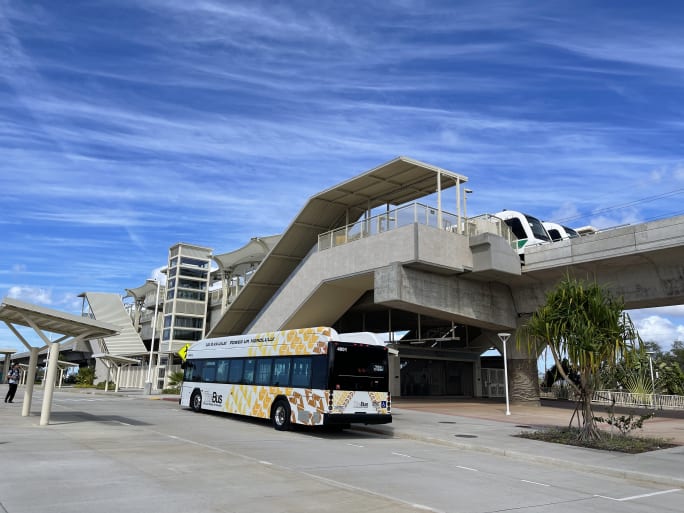
Although the initial section will not yet get into downtown, the island bus system, known as TheBus, added about $10 million of new and added services to better connect to the first segment of the new Skyline rail system.
Photo: Honolulu DTS
More About Skyline
The first leg of the rail system still leaves the system 10 miles short of the Downtown/Ala Moana area. That line, known as Interim Operating Segment 2 (IOS-2), will extend to the Daniel K. Inouye International Airport and onto the Kalihi Transit Center and will be operational within two years. The third and most challenging segment extends from the Kalihi Transit Center to Downtown, Civic Center, Kakaaoka, and Ala Moana Center.
The state-of-the-art system will eliminate an estimated 40,000 car trips per day from the city’s congested streets and highways — equivalent to adding up to eight new freeway lanes — once fully complete.
“We project ridership in excess of 100,000 riders per day by the time rail gets to Ala Moana, but the project's real utility will be to accommodate expected growth along the rail corridor over the next 25 years,” J. Roger Morton, director of DTS at the City and County of Honolulu, recently told METRO. “There are more than 25,000 additional dwelling units already permitted by zoning laws. About nine to 10 daily trips are generated by each additional housing unit, so we are talking about 250,000 additional trips.”
Morton explained that while many of those trips will be short, for example for shopping and school, the additional units will add demand for trips within the primary urban center. The existing highway system is inadequate to absorb the additional demand, but the rail system will provide fast alternative transportation, he said.
Although the initial section will not yet get into downtown, the island bus system, known as TheBus, added about $10 million of new and added services to better connect to the first segment of the new Skyline rail system. Current changes add cost and links but do not replace most existing routes so the overall level of service increases.
Ad Loading...
When Skyline reaches the downtown area, Morton said there will be a need for a massive reorganization to accommodate the rail system. Many of the long trunk corridors will be modified to become shorter bus lines that will be rechanneled into more frequent community circulators feeding the rail system.
In addition to completing construction on the guideway and stations, the Honolulu Authority of Rapid Transportation (HART) also transferred to DTS 12 four-car trains and the 43-acre Rail Operations Center and Maintenance and Storage Facility. DTS is responsible for the operation and maintenance of the transferred assets, with HART continuing to be responsible for the construction of future extensions.
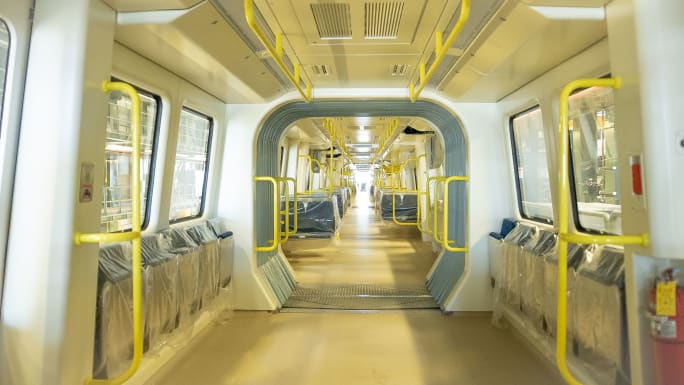
The trains, manufactured by Hitachi Rail, are air conditioned and feature Wi-Fi for all passengers, as well as ample space for bicycles, surfboards, baby strollers, luggage, and more.
Photo: Hitachi Rail
The Skyline Railcar Fleet
Honolulu’s Skyline is the first fully autonomous metro system in the U.S., with the vehicles manufactured by Hitachi Rail.
Design and construction of the subsystems (fire detection, alarm system, passenger screen gate system, etc.).
Testing and commissioning the entire system to be safety certified for passenger service
Operating and maintaining the system during passenger revenue service.
Ad Loading...
Now completed, the overall fleet is comprised of 20 four-car trains, each equipped with the capacity to hold up to 800 passengers. The total train length is 260 feet, with generous open gangways between cars to allow passengers to move freely using all available space.
The trains are air-conditioned and feature Wi-Fi for all passengers, as well as ample space for bicycles, surfboards, baby strollers, luggage, and more.
In addition, the trains are also fully compliant with the Americans with Disabilities Act (ADA), with dedicated spaces for wheelchairs allowing free autonomous movement for disabled passengers embarking on and off the trains.
“Delivering the US’ first ever fully autonomous rail system is an extremely proud moment for Hitachi Rail. It cements our position as an international leader in autonomous metros, which have such an important place in offering reliable, high capacity, sustainable transportation for cities around the world,” said Giuseppe Marino, group CEO for Hitachi Rail.”
The agreement resolves a more than decade-long proceeding before the Surface Transportation Board concerning the terms and conditions for Amtrak services, such as the City of New Orleans, Illini/Saluki, and Wolverine.
Contract Four is the largest in the Second Avenue Subway Phase 2 project and includes construction of station infrastructure, tracks, and signals for the subway expansion, MTA officials said. Work on Contract Four will begin in 2027.
The Garden State Initiative analysis examines the roles of Amtrak infrastructure, fleet management, and agency operations while recommending a more performance-based approach to improving reliability.
Beginning in 2027, Stadler will provide on-site technical expertise, spare parts support, training, and obsolescence management to help extend the reliability and longevity of CapMetro’s GTW fleet.
In METRO's latest installment, we take a look at recent news from Complete Coach Works, Beep, FlixBus, and more partnerships making headlines across the transportation sector.
Pedestrian microsimulation is helping rail planners identify bottlenecks, test station designs, and prepare complex transit hubs for growing passenger volumes.
The privately developed project would offer a 15-minute trip between downtown and O’Hare’s Terminal 2, with trains operating every 15 minutes on a dedicated track. The service would use battery-electric trains and three existing freight rail rights-of-way.