



Mobility-On-Demand: The Future of Transportation
Embracing public-private partnerships can help cities and transit agencies lower operational cost while connecting underserved communities.
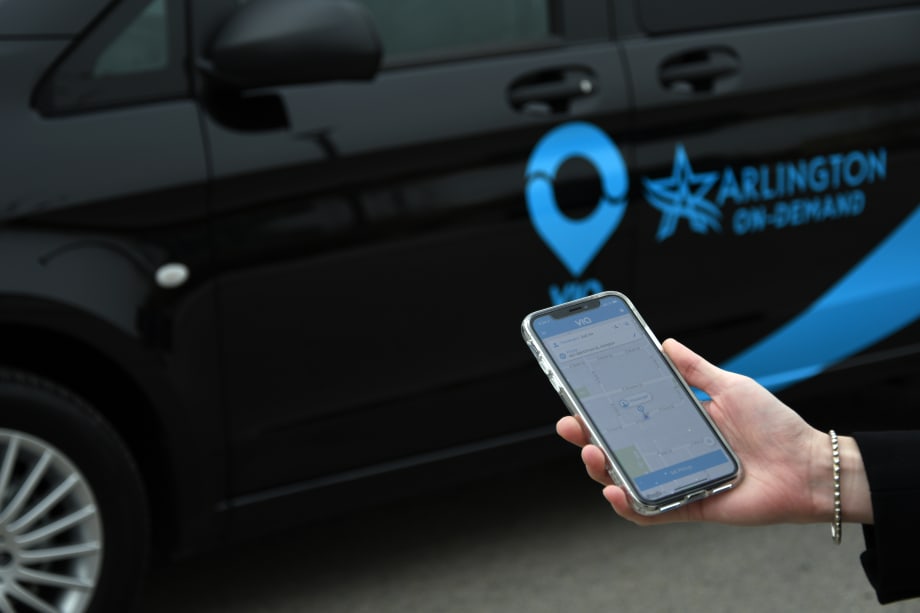
Photo: VIA
Photo: VIA
Ride-hailing services such as Uber and Lyft have been largely viewed as a threat to public transportation agencies, stealing customers and much-needed revenue. These fears are not unfounded. An October report by the University of California, Davis Institute of Transportation Studies found that urban ride-hailing passengers decreased their use of public transit by 6%.
However, rather than fight ride-hailing services, Bob Sheehan, project manager for Multimodal ITS Research and Deployment for the Intelligent Transportation Joint Program Office (ITS JPO), encouraged agencies to explore “emerging technology solutions and different business approaches.”
His department, which operates under the U.S. Department of Transportation (DOT), is focusing on promoting mobility-on-demand — the integration of ride-sharing and ride-hailing services with transit operations.
User experience, more options
During a webinar with Uber, Lyft, ride-sharing app VIA, and various industry officials and stakeholders, Sheehan touted the success of public-private partnerships as the future of transit.
The focus of these partnerships, Sheehan said, should be on user experience and providing travelers with more options.
“We want, and are focused on, this system from a traveler’s perspective, not how effective the highway or the transit services being provided, [but] how effective is the trip for the user?
“Travelers are seeing a benefit, they have more options, hopefully more reliable options, more efficient options,” he said. “And public transit providers, hopefully, they’re providing more economical service and providing more productive and more efficient service.”
From the ride-hailing side, Uber’s Paige Tsai says her organization recognizes its potential to help connect underserved metro areas, reduce parking demand, and alleviate other factors that inhibit mobility and connectivity.
“While Uber’s mission is quite simple, as we’ve grown, we’ve quickly realized that we have the opportunity to work with companies, organizations, cities, and governments alike to help tackle some of the challenges facing our cities today, in terms of transportation,” she explains.
Tsai, who is part of the San Francisco-based Policy Research and Economics team, stresses Uber’s role in filling the first-mile, last-mile gap.
Based on data obtained from Uber trips taken in Philadelphia and San Francisco, Tsai estimates that as much as 30% of Uber trips in a city can be to and from public transit stations. When Los Angeles’ Metro added 12 new stops and extended the existing Gold and Blue Lines, Uber pickups decreased at previous terminal stops and increased where the new terminals are located.
“As we suspected… people were previously using the Expo Line or the Gold Line to get as far as they could on their commute home, but when these new options were available, they continued on their journey and then continued to use Uber to fill that last mile gap,” Tsai says.
Similarly, Paul Davis, transportation and partnership manager for Lyft, says that his company’s 2014 “Friends with Transit” campaign launched after data showed 25% of Lyft rides were starting and ending near major transit centers.
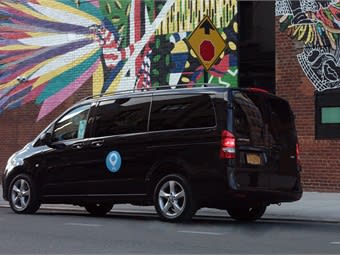
In December, VIA partnered to create a microtransit system for the City of Arlington, Texas.
City partnerships
Based on this information, Lyft has been partnering with cities across the U.S. to provide first-mile, last-mile solutions.
In Dublin, Calif., Lyft and Uber are working with the Livermore-Amador Valley Transit Authority (LAVTA) to subsidize Lyft Line and UberPOOL rides that start and end within city limits. The partnership is helping alleviate traffic and parking congestion at the city’s rail station, which connect commuters with San Francisco, Oakland, San Bruno, and other Bay Area destinations. By entering the promo code “GODUBLIN” on the app, riders only pay the cost difference of the ride after $5.
Christy Wegener, LAVTA’s director of planning and operations,explains that the partnership, which resulted from a 2015 study on the agency’s fixed-route service, has increased public transit ridership.
“We made some healthy choices for the fixed-route network, and in doing so, we left some holes in our service area,” she says. “So, the partnership has provided us a cost-effective way to provide transportation to people who used to have a bus, and we’ve been able to take those resources and reallocate them into frequency on major arterials, which has resulted in more rides.”
LAVTA’s subsidized rides also include trips taken with a local taxi service, which can accept cash-only payments.
Tsai also cites a partnership with Summit, N.J., where city officials were considering building a second parking garage near the city’s train station in hopes of decreasing parking demands. Rather than spending millions on a new parking structure, the City and Uber partnered to give commuters with parking passes free rides to and from the station.
“There is no single approach that we take to these partnerships,” Tsai says. “We really like to hear from the transit agency what problems they’re trying to solve and what solutions Uber can bring using our technology.”
Paratransit rides
In providing underserved areas with transit options, both Lyft and Uber partnered with the Massachusetts Bay Transit Authority (MBTA) to bring on-demand paratransit rides to Boston. The rides are subsidized by MBTA (the agency pays up to $13) and the rider pays only a $2 flat fare. Launched over a year ago, Massachusetts Gov. Charlie Baker expanded the service in February of this year.
In the five months following, over 10,000 trips were completed, Tsai says. While there has been an increase in trips, the cost-per-trip has been reduced “dramatically” due to the on-demand service, she adds.
In October, Lyft announced a partnership with software company Trapeze Group. Transit agencies using Trapeze’s software can schedule rides on the Lyft platform in advance of the trip date. While announcing the partnership, Trapeze officials said that allowing transit agencies to schedule rides through the Lyft app will help reduce operational costs while increasing ride availability.
Davis says that accessibility is important to Lyft, and that they work to ensure transit partners offer wheelchair accessible vehicle services (WAV).
Combining first-mile, last-mile solutions and WAV services, Lyft works with Marin, Calif.-based NGO Whistlestop to provide rides to the community’s seniors. The agency covers the additional cost of paratransit rides to ensure that they cost the same, while increasing mobility.
“So, no partnership is alike,” Tsai says. “But, we are learning a lot from each of these.”
Social equity
During November’s mobility webinar, the DOT’s Sheehan challenged agencies to consider the social equity involved in transportation. Requesting rides on Uber and Lyft typically requires a smartphone and linked credit or debit card, which might exclude underserved and disenfranchised communities.
Lyft has tailored its platform to be Title VI compliant when working with public agencies, Davis says. Users can set up accounts and pay for rides using prepaid cards and PayPal CASH accounts.
Those without smartphones can request rides via Lyft’s concierge center, which can be integrated with the agencies existing call center; call representatives can also help the rider locate the pickup location.
In all of VIA’s partnerships with public agencies, passengers can request rides through a call center, Louis Pappas, who works on VIA’s public sector business development team, says.
The New York City-based ride-sharing company is also formatted for cash payments, he explains. It’s up to the transit agencies to decide if they want to operate a cash system.
While VIA partners with transit agencies across the county, it operates its consumer facing platform only in New York City, Washington D.C., and Chicago. There, users share on-demand rides, with pickup and drop off spots dubbed “virtual bus stops.”
“The idea of a virtual bus stop is to try and make that incrementally a little bit more efficient, so have you walk out to a place that reduces the need for a vehicle to deviate too much to pick you up,” Pappas says. “Our rides are fully dynamic, so we don’t have any fixed routes. The routing updates in real time and all rides are shared.”
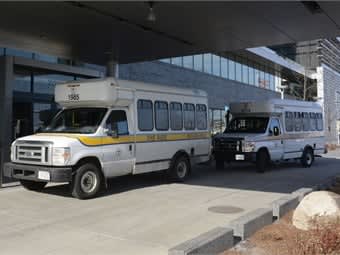
An MBTA pilot program with Uber, Lyft, and local taxi companies helps alleviate strain on paratransit.
MBTA
Microtransit
Private ride-hailing and ride-sharing companies are even stepping in to create transit systems in cities where it hasn’t before been an option.
Take Arlington, Texas — whose claim to fame used to be being the largest city in the U.S. without a public transit system. In December, VIA launched microtransit operations, providing on-demand, shared rides to the city’s 393,000 residents.
“So transit has been voted down in Arlington on a few different occasions,” Zack Wasserman, VIA’s head of business development, explains. “I think it’s perceived as sort of an amenity, that’s just too expensive for them to afford.”
In partnering with the City of Arlington, VIA developed an on-demand, microtransit system, which launched in the downtown area and other small subsets of the city, including a train station that connects to Dallas.
Alicia Winkelblech, the City’s assistant director of strategic planning, says the City believes VIA can provide a high-quality, effective service, before calling the microtransit provider a “great fit.”
“They came to us to develop sort of this entirely on-demand, dynamic microtransit system that they will launch in lieu of creating a conventional, fixed-route service,” Wasserman says. “We bring the technology… Then we also work with local drivers who will bring vehicles, and we’ll be able to provide sort of a complete transit solution for the City of Arlington, at a much lower price point.”
The company identifies people who currently drive for other transportation network companies and recruits them to also drive for VIA.
In addition to Arlington, VIA has incorporated its platform and drivers with the City of West Sacramento, Calif. VIA also allows transit agencies and cities to operate their own microtransit programs.
In Austin, Texas, VIA partnered with Capital Metro by giving the transit agency its technology and platform to build their own system. VIA has a similar partnership with Arriva, a transit contractor in the UK.
More New Mobility
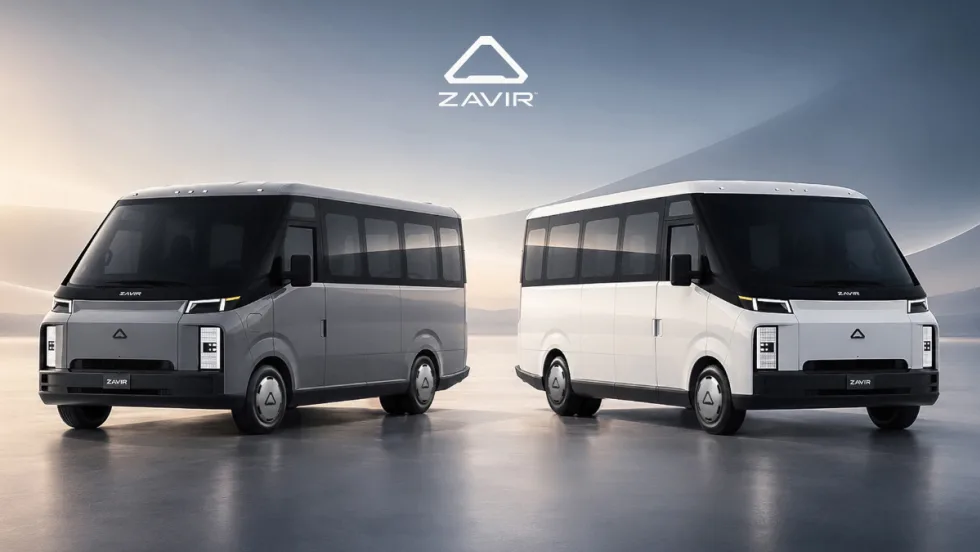
ENC Unveils ZAVIR Medium-Duty Electric Shuttle at APTA EXPO
The new ZAVIR brand targets shuttle and paratransit operations with battery-electric and range-extended electric vehicle options.
Read More →
Public Transit Conference Returning to GFX in 2027, Call for Papers Now Open
The Call for Papers is now open, allowing transit agency professionals and industry experts to help shape the PTC educational program by submitting session ideas for consideration.
Read More →
Everett Transit, Community Transit Outline Consolidation Agreement
The proposed agreement calls for a 50% increase in bus service in Everett, a new microtransit zone, continued paratransit service, and the transfer of Everett Transit operations to Community Transit.
Read More →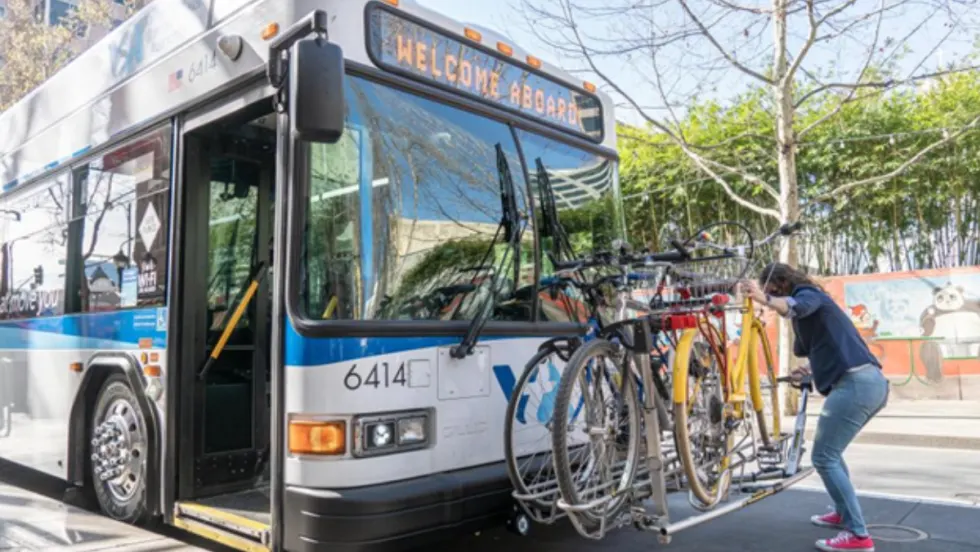
What Multimodal Data Can Tell Transit Agencies About Rider Demand
See how bike-on-bus data is giving transit agencies new insight into rider demand, capacity constraints, and gaps in first- and last-mile connections.
Read More →
From Hardware to Digital Partner: Luminator Charts Its Next Chapter
CEO Magnus Friberg discusses Luminator’s shift toward becoming a digital partner, the growing importance of software and interoperability, and how AI can help agencies improve operations and passenger experience.
Read More →
Biz Briefs: Alstom Lands Canadian Contract, LYT to Supply California TSP, and More
In METRO's latest installment, we take a look at recent news from Complete Coach Works, Beep, FlixBus, and more partnerships making headlines across the transportation sector.
Read More →
CharterUP’s Armir Harris on Technology, AI, and the Future of Group Mobility
In a recent episode of METROspectives, CharterUP Founder/CEO Armir Harris discussed the company’s evolution from an online charter bus marketplace into a technology platform supporting public- and private-sector mobility and much more.
Read More →
Jacksonville’s NAVI Project Charts a New Course for Autonomous Public Transportation
Through its NAVI program, JTA is showing how autonomous vehicles, intelligent infrastructure, and coordinated operations can work together to deliver everyday public transportation.
Read More →
Biz Briefs: Luminator Marks Milestone and More
From manufacturers and suppliers to transit agencies and motorcoach operators, these updates offer a snapshot of the projects, partnerships and business moves driving the industry forward.
Read More →
New Tricks for Old Bureaucracies: Joshua Schank on Making Transit Innovation Stick
Former LA Metro Chief Innovation Officer Joshua Schank discusses why good ideas aren't enough, how transit agencies can overcome resistance to change, and why today's challenges demand more innovation.
Read More →