



Autonomous Vehicles in Public Transit Today…and in the Future
Putting Automation at the Center of the Customer Experience
There are four autonomous vehicle use cases transit agencies can plan for right now and some are already being used successfully around the nation.
by Neal Hemenover
July 7, 2022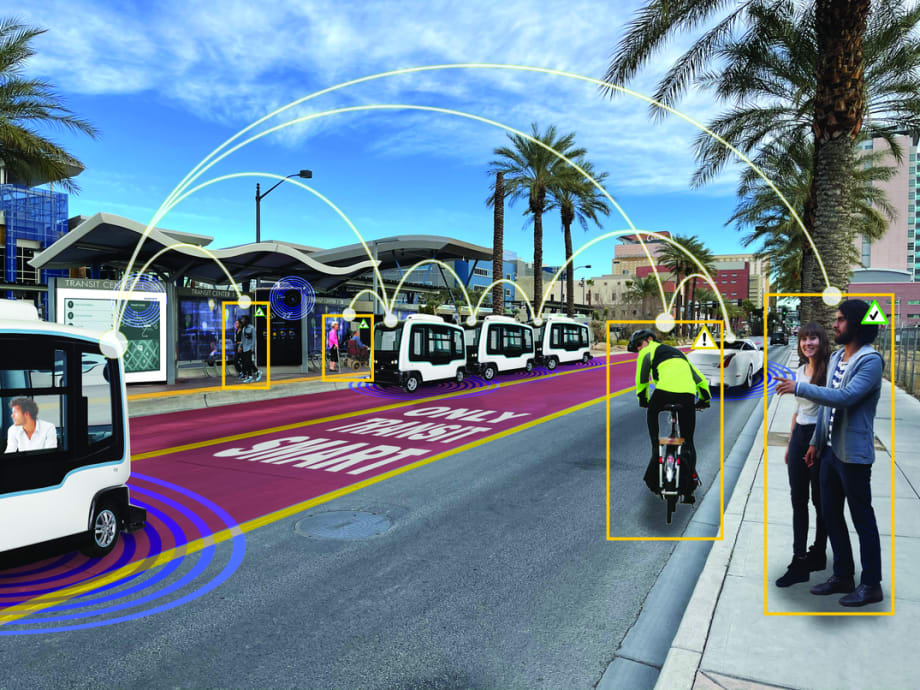
One example of a fixed route AV strategy is in Las Vegas, where Stantec is working with the Regional Transportation Commission to design and deploy AVs in and around the Las Vegas Medical District.
Photo: Stantec
5 min to read
The Public transportation agencies and operators are battling to bring people back. The pandemic has significantly impacted how public agencies and operators manage their transportation networks amid driver shortages and reduced ridership — and forced them to get creative.
One of the key areas agencies and operators are targeting in the hopes of improving customer experience is introducing new technology and different levels of service within and around the existing network. Transit is looking at all ways to put service on the street and create an experience that will help draw customers. Fixed route, microtransit, and paratransit are tackling that customer experience in multiple ways with autonomy and technology.
Moving large amounts of people quickly
Fixed-route bus systems and bus rapid transit (BRT) commuter services are two of the top three ways of moving large amounts of people in and out of cities. Rail systems come in first with their ability to move the most amount of people on a dedicated track, but they come with a high capital infrastructure investment. While there is hope of increased infrastructure spending with the Infrastructure Bill (HR-3684), the work that is supported by this bill will take several years to come to fruition. In the meantime, cities are getting creative by re-working their existing systems.
Fixed Route
Underserved areas of cities and campuses can implement hybrid fixed route models where passengers alert autonomous vehicles (AVs) to stop at their designated stop. If there are no passengers waiting for the service, the vehicle continues onto its next designated stop. This keeps the passenger vehicles moving and provides an improved customer experience.
Some cities are also looking at converting fixed routes in city centers to dedicated lanes. This gives buses and AVs freedom to move more quickly through traffic, while also integrating with traffic signals. The result enhances the riders’ public transit experience while challenging the higher price demanded by existing transportation network companies (TNCs).
One example of a fixed route AV strategy is in Las Vegas, where Stantec is working with the Regional Transportation Commission (RTC) to design and deploy AVs in and around the Las Vegas Medical District. The goal is to move passengers from a local transportation hub around the medical district with AVs that run on a frequent schedule and provide high-quality ADA services.
Bus Rapid Transit
BRT systems are gaining steam as an efficient addition to the mass transit mix, particularly in medium-sized cities. Many BRT lines being planned and implemented have dedicated lanes that whisk buses to and from their destinations. They are ideal candidates for piloting fully autonomous buses to drive these dedicated lanes, taking advantage of platooning with other automated buses to provide a more efficient and safer ride. Some states and agencies have already taken the first step to test AV technology with BRT.
Addressing Transportation cutbacks, deserts with microtransit
Microtransit aims to feed the broader transportation network by deploying on-demand vehicles into a geo-fenced area, addressing transportation deserts or cutbacks on routes due to driver shortages. On-demand applications have created an improved customer experience by providing easy booking, payment, tracking, reserved space, and ADA service. Passengers can book trips to nearby virtual stops, transporting them to transportation or service hubs — the on-demand application can be integrated with AVs to route them to the requested virtual stop.
Common deployments for microtransit with AVs include:
Cities with limited public transportation options
Cities with transportation deserts
Cities re-designing existing fixed route systems
Cities that have lower ridership on off-peak hours
University campuses
Business campuses
Hospital campuses
Microtransit and TNCs are often considered similar services, as they leverage similar on-demand tools. However, the true difference is that microtransit is generally deployed by public agencies required to provide ADA and equity of service to their community. In the past, microtransit services have been subsidized by the city or public agency, reducing the overall cost to the passenger. TNCs run a higher cost and aren’t required to provide ADA and equitable services. The lower cost of these microtransit services, coupled with the ability to schedule on-demand service that can pick up passengers close to their current location, are significant improvements in public transportation customer experience. Adding AVs into the delivery of these microtransit systems allows for the addition of more vehicles, further increasing the quality of service.
An example of how this benefits communities can be seen in Jacksonville, Fla., where Stantec is working with Balfour Beatty and the Jacksonville Transportation Authority to modernize and expand their transit skyway to accommodate AVs. We’re delivering smart infrastructure and ITS design, supporting the AV deployment, and advising on smart mobility and AV policy and funding, all with the goal of providing safe, equitable transit options for the community. Ultimately, the project will put more service on the street, provide faster service, and reduce driver shortages.
A new era of paratransit service
Customer experience over the years for paratransit has been extremely poor, with services being based on old dial-a-ride systems through a call center that require trips to be booked days in advance. These old paratransit systems lack transparency on booking confirmation, and since the ride was booked in advance, there is no day-of confirmation, so passengers aren’t sure where the vehicle is or if it’s late. Nor is there a confirmation for caregivers that the passenger made it to the destination. Additionally, paratransit vehicle operators must focus on driving when passengers oftentimes need assistance in the back.
Many public agencies and operators are trying to improve these customer challenges by leveraging on-demand microtransit software. Now, paratransit riders can book trips via app or desktop computer, get regular confirmations of pick-up, and drop off, and track the vehicle’s location and communicate with the driver if required. Plus, caregivers can get regular updates on where their passenger is on the route. Cities are looking at the success of these microtransit systems leveraging AVs and are evaluating whether they can allow the operators to be on-board as more of a safety operator to monitor the vehicle and focus on the needs of the passengers simultaneously.
Public agencies and operators have a lot riding on technology investments to help them deploy services that can reach riders in a new way — it’s a combination of technology that can help provide this new level of service and AVs are just a part of that solution. Fixing driver shortages, providing reliable quick service, and putting more control in the hands of the rider will help bring those riders back and will help transform aging transportation networks into the new generation of public service.
Neal Hemenover is Director of Product Development for Stantec GenerationAV, based in Chicago
Subscribe to Our Newsletter
More New Mobility

From Hardware to Digital Partner: Luminator Charts Its Next Chapter
CEO Magnus Friberg discusses Luminator’s shift toward becoming a digital partner, the growing importance of software and interoperability, and how AI can help agencies improve operations and passenger experience.
Read More →
Biz Briefs: Alstom Lands Canadian Contract, LYT to Supply California TSP, and More
In METRO's latest installment, we take a look at recent news from Complete Coach Works, Beep, FlixBus, and more partnerships making headlines across the transportation sector.
Read More →
CharterUP’s Armir Harris on Technology, AI, and the Future of Group Mobility
In a recent episode of METROspectives, CharterUP Founder/CEO Armir Harris discussed the company’s evolution from an online charter bus marketplace into a technology platform supporting public- and private-sector mobility and much more.
Read More →
Jacksonville’s NAVI Project Charts a New Course for Autonomous Public Transportation
Through its NAVI program, JTA is showing how autonomous vehicles, intelligent infrastructure, and coordinated operations can work together to deliver everyday public transportation.
Read More →
Biz Briefs: Luminator Marks Milestone and More
From manufacturers and suppliers to transit agencies and motorcoach operators, these updates offer a snapshot of the projects, partnerships and business moves driving the industry forward.
Read More →
New Tricks for Old Bureaucracies: Joshua Schank on Making Transit Innovation Stick
Former LA Metro Chief Innovation Officer Joshua Schank discusses why good ideas aren't enough, how transit agencies can overcome resistance to change, and why today's challenges demand more innovation.
Read More →
How DART's GoPass Is Redefining Regional Mobility
Serving 14 transit agencies, GoPass simplifies multimodal travel by allowing riders to plan, pay for, and manage an entire trip through one app.
Read More →
Biz Briefs: OCTA Taps Clean Energy for Hydrogen Station, Stadler to Supply Via Rail Vehicles, and More
From manufacturers and suppliers to transit agencies and motorcoach operators, these updates offer a snapshot of the projects, partnerships and business moves driving the industry forward.
Read More →CharterUP Expands Into New Mobility and Autonomous Transportation
Vice President of New Mobility Stephen Joos discusses how CharterUP is leveraging its nationwide transportation network, technology platform, and autonomous vehicle partnerships to expand into workforce mobility, campus shuttles, and transit solutions.
Read More →
METRO Magazine Announces 2026 Innovative Solutions Awards Winners
Projects Recognized for Advancing Mobility Through Technology, Accessibility, Workforce Innovation, and Operational Excellence
Read More →