



Safety at the Crossroads: Eliminating Dangerous Roadway and Rail Crossings
With the removal of six rail crossings and the elevation of a Long Island Rail Road crossing, both the safety and quality of life of drivers and nearby residents in the village of Mineola in Long Island, N.Y., have been dramatically improved.
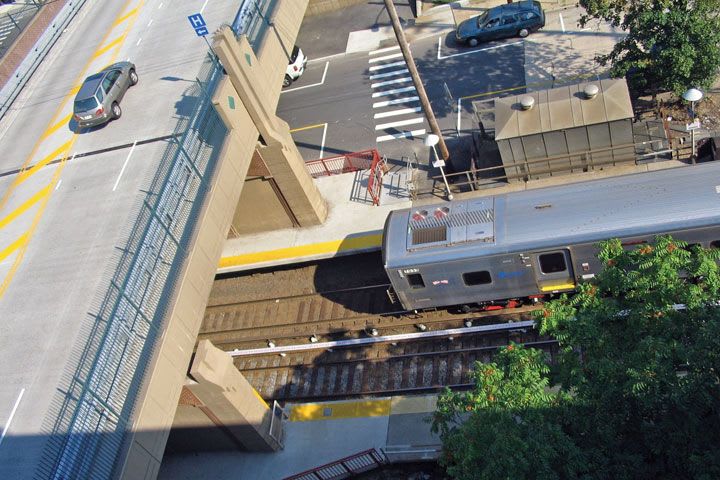
[IMAGE]MET0209p24-large.jpg[/IMAGE]More than a century ago when railroads were becoming the predominant force in land transportation, numerous grade crossings between the existing roadway network and the proposed railroad lines were created with little concern for safety and congestion. The railroad was king, and the potential for faster, cheaper and more comfortable travel far outweighed the possible negatives that came with the construction of a railroad through areas already populated with roadways.
At the time, the headway between trains was great and the volume of vehicular traffic was low enough that there was little cause for concern. Today, however, these railroad grade crossings have become problematic vestiges of the past, especially in more urbanized communities.
The Safety Issue
Traffic and safety, in particular, are the biggest issues at many rail crossings. In densely populated urban and suburban areas, traffic volume tends to be high, so closing through-traffic for even a couple of minutes to allow a train to pass can create severe congestion and bring what’s called the vehicular ”level of service” of the area below an acceptable level. The frustration with congestion and waiting can then lead drivers and pedestrians to try to circumvent the closed railroad gates, with sometimes tragic results.
In 1959, the village of Mineola in Long Island, N.Y., first addressed the problems created by seven railroad grade crossings in the village, six of which were right in the central business district. After considering several options, the village settled on plans to elevate the Long Island Railroad (LIRR) through the village. However, due to a variety of issues, including financial constraints and local objections to the possible disruption construction would cause, plans for the project were eventually shelved.
But in 1982, nine teenagers were killed when they drove their van around a properly functioning crossing gate at one of the most dangerous crossings in the country at the time, bringing them into the path of an oncoming LIRR train. This tragedy was all the impetus the village needed to refocus their attention back to eliminating the grade crossings.
Coordination, Communication
Managing the process to remove the grade crossings was an arduous task, subject to lots of starts, stops and countless roadblocks. Soon after the tragic accident, an environmental assessment was conducted to determine the best way to address the grade crossings and the potential impacts of the work. Throughout this process, the team also reviewed the many implications raising the roadways or train tracks could have on stakeholders and the community, including costs, schedule, LIRR operations, right-of-way acquisitions, community impacts, safety and security. By 1986, the results of these analyses led the project team to conclude that the LIRR should be depressed through the central business district to eliminate six of the seven grade crossings and elevated over the road for the last crossing, which was where the accident occurred.
By 1990, the design process was under way. However, by that time the country had fallen into an economic recession and the original cost of the project had almost doubled thanks to inflation, which hadn’t been factored into the initial budget. So, the dilemma became how to address the problem at all seven grade crossings given these new budget constraints.
Over the next few years, staff from the New York State Department of Transportation (NYSDOT), the railroad and design firm, Stantec, held numerous meetings with the public — who were in favor of removing the crossings for safety — to determine how to remove the crossings quickly, efficiently and with the least disturbance.
Once the project team and the community had reached a consensus on how to move forward, the consultants finalized the plans, including elevating the LIRR over Herricks Road, where the 1982 accident had occurred. To be sure trains could continue to run as scheduled throughout construction, the design plan involved installing bypass and three new interlocking tracks to allow trains to run in the reverse direction on one track, if needed. By 1996, construction on this portion of the project was completed successfully, with little significant disruption to LIRR commuters or to the village itself.
Thanks to such success in eliminating the most dangerous crossing, attention then shifted to removing the crossing at Mineola Boulevard, which had fallen into disrepair. For this crossing in the heart of the village, the plan involved constructing a bridge over the LIRR, rather than elevating the tracks over the road as with the Herricks Road effort. By 2000, the new bridge was finished, complete with aesthetic details to match its surroundings, which have made the bridge a landmark in the community and an award winner in the industry.
[PAGEBREAK]Trains, Traffic and Teamwork
However, with two down and five to go, the community and the project team still faced some significant challenges in finishing the job. Using the experiences of the first two projects as examples, the project team was able to determine the best way to use the remaining funds that had originally been allocated in 1986 to maximize safety and minimize traffic congestion. In conjunction with the community and project funding partners such as the Federal Transit Administration (FTA), NYSDOT, Nassau County and the LIRR, the team determined that separating the grade levels at the next-busiest grade crossings and creating additions to the roadway network would allow motorists to detour away from existing crossings to newly created separations between the road and the rail tracks.
In addition, the design team added several safety improvements at the remaining grade crossings until they could be removed. Up to this point, drivers in Mineola were warned of rail crossings by two barrier gates at each crossing that, as usual, lowered when a train was approaching. But because some drivers had still managed to circumvent the gates in the past, the team added small raised medians to physically prevent them from driving around and putting themselves in harm’s way.
But the last crossing — one that involved both lifting the railroad and depressing the cross street — was by far the most challenging and complex of all the crossing projects. The first issue to tackle was the road’s alignment. The need to minimize impacts to rail traffic, vehicular traffic, noise and utility infrastructure drove the decision to use a curved alignment for the roadway, as the curve shifted the road away from a nearby apartment complex and eliminated the need to relocate a utility power line, which would have added another $5 million to the project cost.
However, curving the road also meant buying some adjacent industrial and commercial property as well as constructing two recharge basins. These basins were designed to handle the new stormwater flow, which would now be concentrated at this one location, alleviating previous flooding problems at the other nearby railroad grade crossing.
In addition to the complexities of the road itself, the team also had to focus on the next challenge — how to construct a bridge that would carry the two most active commuter railroad tracks in the country without causing massive scheduling headaches. The Mineola tracks see an average of 200 trains per day, with trains traveling at speeds of up to 80 miles per hour. Raising the tracks and constructing a bridge, all while maintaining such an intense schedule, meant building temporary bridges to accommodate commuters while the permanent bridge was constructed.
To do so, the team designed a 73-foot, steel through-girder railroad bridge immediately adjacent to the tracks at the level of the future grade-separated crossing. Once the bridge was assembled next to the tracks, the LIRR took the tracks out of service over a three-day holiday weekend, which had been planned more than two years in advance (alternative bus service was provided). While the active tracks were out of service, the new bridge was rolled into place on top of foundations that had been constructed underneath active train traffic. This “roll in” bridge process was planned on an hour-by-hour basis to ensure that LIRR commuter traffic would be back on schedule by the end of the holiday weekend. As with the Herricks Road effort, the team also made provisions for resuming train service in other ways should the weekend not progress exactly as planned. As a result of the careful planning, the “roll in” operation went smoothly and the LIRR was fully operational by the start of the work week.
Ray Weixler, the engineer in charge of the effort for the NYSDOT, agrees that careful planning and clear communication were critical to getting through the weekend successfully. “We had a full-time liaison from the railroad, who attended all of the progress meetings, so coordination with them was not a problem,” he says. “And, we put a notification to drivers in the newspaper and contacted the local police and emergency services to be sure they were aware of the closing beforehand. It went smoothly.”
A Smooth Ride
Now, 19 years after the LIRR grade-crossing elimination project began, the final chapter of Mineola’s quest to eliminate its grade crossings is complete. Some of the busiest crossings in New York State have been remedied, and the roadway network has been improved to allow residents to take full advantage of the new arrangement.
“When we opened Roslyn Road back up,” says Weixler, “people were driving by, blowing their horns and shouting how happy they were with the new road. It was great.”
Thanks to this decades-long project, both the safety and quality of life of drivers and nearby residents have been dramatically improved, as removing the crossings also meant removing the need for trains to blow their horns as they travel through. What’s more, the lack of crossing gate closings during peak hours has all but eliminated traffic congestion in those spots, a welcome perk to residents, business owners and the environment, since fewer idling cars means less air pollution and energy consumption.
Stuart Lerner, PE, is a vice president in the New York City office of consulting firm Stantec.
More Rail
FRA Announces $5.3B in Rail Investments, Including $2B for Amtrak
Funding will support grade-crossing improvements, infrastructure upgrades, and new Amtrak equipment in 23 states.
Read More →
Finding the ‘Happy Medium’: Optimizing Maintenance Without Sacrificing Reliability
The key to maintenance optimization isn’t doing less work—it’s doing the right work at the right time on the right assets.
Read More →
OKC Streetcar Makes Zero-Fare Service Permanent
Ridership increased an average of 71% compared with the same period a year earlier during the fare-free pilot.
Read More →
DART Customer Satisfaction Reaches Six-Year High
Overall satisfaction rose to 74.9%, while the agency’s Net Promoter Score reached a record 33.7.
Read More →
How DART's GoPass Is Redefining Regional Mobility
Serving 14 transit agencies, GoPass simplifies multimodal travel by allowing riders to plan, pay for, and manage an entire trip through one app.
Read More →
Amtrak Board Advances Plan to Restructure Organization, Seeks Public Input
The proposal, developed by Amtrak management and approved by the board for further consideration, is intended to modernize the organization's structure while improving accountability, operational efficiency, and customer service.
Read More →
Biz Briefs: STV teams with Amtrak, Motorcoach Operators Boost Fleet and Land Contracts, and More
From manufacturers and suppliers to transit agencies and motorcoach operators, these updates offer a snapshot of the projects, partnerships and business moves driving the industry forward.
Read More →
Metra Celebrates 100 Years of Electric Rail, Looks to the Future
The event was also a celebration of recent reforms to public transportation in the Chicago area, changes that could be as transformative in the future as the major civic achievement a century ago, said officials.
Read More →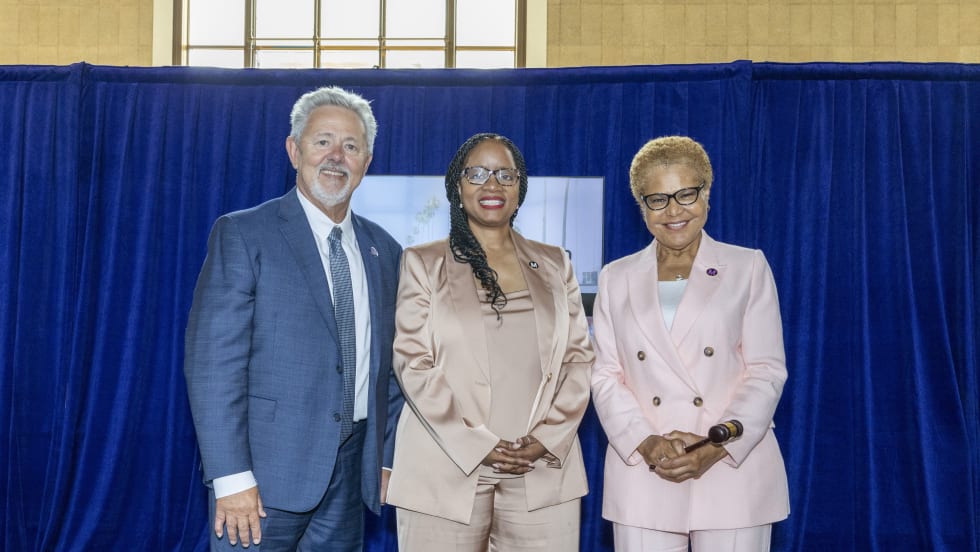
LA Metro Marks Banner Year, Sets Ambitious Goals for New Fiscal Year
Incoming LA Metro Board Chair and Los Angeles Mayor Karen Bass joined outgoing Board Chair Fernando Dutra and LA Metro CEO Stephanie Wiggins to review accomplishments from fiscal year 2026, which included the opening of new rail extensions, advancement of major transit projects, expanded safety programs, and new rider amenities.
Read More →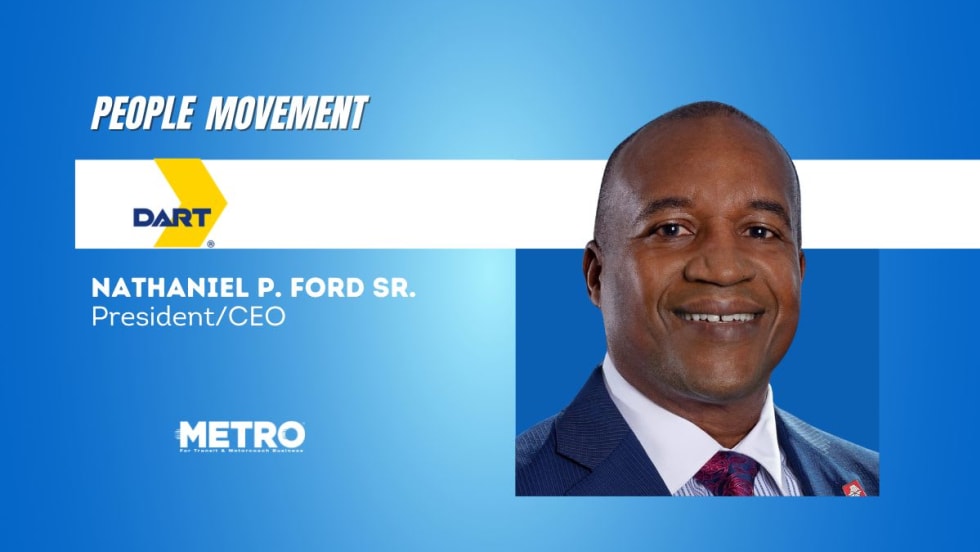
DART Taps Nathaniel P. Ford Sr. as Next President/CEO
Since 2012, Ford has served as the CEO of the Jacksonville Transportation Authority
Read More →