



Securing Rail Systems From The Ground Up
Austin, Texas' Capital Metro and Phoenix-based Valley Metro employed special crime prevention tactics when designing their systems, as well as CCTV cameras and manpower to secure their rail systems' passengers, trains and other infrastructure.
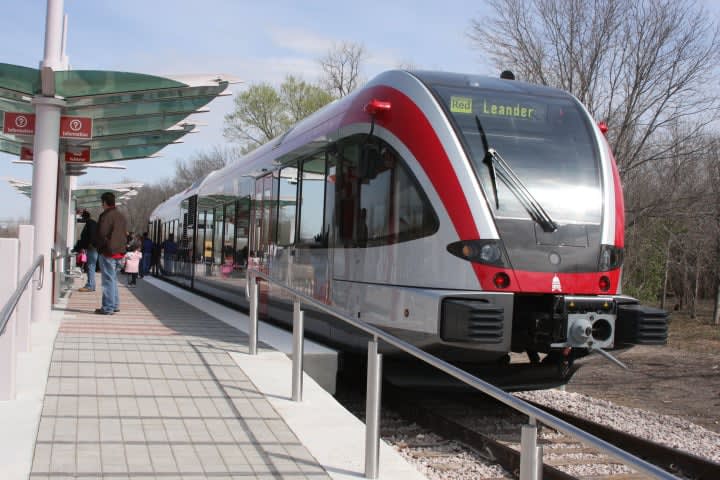
Courtesy CapMetro
[IMAGE]MET4rail.jpg[/IMAGE]With much fanfare and hoopla, two transit agencies — Austin, Texas’ Capital Metropolitan Transportation Authority (CapMetro) and Phoenix-based Valley Metro — recently launched light rail systems.
Prior to launching their respective systems, years of planning went into protecting passengers, personnel and the line itself from theft, damage and various known and unknown factors that may arise. So how and what did the agencies do to prepare? One thing is clear, just as the focus of rail security shifted after 9/11 and system attacks in Madrid, Spain and London, it seems to have shifted again, recently, to focus more on everyday issues and less on the remote yet still real possibility of terrorist attacks.
Looking at design
Each system began by identifying what it is, exactly, that they wanted to protect. Namely, each determined that they wanted to focus on personnel, passengers, the rail system itself and its infrastructure, including rail stations, platforms and park-and-rides.
CapMetro, which was scheduled to launch its new 32-mile system in late March, started planning in 2004, with an idea to simply extend some of its bus security initiatives to its rail system. As Mark Ostertag, CapMetro’s director, safety and security, explains, though, the agency took great care in identifying all the necessary issues it would encounter in trying to plan rail security.
“We wanted to start off well and not have to find out where the problems were first and then address them,” he says. “We wanted to be ahead of the game, so that was our approach.”
Meanwhile, Phoenix’s Valley Metro began its planning process in April 2001, forming the Fire Life Safety and Security Committee, which was made up of fire and police officials from each of its member cities — Phoenix, Tempe and Mesa — and met 50 times over the next several years. The 20-mile system launched toward the very end of December 2008.
“Two of the members that started the committee, finished the committee,” says Larry Engleman, director, safety and security for Valley Metro. “One of those people, fortunately, was a Crime Prevention Through Environmental Design (CPTED) expert.”
A National Crime Prevention Council program, CPTED’s goal is to prevent crime through designing a physical environment that positively influences human behavior, focusing on four principles: natural access control, natural surveillance, territorial reinforcement and target hardening. CPTED played a huge role in both agencies’ planning process.
“As a result of our focus on CPTED’s principles, the stations are very open with good sightlines. It even goes as far as looking at the landscaping to make sure that we didn’t provide hiding places in the park-and-ride lots, for example,” says Engleman.
Says CapMetro’s Ostertag: “Basically, what CPTED says is do not provide criminals a place to hide or lurk. When you hear it, it sounds like pretty basic stuff. But, the point is that you do have to pay attention to it as you’re designing and building your facilities to make sure that you don’t inadvertently give the criminals what they want.”
Further CPTED principles that each agency took into account and used include well-lit stations, platforms and park-and-ride lots and on-site security personnel. Valley Metro even went as far as to change the initial design of one of its art pieces because it provided a large and potentially dangerous hiding place.
Finding technology
Following their focus on design, both agencies chose to use closed circuit television (CCTV) camera systems that record the entire system, including on board trains, 24 hours, 7 days a week. Additionally, emergency phone systems, “Blue Phones,” are located at all platforms, rail stations and park-and-ride lots.
Each of CapMetro’s six trains have 16 CCTV cameras that are monitored in real-time at two locations and feature analytics software that help make the monitoring process a little easier.
“The problem is that you have so many cameras that you can’t possibly watch them all. So, we have software that tells us when something is going on somewhere,” says Ostertag. “If a park-and-ride or station is actually shut down at night and we have motion there, for example, then it draws the attention to the person who is monitoring it that something peculiar is going on.”
Additionally, to protect CapMetro employees, all the stations, offices and facilities have electronic locks with card readers.
Meanwhile, in addition to the CCTV system and Blue Phones, each of Valley Metro’s vehicles have six emergency call buttons that can be pressed by a passenger in case of an emergency. Once the button is pressed, the nearest camera focuses on that area, enabling the operator responding to not only hear but also see what’s going on with the passenger.
“When the button is pressed, they speak directly with the operator, then the operator can call in to the control center, who can then contact 9-1-1 or other emergency service providers,” explains Hillary Foose, public information officer for Valley Metro. “Likewise, for the call boxes, the calls go into our Passenger Assistance Aids, and then they contact emergency services as needed.”
Foose adds that the calls go into an intermediary source rather than directly to 9-1-1, because customers will often use them for non-emergencies, such as missing their train or trying to find out when the next train is scheduled to arrive.
Valley Metro also has a policy that customers will never see graffiti on its trains, platforms or stations twice. To that end, the agency integrated anti-graffiti measures into the design of their trains.
“We have vandal shields on the windows to prevent etching, and the paint on the exterior of the light rail vehicles and all the interior surfaces is very non-porous and slick, making graffiti easy to wash off. Same with all of our station structures,” says Engleman.
The seats also have a removable thin pad, are coated with a Scotchgard-type material and the fabric is laminated with Kevlar, which prevents damaging or separating the fabric if the Kevlar is cut and enables any type of magic marker to be wiped off easily.
[PAGEBREAK]
Personnel, fare evaders
Providing security personnel was a unique challenge for Valley Metro, with Phoenix providing police aides and Mesa and Tempe choosing to contract with Wackenhut to provide security in their jurisdictions. Engleman says despite this unique situation, security on the system to this point has been seamless.
“It has not posed any problems. They all have the same level of authority, do fare inspections, and provide security presence on the trains and platforms,” he says. “Also, they can write citations for the jurisdictions that they are working in and have contact with either the local police agencies or Metro if they need assistance.”
Besides providing a presence on trains, stations and platforms, Valley Metro’s security personnel are also responsible for making sure that passengers are paying the proper amount, or at all, for their trip. Having to currently do fare inspections manually, the system inspected about 10 percent of its passengers in January, — 81,576 in all — resulting in 13 citations issued and a fare evasion rate of less than one percent. Although the agency hopes to inspect more customers, Engleman explains that the transit system is pleased because it expected a fare evasion rate around three percent. With a little help, the agency is also expecting to increase the amount of inspections in the near future.
“Right now, when an officer does fare inspections they have to physically take the card, look at it, check the date and then give it back to the person,” Engleman says. “Eventually, security will have handheld verifiers that will enable them to cover a train in just a fraction of the time it takes them now.”
Valley Metro officers will also soon have the capability to enter a fare evader’s name and picture into the machine, which will then be downloaded to the server and uploaded into all the other handheld units so when that person is encountered the next time and their name comes up in the database, they can be cited.
Emergency planning
Austin, Texas-based CapMetro created an emergency response guide for all first responders, including local police and fire departments and Emergency Medical Services, which tells them everything they would need to know about the rail system in the case of an emergency.
“It explains how to disable the train, how to access it, how to open the doors without power, basically anything they would need to know when responding,” says Ostertag. “We’ve actually done it for all of our bus models, facilities and rail, and it all fits on one CD that we give each of the departments.”
The emergency response guide, which the FTA asked for a copy of to use as a model for all transit agencies in the U.S., was developed with input from each agency, who were brought in separately to provide feedback and discuss what else they may need to know in the event of an emergency.
Ostertag says the result of the guide has been an increased amount of emergency drills, from one or two a year to around 23 when the first guide was developed to approximately seven or eight a year, currently.
“The difference was that they had something to actually train to,” Ostertag says. “In the past, if something would happen we would send out a supervisor, mechanic or somebody like that, who would tell them at the emergency scene what they need to know in dealing with one of our buses.”
CapMetro decided to devise the guide after it occurred to them that it would be unrealistic to get several people out to the various sites in the case of multiple emergencies happening or affecting many areas at once. Therefore, the agency decided that by giving the emergency responders all the pertinent information about their system, the various agencies could then be better prepared, able to plan, and have the ability to check for accuracy and make improvements.
The agency gives each first responder two CDs. If any of the emergency agencies needs more copies, they can simply burn more or print them out if they prefer a hard copy. Either way, getting the guide out to the necessary people is inexpensive for CapMetro.
Ostertag explains that the guide is an ongoing process. “We’ve actually published the third version just a couple weeks ago and, to be honest, we’re already working on version four, because, based on version three, another agency made a suggestion,” he says. “Even if we don’t see the value, if they think it’s going to be useful, we’ll provide that information in the guide.”
Adapting in the future
In the few months since its launch, Engleman says that Valley Metro hasn’t noticed anything they would need to be changed to address new or additional security concerns.
The agency does plan on keeping all of its personnel properly trained and will add analytics software to their CCTV system during the next phase of its light rail system. In fact, the operation is currently trying to attain economic stimulus funds to try to incorporate those analytics into its existing system. For now, Engleman says that its CCTV system has been helpful to the community as well, with police officials asking to view the tapes to help solve some incidents.
CapMetro’s Ostertag explains that the agency is constantly examining its system to see where the “hotspots” may be and if they need to add more resources or cameras to make improvements. He also points out that utilizing this tactic during his three-and-a-half years as director, safety and security, CapMetro has reduced crimes against persons and property by 42 percent and 55 percent, respectively.
As for the focus on the new rail system, Ostertag says: “We’ll just be doing the same thing we usually do, but probably pay a little closer attention in the initial startup to see if there’s something we’ve missed. You know there’s all types of opportunities to improve, it is just limited by money, quite frankly.”
More Rail

Biz Briefs: RIPTA Unveils New Frontrunners, Clevland RTA Adds New Siemens, and More
In METRO's latest installment, we take a look at recent news from Siemens, Prevost, Dodge, and more partnerships making headlines across the transportation sector.
Read More →
CATS Gold Line Marks 5 Years of Service, 2.8M Passenger Trips
With a six-mile expansion planned, the Charlotte streetcar is positioned to connect more neighborhoods and major transit hubs across the region.
Read More →
Why Simulating Pedestrian Movement Has Become Essential for Modern Rail Stations
Pedestrian microsimulation is helping rail planners identify bottlenecks, test station designs, and prepare complex transit hubs for growing passenger volumes.
Read More →
Amtrak Begins Major Construction at New York’s Sunnyside Yard
The new maintenance facility will support Amtrak’s Airo trainsets while improving maintenance efficiency and turnaround times in New York.
Read More →
Chicago Leaders Unveil Plans for O’Hare Airport Express Train
The privately developed project would offer a 15-minute trip between downtown and O’Hare’s Terminal 2, with trains operating every 15 minutes on a dedicated track. The service would use battery-electric trains and three existing freight rail rights-of-way.
Read More →
OCTA Maps Out 30-Year Strategy to Protect Coastal Rail Corridor
The draft feasibility report identifies strategies to protect the coastal rail line for decades as the agency continues near-term stabilization and sand placement efforts.
Read More →
The Business Voice Behind Public Transportation
As chair of APTA’s Business Members Board of Governors, Ray Melleady explains how more than 850 business members are partnering with transit agencies to advance funding, innovation, and industry-wide collaboration.
Read More →
FRA Announces $5.3B in Rail Investments, Including $2B for Amtrak
Funding will support grade-crossing improvements, infrastructure upgrades, and new Amtrak equipment in 23 states.
Read More →
Finding the ‘Happy Medium’: Optimizing Maintenance Without Sacrificing Reliability
The key to maintenance optimization isn’t doing less work—it’s doing the right work at the right time on the right assets.
Read More →
OKC Streetcar Makes Zero-Fare Service Permanent
Ridership increased an average of 71% compared with the same period a year earlier during the fare-free pilot.
Read More →