



Sometimes Looking Ahead Means Remembering What Was
Many innovations that we celebrate as having profound implications for the industry’s future are simply reworked ideas from its rich past. That’s one important theme of Bill Luke’s new book, Bus Industry Chronicle: U.S. and Canadian Experiences.
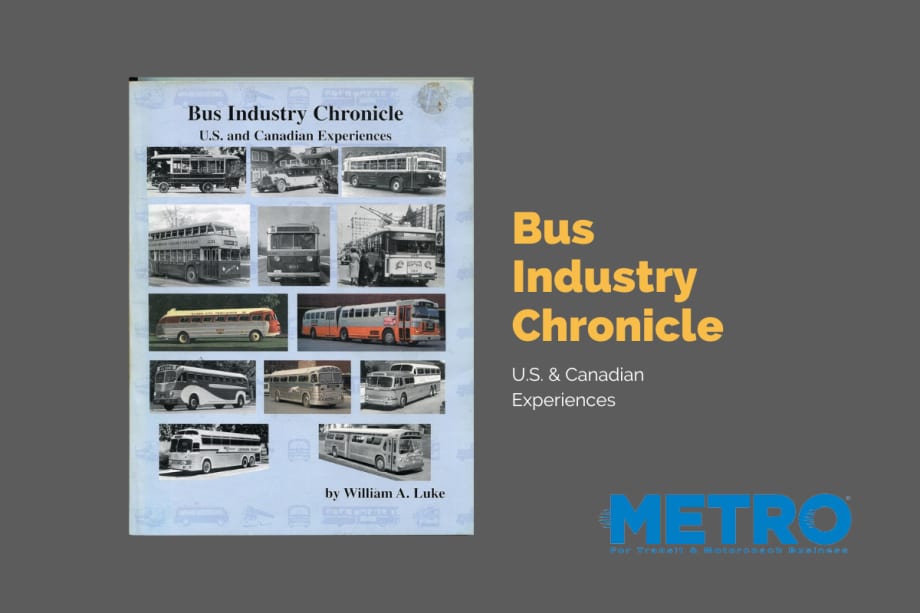
In the book, Luke traces the history of the bus industry worldwide, from the early conversions of automobiles and trucks, to the war years during the mid-20th Century, to the challenges and issues facing it in recent decades.
Photo: Metro | Amazon
Many innovations that we celebrate as having profound implications for the industry’s future are simply reworked ideas from its rich past. That’s one important theme of Bill Luke’s book, Bus Industry Chronicle: U.S. and Canadian Experiences.
In it, Luke traces the history of the bus industry worldwide, from the early conversions of automobiles and trucks, to the war years during the mid-20th Century, to the challenges and issues facing it in recent decades.
All That is Old is New Again
Issues, and even technologies, have been tried and retried through the industry’s colorful past. For example, intermodal concepts were introduced by streetcar and railroad companies as far back as when buses began to ply the streets. In fact, railway operators were among the first to see the advantages of buses on lower-density routes, and how the ticketing and timetables should be seamless for the passenger.
Most of those companies did not see their buses as the “Trojan horses” used in a conspiracy to get rid of streetcar services, as many have charged. Rather, they saw buses as a way to complement their rail routes to keep the whole network healthy.
In other words, these guys saw the concept of “network effects” far before our New Economy propellerheads ever were a gleam in their daddies’ eyes. Luke’s book adds to the body of evidence that what really engineered the demise of streetcars was the heavy highway subsidies being enacted, and our policymakers’ own stupidity for forcing electric utilities to divest themselves of their transit operations.
Even the military, which had a strong bias toward carrying troops and equipment by rail, saw the advantages of carrying men and materiel by bus in certain conditions. One such advantage: Buses could be put into service much faster than new trainsets, sometimes by buses whose shells were wood, Luke reports. Perhaps it is one reason why the commander of the combined forces in Europe during World War II, Dwight D. Eisenhower, signed the Federal Highway Act in 1954 after he became president.
In another example, bus operators employed a variety of bus sizes and configurations to meet various types of service demands. Small buses were used on routes and during times with lighter ridership as far back as the 1930s. Using articulated and doubledecker buses for higher-capacity lines is perhaps even older than that. Artics were also used for intercity routes, and doubledecker units often used the higher deck for lounges with nice views and snack bars, much like rail services and airlines do today. And today’s darling, bus rapid transit, has long been with bus transportation, when the industry called the concept busways and city officials reserved lanes and built bridges for buses.
The engine concepts that we are currently engaged in a debate about are also rooted far into the industry’s past. For example, Frank Fageol was developing a bus with hybrid propulsion prior to WWII. Automatic transmissions and air conditioning were introduced in the 1930s. Aluminum and airplane construction methods also date to the first half of the past century.
Confident View of the Future
The last chapter of the book is also an interesting examination of where bus transportation is headed. To Luke, the future looks bright indeed, not so much because individuals and governments are willing to spend gobs of money on buses in the future—which they are—but because of where the bus has already been.
“The bus industry is a small industry, but it can be a strong, important part of the economy of any country,” he writes. “The role the bus industry plays in improving the environment, relieving congestion and promoting safety needs to be told again and again.”
All we need to do to chart that better future is draw better upon where we have been.
More Management

LIT Marks 10-Year Milestone at Annual Summit
Hosted by the COTA from September 10 to 13, the Summit carried the theme “Celebrating 10 Years of Excellence, Leadership, and Impact,” with every part of the program honoring the people, agencies, and partners who built LIT over its first decade.
Read More →
People Movement: Dan Dipert Coaches Adds Third-Generation Leader, Keolis Names New Valley Metro VP/GM, and More
In this edition, we also cover recent appointments and announcements at the Wabtec, SilverRide, HNTB, and more, showcasing the individuals helping to shape the future of transportation.
Read More →
METRO Opens Submissions for 2026 Motorcoach Awards
Nominations are now being accepted for METRO Magazine’s Operator of the Year and Innovative Operator of the Year awards.
Read More →

New York MTA Advances Final Contract for Second Avenue Subway Expansion
Contract Four is the largest in the Second Avenue Subway Phase 2 project and includes construction of station infrastructure, tracks, and signals for the subway expansion, MTA officials said. Work on Contract Four will begin in 2027.
Read More →
Transit Agencies Highlight Safety Gains at National Summit
Leaders from 15 major transit systems shared crime-reduction results and safety initiatives while discussing the role of continued federal support.
Read More →
NITA Names New Leadership, Expands Reduced-Fare Program at First Board Meeting
The new regional transit authority appointed its first board chair and interim executive director while extending reduced fares across CTA, Metra, and Pace for eligible riders.
Read More →
Beyond the Checklist: A Structured Approach to Transit Maintenance
Reliability-Centered Maintenance helps transit agencies move beyond routine checklists to focus limited resources on the assets and failures that have the greatest impact on safety, reliability, and service.
Read More →
APTA 2026 Nominating Committee Selects Leadership Slate, Names Chair and Vice Chair Nominees
Leadership changes will help shape the association’s priorities and its representation of the transportation industry during the 2026–2027 term.
Read More →
DART Launches Major Security, Fare Enforcement Initiative
The 90-day demonstration will deploy coordinated security teams at five light rail stations while testing controlled access and gathering data to guide future investments.
Read More →
Advancing Fare Collection Through Technology and Innovation
Learn about delivering 1300 gates at 91 stations while managing fare evasion. Explore the large scale deployment, solution customization and real-world results that affect the region. Prepare for deployment in your region now.
Read More →