



Specialized Training Boosts Technicians' Hybrid Bus Knowledge
New curriculum, which should be ready this fall, focuses on the entire operation of the hybrid system, including electronics, component identification, energy storage, manual discharge, regenerative braking and energy flow, as well as the cooling system.
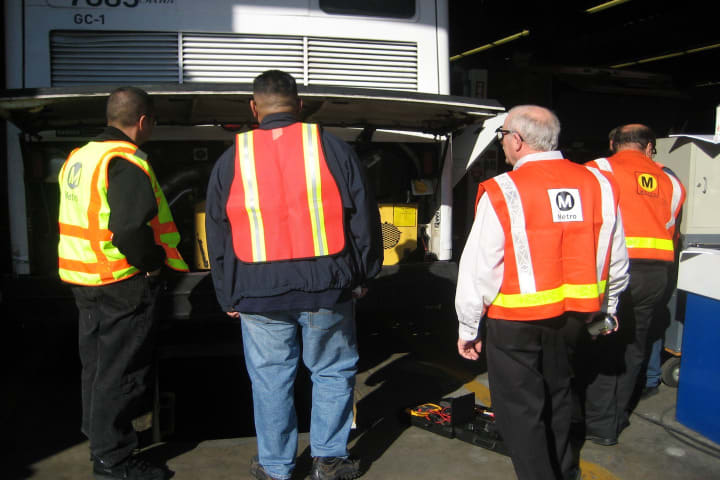
[IMAGE]Maintenance.jpg[/IMAGE]As the technologies that go into building buses continue to evolve at a rapid pace, technicians have the unenviable task of playing catch up.
With the oft-mentioned gap in tech training continuing to widen, the growing interest and purchase of hybrid buses is adding yet another issue that transit agencies must tackle in their garages — essentially, getting up to speed on vehicles that require technicians to have a much broader working knowledge.
“In terms of being able to work on this equipment, you are really talking about two main disciplines in the repair area, bus technology and rail technology coming together because of the amount of ITS and electronic equipment on buses these days. It is not normal to see that mix in our industry until now,” says David Stumpo, program manager for the Southern California Regional Transit Training Consortium (SCRTTC). “Usually, you are either a good electronic technician or you are a good diesel or gasoline technician. You don’t normally see somebody that is good at both.”
California going green
With California Air Resources Board (CARB) regulations restricting the use of diesel-fueled vehicles, area transit agencies have turned to alternative-fuels, such as compressed and liquefied natural gases (CNG, LNG), to propel their fleets in the future. With a growing concern for being greener, many, such as Long Beach Transit (LBT), have chosen gasoline-electric hybrid buses to meet the challenge.
“LBT currently has 62 gasoline-electric hybrid coaches in service and is in the process of accepting 25 more coaches,” explains Rolando Cruz, executive director/vice president, maintenance and facilities at LBT. The agency is planning on replenishing its entire fleet with gasoline-electric buses as older vehicles come up for replacement, with LBT expecting to retire its last diesel coach by 2015.
The interest in hybrid technology is also growing at many other California transit agencies, with Los Angeles County Metropolitan Transit Authority, as well as agencies in the cities of Santa Monica, Montebello, Norwalk and Gardena, using, or planning to use, the same gasoline-electric buses on their streets.
“Now, there are other transit systems around the country that are putting hybrid buses into service, but the majority of those use diesel-electric technology,” says Stumpo. “There are slight differences between gasoline and diesel engine knowledge, but either way, there is a national need for hybrid bus training.”
Developing Training
Stepping in to help provide California-based agency technicians with the proper training they will need to deal with this new world of buses, the SCRTTC, a group comprised of public transportation agencies and college members located in Southern California, has teamed with LBT; ISE Corp., supplier of the gasoline-electric systems; and its own group of college academics to create a comprehensive training course.
“We partnered up with the Advanced Technology Transportation Energy Initiative, which is part of the California workforce development out of the statewide chancellor’s office, and they will fund pieces of the development along with SCRTTC in putting together this hybrid curriculum,” says Stumpo. “Once the curriculum is developed in concert with the three entities, we have this kind of mini consortium of consortiums working to put together the three phases.”
The three phases of development — design of the program, building of the actual curriculum and the delivery of that curriculum — has thus far been an extensive process for all the involved parties.
“Because of the discipline being so new, we wanted to take our time and get it right, so it’s taken about 18 months to develop the gasoline-electric hybrid course,” says Stumpo, whose Aptrex Institute manages the contract to the SCRTTC. “A normal course can usually be built within a six-month timeframe.”
Stumpo adds that because there was a limitation in terms of how many people actually utilize hybrids, the group was working with a small number of experienced people, which made it much more difficult and time-consuming to be able to put together the learning objectives and courseware.
The collective group has worked on a curriculum, which should be ready this fall, that focuses on the entire operation of the hybrid system, including electronics, component identification, energy storage, manual discharge, regenerative braking and energy flow, as well as the cooling system. The course is administered in an academic setting by a college-certified instructor.
“SCRTTC has played a key role in helping coordinate the manufacturer, a local college and our internal training department to create a series of hybrid classes,” says Cruz. “You know four experts are going to create a much better class than one.”
The process the group will go through after development of the courses includes validating the course against learning objectives, developing the courseware, beta class delivery and train the trainer, and the certification of its instructors.
The SCRTTC delivers the courses depending on need and capacity at the transit site or on the college campus of one of its members.
“We’re able to deliver around the Southern California region pretty much anywhere, anytime,” says Stumpo.
Interested technicians can register through a simple process via the Web, with any SCRTTC member able to take the courses free of charge, thanks to funding from the Federal Transit Administration’s (FTA) research and technology arm.
[PAGEBREAK]
Filling the gaps
“There really was no formal training ready to be delivered by the manufacturer at the time of delivery,” explains Cruz. “LBT was the first agency to put gasoline-electric hybrid propulsion into service with a delivery of 47 coaches in 2005. This was a major risk, since we only had a couple of test buses with a few miles. No one had any maintenance experience and no training was formally developed.”
Cruz adds that LBT’s first training sessions were delivered by engineers, who explained safety and the theory on how the system was developed to work. Since no one knew what maintenance to expect, no training could really be designed. The agencies’ technicians shadowed engineers and ISE repairmen for three years as they repaired the failures under warranty, which helped them develop some content for basic training. Those materials, however, still needed to be streamlined.
Three major differences that technicians need to address to be able to work on hybrid-electric vehicles are an understanding of how to deal with high voltage, in particular, ultracapacitors; working on a gasoline engine that is powering a generator versus a conventional diesel engine that works through a transmission (hybrid-electric buses have no transmission); and working with a traction motor — an electrical motor that drives the wheels.
To have an understanding of hybrid technology and what techs need, it was found through SCRTTC assessments that they must have foundational courses in order to be able to work on hybrid buses.
“We basically are saying that the pre-requisites for this course are going to be understanding Digital Volt-Ohm Meters, Electrical I, which is foundational electrical, Electrical II (advanced) and Electrical III (foundational electronics). We think they need to have those levels of pre-requisites in order to get into the hybrid training,” says Stumpo, who adds that another reason it has taken so long to develop the course was that it was necessary to develop and begin administering these courses along with two additional levels of electrical classes.
Impact
As mentioned earlier, the growing expansion of global consciousness is driving many agencies to begin exploring the use of hybrid buses, in addition to the growing acceptance of the technology in the consumer market. For this reason, the FTA has taken a vested interest in the development of the SCRTTC’s training course, hoping to utilize the program as the need for increased training in hybrid buses continues to grow.
“Personally, I think the market is starting to understand the environmental benefits [of hybrid-electric buses], and once we clear the fuel efficiency (lots of work being done here), the market will grow exponentially,” says Cruz. “The hybrid-electric systems are without a doubt the stepping stone to the future — a zero emissions system.”
With CARB classifying diesel as a carcinogen and many California agencies looking to gasoline-electric hybrids as a solution to fill their needs, the SCRTTC is seemingly developing this course at just the right time, proactively taking steps that will help technicians fill the learning gap before it widens further.
For techs, training starts with the manufacturer
Typically, manufacturers also supply training to transit agencies that purchase their buses; however, learning what type of day-to-day maintenance will be necessary once the buses are in service is up to the agency to sort of learn on the fly.
Daimler Buses North America (DBNA) offers a complete technical training package for every system on its buses, according to the company. This is inclusive of a wide range of training from how to tighten hardware; to a week-long training program; to being trained to use the onboard intuitive diagnostic system used to troubleshoot the hybrid propulsion system. DBNA also customizes all of its training to focus on areas that a customer requests, and technical representatives are also available to assist its customers at any time.
Key aspects of its hybrid-specific training are high-voltage safety and onboard diagnostics.
In addition, “Motor Coach Industries (MCI) offers various training programs for our coach’s EX225 disc brakes, HVAC, I/O controls, SmarTire, wheelchair lift training, etc. This training is done at the customer location,” says Dan Besserer, director of MCI Fleet Support, Public Sector. “MCI does recommend that technicians take the Allison Hybrid training programs that are offered by Allison Transmission. They offer a couple levels including two-day training, which is an overview, and a five-day curriculum, which is more in-depth. The hybrid drive unit is taken apart, inspected and reassembled.”
Additionally, MCI offers “Technical Tune Ups,” free to its customers, several times a year at its National Training Center in Louisville, Ky. The curriculum for 2009 offers several new courses, including clean-diesel engine technology, electronic stability control, steering and suspension systems, and more instruction time for multiplexing. For more information, or to register, visit: www.mcicoach.com /training.
More Bus

ENC Lands MATA Contract and More in Biz Briefs
In this edition of Biz Briefs, we spotlight the latest developments shaping the future of mobility.
Read More →
From Surviving to Thriving: Building Stronger Transportation Organizations
Bus Business Consultants founder Brian Dickson shares lessons on leadership, organizational health, and creating options for long-term success in a changing transportation industry.
Read More →
Everett Transit, Community Transit Outline Consolidation Agreement
The proposed agreement calls for a 50% increase in bus service in Everett, a new microtransit zone, continued paratransit service, and the transfer of Everett Transit operations to Community Transit.
Read More →
SEPTA Details Accelerate Vision for Transit System
The plan outlines investments in trolley modernization, new Metro and Regional Rail vehicles, accessible stations, and more frequent bus and rail service.
Read More →
Report: Transit Bus Manufacturing Supports 34,100 Jobs, $5.1B in GDP
The “Buses Mean Business” report examines the transit bus manufacturing industry’s economic footprint, supply chain, and rising demand for vehicle replacements.
Read More →
Biz Briefs: New Flyer Delivers in Columbus, Houston, Beep and Freebee Merge, and More
In this edition of Biz Briefs, we spotlight the latest developments shaping the future of mobility.
Read More →
People Movement: Dan Dipert Coaches Adds Third-Generation Leader, Keolis Names New Valley Metro VP/GM, and More
In this edition, we also cover recent appointments and announcements at the Wabtec, SilverRide, HNTB, and more, showcasing the individuals helping to shape the future of transportation.
Read More →
New York MTA Plans Largest Bus Fleet Upgrade in More Than a Decade
The agency is seeking manufacturers for 650 new CNG buses to replace aging vehicles, improve reliability, and advance its broader fleet modernization strategy.
Read More →
Building a Flexible Path to Transit Electrification
John Hroncich discusses BAE Systems’ modular and scalable approach, lessons learned from decades of real-world operations, and how agencies can identify electrification strategies that fit their fleets.
Read More →
Bus Tech Talk: Keeping Transit Technicians Ahead of the Technology Curve
LA Metro’s Obed Mejia discusses technician training, evolving maintenance technology, fleet replacement, and strategies for getting the most out of today’s transit fleets.
Read More →