



Supply Side Ready to Take on U.S. High-Speed Market
Although funding impacts businesses as much as high-speed rail authorities, many manufacturers are excited for the opportunity to provide services in the U.S. and optimistic their products have what it will take.
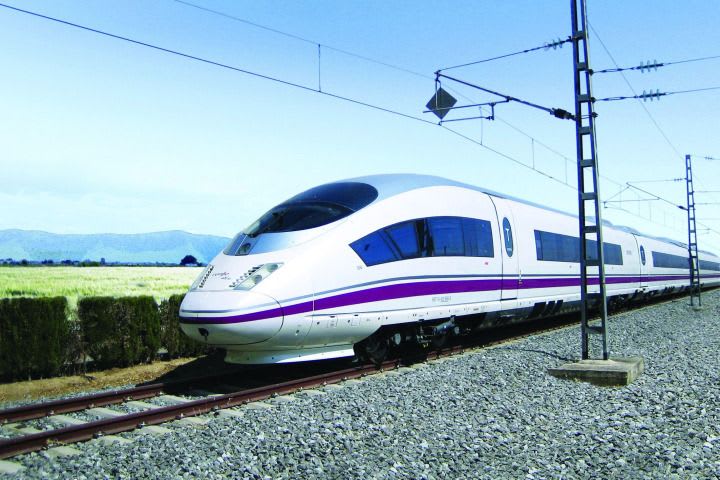
Siemens has several higher-speed vehicles, such as its Viaggio, in operation throughout the world. The company has a facility in Sacramento, Calif., which it has recently expanded in part to ramp up for high-speed vehicle production in the U.S.
[IMAGE]Alstom3-2.jpg[/IMAGE]In August, U.S. Secretary of Transportation Ray LaHood announced that the Federal Railroad Administration (FRA) received 77 applications from 25 states for the most recent round of High-Speed Intercity Passenger Rail (HSIPR) grant funding to be awarded this fall.
The application requests, totaling more than $8.5 billion, are being considered for the more than $2.3 billion appropriated in FY 2010, which is in addition to the $8 billion appropriated earlier this year by the American Recovery and Reinvestment Act (ARRA) as a down payment for the HSIPR program.
A majority of those grant applications — 20 applications from 10 states totaling $7.8 billion — are for high-speed rail corridor development programs. The FRA also received 57 applications from 18 states totaling $700 million for smaller, individual projects within rail corridors that are ready to begin construction. To date, the FRA has awarded more than $583 million to states for HSIPR.
With the continuing funding serving as a jump-start for President Obama's vision of a national high-speed rail network, manufacturers with an enormous wealth of experience worldwide are gearing up for the eventual implementation of higher-speed rail vehicles, particularly on high-speed rail systems in California and Florida.
So, what do these manufacturers bring to the table? METRO reached out to several companies to discuss their products and services, as well as their international project experience.
These manufacturers' array of products and knowledge will greatly help the U.S. fulfill its high-speed rail vision but first, many agree that the continuing funding of HSIPR program will be essential.
Alstom Transport
Headquartered in France, Alstom Transport has been involved in high-speed trains and services in that country since 1981 and has worked with Switzerland since 1984; Spain since 1992; Belgium since 1993; Eurostar and KTX (Korea) since 1994; and Amsterdam and Germany since 1996.
In June, Alstom unveiled a new model of Very High Speed train at the international railway exhibition EXPO Ferroviaria in Turin, Italy. The new platform is in addition to its already extensive portfolio of articulated Very High Speed platforms — TGV, TGV Duplex and AGV — and non-articulated High Speed platforms — Pendolino.
The train, designed to reach a maximum speed of approximately 248 mph, relies on eight traction systems with eight motors in powered bogies, delivering a total power of 10 MW and is capable of a commercial speed of up to approximately 224 mph. It is targeted for the worldwide market.
Keith Stentiford, interim vice president, North America, explains that adapting its vehicles to fit the U.S. marketplace should not be an issue.
"For customers, not only is technology a choice, but also there is an operational choice as well as capacity, maintenance and speed. So, any adaptation to our standard products depends on the client and is based on performance," he says. "We have incremental high-speed vehicles already operating on Amtrak's lines; our product range is pretty big. We can build whatever train the customer wants."
Like most of the manufacturers METRO spoke with, Stentiford says that the second biggest question U.S. high-speed groups are asking is about the technology of the vehicles themselves. Likewise, the manufacturers are unsure of how exactly their technologies in use around the world will be utilized here in the U.S.
"There is also a lot up in the air; a lot of speculation that leaves the manufacturer with a little uncertainty about what the technology transfer from Europe into the U.S. market will be," he says.
Aside from its wide array of rolling stock, Alstom also offers signaling, infrastructure, information systems, electrification and turnkey solutions.
[PAGEBREAK][IMAGE]BombardierZefiro380-2.jpg[/IMAGE]
Bombardier Transportation
Headquartered in Berlin, Bombardier has more than two decades of experience in delivering core engineering and systems for high-speed and very high-speed trains, including entire vehicles, car bodies, locomotives, propulsion systems and bogies.
"We have participated in the delivery of more than 850 high-speed and very high-speed trains and vehicles worldwide, including all major European and North American high-speed and very high speed trains," says Maryanne Roberts, Bombardier Transportation's U.S. spokesperson.
Examples of Bombardier's worldwide work include four TGV series vehicles in France, the AVE S-102 in Spain, the ICE family in Germany, the ETR 500 in Italy and the high-speed trainsets for Amtrak's Acela Express service.
Bombardier's ZEFIRO high-speed technology, developed for speeds between approximately 155 and 236 mph, is the culmination of its long-standing reputation in the high-speed market segment, Roberts explains.
"The vehicle offers high levels of comfort and capacity, low operating costs, and diverse application options for different countries and railway networks," she says. "We are currently delivering the world's first ZEFIRO trains to the Chinese Ministry of Railways (MOR). The 80 ZEFIRO 250 trainsets feature Electrical Multiple Unit sleeper cars capable of speeds up to [155 miles per hour]."
In September 2009, Bombardier won an additional contract to supply the MOR with 80 ZEFIRO 380 very high-speed trains.
This last August, the board of directors of Italy's Trenitalia issued a preliminary award to the Bombardier-AnsaldoBreda consortium for 50 V300 ZEFIRO very high-speed trains — the third model in the product family.
"Contract negotiations are now under way," Roberts says. "If successful, this would mark the first sale of a ZEFIRO train in Europe, following our success in China."
In addition to providing rolling stock, Bombardier can design, supply and integrate the electrical and mechanical components of an entire system, as well as coordinate infrastructure work with the vehicles and sub-systems. Bombardier can also provide operations and maintenance services.
Currently, Bombardier is closely following activities related to all of the designated high-speed rail corridors in the U.S. and is providing information to various high-speed rail groups.
"Bombardier is a member of the Next Generation Corridor Equipment Pool Committee established by Amtrak to design, develop specifications for and procure standardized, next-generation corridor equipment; participates on APTA's High Speed & Intercity Rail Committee; and participates in the various high-speed rail conferences taking place around the country," Roberts says.
[IMAGE]siemensVelaro-2.jpg[/IMAGE]
Siemens
In 2009, Siemens completed a $26 million expansion of its Sacramento, Calif. manufacturing facility to begin ramping up for U.S. high-speed rail production. The company also recently purchased 20 acres adjacent to its 34-acre plant for further expansion. In sum, the company could increase to 250,000 square feet of additional manufacturing space, for a total of 550,000 square feet and as many as 1,700 direct employees.
The plant, where Siemens builds light rail vehicles for systems throughout the U.S., including Oceanside, Calif.-based North County Transit District's Sprinter diesel multiple units, has been in operation for 26 years.
"From the 3,000 pieces of steel that we weld together to 26 miles of wiring per vehicle, they are produced 100 percent here in our plant," says Becky Johnson, director of communications Siemens Industry, Mobility Division. "Right now, it's just a matter of waiting to see who's going to release specifications and requests for proposals."
Siemens' 220 mph Velaro train, currently operating in countries including Germany, Spain, Russia and China, could be a fit for the planned systems in California and Florida, Johnson explains, while the Viaggio vehicle, which operates in Austria, Switzerland and Hungary and has a top speed of 150 mph, would be ideal for Chicago and the rest of the Midwest.
"We would need to make them adaptable to the U.S. marketplace to be compliant with the FRA's requirements," Johnson says, adding that since Siemens has a facility in the U.S., Buy America requirements should not be an issue for the company. "So, we would simply take the best of our products overseas and apply them to the U.S. and whatever the specs are that the different high-speed rail authorities set out."
Aside from its true high-speed vehicles, Siemens is also looking at the need for 110 mph and 125 mph higher speed rail vehicles — meaning higher that what is currently run in the U.S. Siemens can also provide automation, electricification, program management and turnkey applications for prospective U.S. partners.
Keeping with the spirit of creating a "greener America," half of the electricity used by Siemens' facility is generated by solar panels, and the company is currently doubling its capacity to 2 megawatts, which will help generate up to 90 percent of its power needs.
The company also employs a dry-cut welding process that requires no water disposal and has cut volatile organic compound waste by more than 50 percent, while simultaneously increasing production by more than 200 percent over the last three years.
"One of the things that we had presented to the California High Speed Rail Authority was the concept of a carbon neutral system," Johnson says. "So, not only would the vehicles be produced in our factory, where we operate mostly on solar power and use all kinds of green technologies, but the system could be run on a combination of solar, hydroelectric and wind power. It may be cost prohibitive at this point, but it was a concept that we were exploring, and Siemens definitely has the capabilities to do that."
[PAGEBREAK][IMAGE]Talgo350spain-2.jpg[/IMAGE]
Talgo
A Spanish company founded in 1942, Talgo incorporated in the U.S. in 1983 and expanded its presence in 1994, when Renfe-Talgo of America was awarded a contract by the Washington State Department of Transportation (WSDOT) for a leased Talgo trainset to be operated on the operation in the Seattle to Portland, Ore., corridor for six months.
The success of that relationship led to WSDOT and Amtrak ordering three Talgo TPU trains in July 1996 — two for WSDOT and one for Amtrak — and leasing one additional train for use by Amtrak. The vehicles, assembled in Seattle using American workers, began service in February 1998 and continue to be operated under the Amtrak Cascades brand name.
In 2009, Wisconsin Gov. Jim Doyle announced that the state would purchase two, 14-car Talgo trainsets for $47 million, with an option to buy two more if the state was successful in securing ARRA funding for the extension of passenger rail service from Milwaukee to Madison. The trains will be put into service on the Amtrak Hiawatha service, with the cars pulled by existing locomotives.
"Since we didn't have a manufacturing facility, when we talked to other states we said we'd be willing to set up a facility in the state where the first order was placed," explains Antonio Perez, president/CEO of Talgo Inc. "Wisconsin took a leap at that, we reached an agreement and, as a result, we are setting up a new facility in Milwaukee."
Taking over the Tower Automotive site, Talgo's new 130,000-square-foot U.S. manufacturing facility will employ 60 people when it opens in September 2010 and will eventually grow its workforce to 125 employees. It will also be set up to handle the maintenance of the new vehicles being built for both Wisconsin and Oregon set to be delivered in Fall 2011 and Winter 2012, respectively.
Talgo's vehicles are made of aluminum alloy with welded seams to form a structural frame, making them lighter and stronger than traditional railcars, Perez explains.
"The lighter weight is something that is very critical for us. This is how our first product was invented; having in mind that lightweight equipment was better," Perez says. "We feel it's more valid today, because people are more conscious about fuel consumption and so on."
The articulated railcars also use passive tilt technology, enabling them to navigate curves at higher speeds with less car tilting and ride smoother at higher speeds, enhancing passenger comfort.
"Within our technology principles, we have a range of products that go from 110 mph to 238 mph, covering the three different types of vehicles for the market," Perez says. "Talgo also continues to provide support to the customers, even after the train is sold, by signing a maintenance contract."
Perez adds that Talgo's experience, which includes 46 trains operating in Spain's high-speed system, as well as the experience of other manufacturers, will prove to be extremely helpful for U.S. high-speed rail authorities.
"Where the U.S. can benefit from high-speed rail manufacturers is through products that are proven and incorporate the most advanced technological systems in the world to make sure the trains they implement are successful," he says.
Hurdles
All the manufacturers have their sights set on the Tampa-to-Orlando line in Florida as being the first true high-speed system that will be putting out an RFP for their services soon. Many are also gearing up for work in the Midwest.
With technology transfer being the No. 2 question, it is obvious that funding is the No. 1 hurdle facing both high-speed rail authorities and manufacturers.
"Right now, the questions aren't necessarily about our products or services, it's more about money - who can bring money to the table because the local governments don't have the funds to pay for it," Siemens' Johnson says.
Adds Talgo's Perez: "The administration keeps promising that there's going to be a constant flow of funding for this, but the reality is that money isn't available yet. The [government] really wants to do it, but they cannot provide that assurance to the manufacturers that the money is available, so the funding issue is very critical."
Johnson adds that because of the lack of funding sources, public-private partnerships will play a huge role in completing high-speed projects around the nation, a strategy that all manufacturers say they are capable of helping to implement.
Alstom's Stentiford says without the promise of a steady flow of funds, U.S. high-speed rail projects are moving at a snail's pace.
"To compare the U.S. to others, you will find them to be much slower," he says. "If you take China, for example, they set the record, as well as the Japanese. I think we are behind the curve, but that is typical of this country's cautious approach."
More Rail
Amtrak, CN Reach Agreements to Strengthen Passenger Rail Service, Safety
The agreement resolves a more than decade-long proceeding before the Surface Transportation Board concerning the terms and conditions for Amtrak services, such as the City of New Orleans, Illini/Saluki, and Wolverine.
Read More →
New York MTA Advances Final Contract for Second Avenue Subway Expansion
Contract Four is the largest in the Second Avenue Subway Phase 2 project and includes construction of station infrastructure, tracks, and signals for the subway expansion, MTA officials said. Work on Contract Four will begin in 2027.
Read More →
San Diego MTS Breaks Monthly Trolley Ridership Record
Agency officials said July’s ridership indicates MTS’s continued recovery from the pandemic.
Read More →
Report Examines NJ TRANSIT Reliability, Funding Challenges
The Garden State Initiative analysis examines the roles of Amtrak infrastructure, fleet management, and agency operations while recommending a more performance-based approach to improving reliability.
Read More →
Stadler, CapMetro Sign Long-Term Rail Fleet Support Agreement
Beginning in 2027, Stadler will provide on-site technical expertise, spare parts support, training, and obsolescence management to help extend the reliability and longevity of CapMetro’s GTW fleet.
Read More →
Biz Briefs: Alstom Lands Canadian Contract, LYT to Supply California TSP, and More
In METRO's latest installment, we take a look at recent news from Complete Coach Works, Beep, FlixBus, and more partnerships making headlines across the transportation sector.
Read More →
CATS Gold Line Marks 5 Years of Service, 2.8M Passenger Trips
With a six-mile expansion planned, the Charlotte streetcar is positioned to connect more neighborhoods and major transit hubs across the region.
Read More →
Why Simulating Pedestrian Movement Has Become Essential for Modern Rail Stations
Pedestrian microsimulation is helping rail planners identify bottlenecks, test station designs, and prepare complex transit hubs for growing passenger volumes.
Read More →
Amtrak Begins Major Construction at New York’s Sunnyside Yard
The new maintenance facility will support Amtrak’s Airo trainsets while improving maintenance efficiency and turnaround times in New York.
Read More →
Chicago Leaders Unveil Plans for O’Hare Airport Express Train
The privately developed project would offer a 15-minute trip between downtown and O’Hare’s Terminal 2, with trains operating every 15 minutes on a dedicated track. The service would use battery-electric trains and three existing freight rail rights-of-way.
Read More →