



Track Maintenance Equipment Gets the Job Done Faster, Safer
Whether transit agencies are looking to procure equipment or hire a contractor, the evolution of track maintenance technologies and services have made it possible to do certain tasks in less time, while keeping workers out of harm’s way.

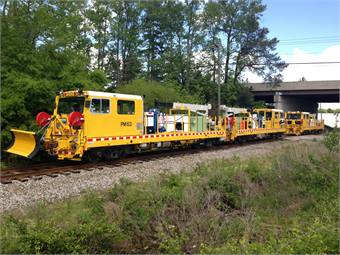
When it comes to track maintenance, transit systems are looking to accomplish specific tasks easier, better, faster and safer. Whether transit agencies are looking to procure equipment, or hire a contractor, the evolution of track maintenance technologies and services have made it possible to do certain tasks in less time, while keeping workers out of harm’s way. METRO Magazine talked with two companies, Plasser American Corp. and Herzog Transit Systems Inc. (HTSI) to discuss their companies’ equipment and services.
Plasser American
Plasser American is a Chesapeake, Va.-based manufacturer of equipment for freight railroads and transit systems. The company works very closely with its transit and commuter customers to accommodate their specific needs in track maintenance equipment.
Track maintenance machines have become technologically advanced with PLC control systems and on-board monitoring and diagnostic systems, according to Plasser American. Some machines are equipped with features that allow the machine to work automatically with the operator overseeing its functions as well as being able to intervene if needed, according to Plasser officials.
Transit systems are looking for mechanized ways to do things more efficiently. The Switch and Production Tamping Machine is an excellent example of maintenance equipment that helps users get the job done more efficiently. It tamps the track, lifts and lines the track, works on plain track in production mode and can work in switches.
Some of Plasser’s tamping machines are equipped with a third rail lifting device, which in the switch it lifts the turnout rail as it tamps through the switch. By automating this process, workers avoid having to go through the cumbersome job of using track jacks under the track and cleaning out the ballast to get the jack underneath.
Dynamic Track Stabilizer
All track is subject to settling due to traffic loads. This settling occurs irregularly and uncontrolled, resulting in track deterioration. Plasser’s Dynamic Track Stabilizer is a machine that generally follows behind tamping machines. During the tamping process, the track is being lifted to correct the track geometry, which loosens the ballast underneath it. The Dynamic Track Stabilizer is designed to apply controlled, accurate stabilizing forces into the track structure at continuous speeds of up to one mph.
The stabilizer is used to settle the disturbed track and consolidate the ballast again, which gives the track a higher lateral resistance. This is especially important for reducing slow orders, according to the company. Also in summertime, when the tracks heat up, you can avoid track buckling and kinks in the rail by using the stabilizer. On higher-speed lines, like Amtrak, the stabilizer can reduce slow orders quite a bit, according to Plasser.
[PAGEBREAK]
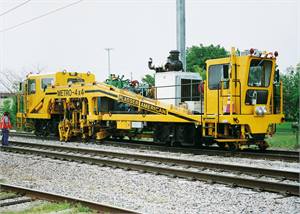
The Plasser METRO 4x4 is a heavy-duty, high-performance switch and production tamping machine, equipped with fully automatic, computer controlled (AGGS) lifting, leveling and lining systems.
Ballast Vacuum System
There are a great many instances where it is very difficult to remove ballast or other types of material from the track area, for example, near station platforms, level crossings, tunnels, bridge approaches, switches, etc. Plasser’s Vacuum Systems are ideally suited for a range of applications.
One particular unit was built purely for ballast vacuuming so that when ballast has to be removed from hard-to-get-to places, this machine goes in and draws it out, so you avoid people having to do the difficult, backbreaking work of removing it with shovels and forks. The vacuum will collect the ballast in a hopper where it can be taken back to the yard and disposed of so that new ballast can be brought into the track.
Plasser also developed a specialized vacuum system for a transit system to use to clean drains. The company is currently working on a larger ballast vacuum system, which would store the ballast in the machine so that once the repair work is done, the ballast can be brought back into the track.
Prime Mover Cars
To help transit systems with track and other rail-related maintenance, many times a flat car is needed to carry their equipment and materials.
Plasser’s Prime Mover Car is a power car that can tow flat cars and other equipment. Transit systems are generally looking for “what they call a workhorse,” the company says, which can repair anything on the track that can only be accessed by rail.
Whether it’s replacing a piece of rail or repairing/replacing switch components, the Prime Mover usually has a crew cab on it to fit a certain number of people, depending upon what the customer specifies. These machines have a powerful engine and drive system to be used for rescue operations, such as a vehicle breakdown, so they can tow it away.
Prime Mover machines are also equipped with a crane to do various lifting jobs. Some of them have large compressors and generators on them for air and electric tools and other devices. The vehicle acts just like a power plant, in that it provides power and capacity to pull other vehicles, or just the power that gives you electricity, compressed air or hydraulics to operate other hand tools, according to the company.
Mobile Maintenance Unit
One new project is the Mobile Maintenance Unit, which is a three-machine consist to protect workers from passing trains when working on multiple track territory. This new concept, which was derived from a system in Europe, was introduced last year on Amtrak, according to Plasser.
The unit itself is fully enclosed and the sidewalls are movable to allow workers to be within the confines of the machine on the ground doing track work. For example, when a worker is welding a rail joint or replacing switch parts, the machine can park over the area that you want to repair. By doing so, it provides protection from the weather and also passing trains on multiple track territory, the company says.
The development of this particular equipment came into being after an inspection visit in Europe. There are several of these mobile maintenance systems being used in Europe, including Germany, Norway and Austria.
Specialized Equipment
Although track maintenance equipment can be more productive based on its larger size, some transit agencies are limited due to their infrastructure. Older transit systems such as New York City Transit and Boston’s Massachusetts Bay Transportation Authority have smaller clearances, which prohibits them from purchasing equipment that is too big because it won’t fit.
Because these agencies cannot purchase equipment “off the shelf,” Plasser works with them to develop specialized equipment that can fit their system. The basic functions will work the same as a standard size machine, but they are specifically designed for that property because they have to fit into a smaller clearance envelope, according to Plasser.[PAGEBREAK]
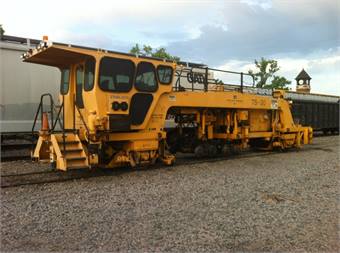
Herzog’s Dynamic Track Stabilizer reduces slow orders and takes full advantage of work windows.
Herzog Transit Systems Inc.
With its corporate offices based in St. Joseph, Mo., HTSI provides transit services throughout the nation. The company offers turnkey servies for transit systems, including operations, inspections, maintenance and construction. Some current transit projects include operating, maintaining track and signals for 70 route miles of the Oceanside, Calif.-based Coaster trains; 115 route miles for Austin, Texas-based Capital Metro; and 120 route miles for the Rail Runner system in Albuquerque, N.M.
Over the years, “track maintenance has become very scheduled and planned out, unless an emergency arises. Work windows are scheduled two to three months out,” says Gerry Di Ioli, national division manager. “With the necessity to keep trains running on time, these scheduled work windows are of extreme importance.”
Track maintenance “really boils down to inspections and repair,” Di Ioli explains, adding that the inspection process is “not just rails, ties and ballast anymore,” he says of the inspection process.
“You have to look at the overall infrastructure, whether a drainage facility is clogged, [or]vegetation is impeding the vision of our personnel or the public, or growing too close to a wooden structure or bridge, where it creates a fire hazard,” he says.
As part of the overall infrastructure, HTSI also inspects station buildings and equipment facilities.
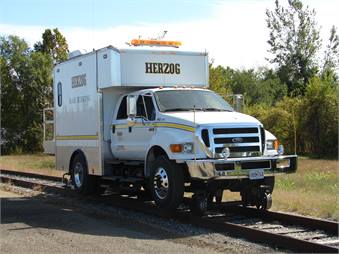
Herzog uses ultrasonic test data with sub-meter precision GPS for track inspections.
“An integral part in keeping trains on time is maintaining an equipment fleet that is updated and in top-notch shape,” Di Ioli says. “On-time performance is everything. If you tear out a piece of rail, you must get it back in on time.”
The Herzog companies has an extensive fleet of updated and exclusive track maintenance equipment to draw from for its various rail services as well as offer for lease to transit systems.
Multi-Purpose Machine
One piece of equipment that is in demand is HTSI’s Multi-Purpose Machine (MPM). This maintenance provider handles labor-intensive tasks such as ditching, tie distribution, tie pick up, rail pick up, PTC and signaling installation, general clean up, OTM distribution and pick up, grading and crossing work among other tasks.
The MPMs, which can reach up to 27 feet from the track center, is equipped with a Roto-Tilt articulating head making it ideal for a variety of jobs. The operator is able to change the variety of quick-connect attachments in less than five minutes, according to the company.
The self-propelled MPM does not require a work train and only one HTSI employee is required for operation. The MPM can travel to the next job site at 50 miles per hour or can be put on the rear end of a train for movement.
P.L.U.S. Train
Using less manpower is also one of the key benefits of the P.L.U.S. (Programmable Linear Unloading System) train. The P.L.U.S. train unloads ballast using a pre-programmed survey linked to GPS satellites. Technicians can access these survey files from a server. The survey file is then loaded into the train’s computer which, through specialized software, directs the spread of exact amounts of ballast at precise locations based on the survey, according to the company’s website. The software also gives the train’s exact location and speed, satellite availability, active ballast cars, empty cars and ballast inventory.
Since no ground personnel are required, the P.L.U.S. train is capable of night and inclement weather-spreading assignments. This greatly reduces the potential of injury and exposure to ballast dust. Additional benefits of the P.L.U.S. system include a reduction in ballast costs and railroad overhead, fewer locomotives, train crews and ballast cars are required, and a reduction in fuel use, according to the company.
More Rail
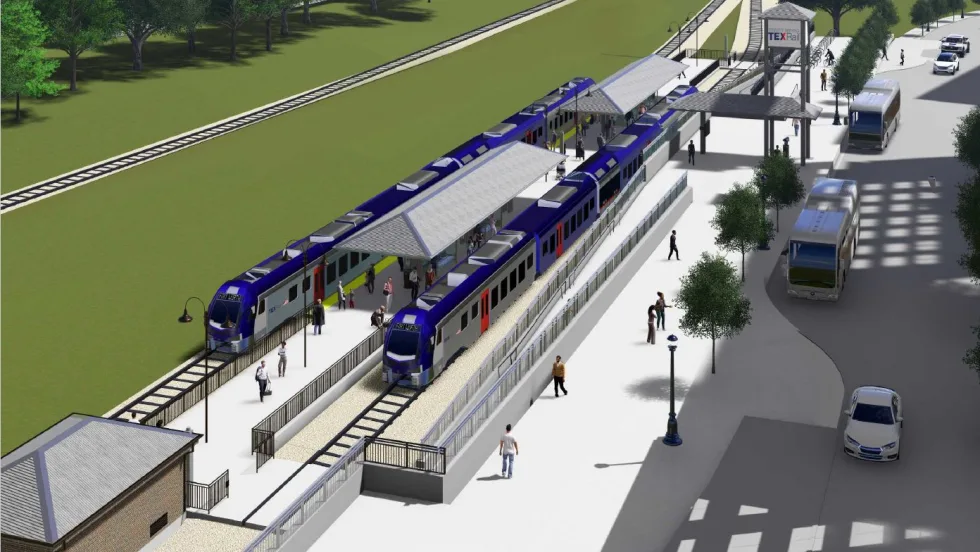
Trinity Metro Breaks Ground on $270M TEXRail Extension
The 2.1-mile extension will connect Fort Worth’s Medical District and Near Southside to downtown, surrounding communities, and Dallas-Fort Worth International Airport.
Read More →
Bringing Austin’s First Light Rail System to Life
Austin Transit Partnership CEO Greg Canally discusses the city's nearly 10-mile light rail project, its collaborative approach to project delivery, the importance of community engagement, and the milestones ahead as construction approaches in 2027.
Read More →
Metra Draft Plan Outlines Costs, Service Improvements for Regional Rail
The Systemwide Network Plan identifies infrastructure needs and potential investments to expand all-day, bidirectional rail service across the Chicago region.
Read More →
Amtrak Completes First Street Tunnel Upgrades, Restores Service
The nine-day construction project included replacing aging track infrastructure and modernizing switch systems near Washington Union Station.
Read More →
FRA Announces $2.3B for Passenger, Freight Rail Projects Nationwide
The CRISI Grant Program funding will support rail infrastructure improvements, safety upgrades, and projects aimed at improving freight and passenger rail service across 45 states and Washington, D.C.
Read More →
Caltrain’s Electrification Drives a New Era of Ridership Growth
The railroad’s shift to electric service has brought more frequent trains, stronger customer satisfaction, and increased ridership, earning it APTA’s Outstanding Public Transportation System award.
Read More →
FTA Advances $164M Broward County Commuter Rail Project
The proposed 10.5-mile commuter rail extension would connect Fort Lauderdale and Aventura, expanding passenger rail options in South Florida.
Read More →
New York MTA Launches Historic $1.9B Signal, Track Modernization Project
Funded in part by congestion pricing revenue, the project will replace nearly century-old signals along the A and C lines in Brooklyn and Queens.
Read More →
LA Metro Breaks Ground on East San Fernando Valley Light Rail Project
The 6.7-mile line will add 11 stations along Van Nuys Boulevard, expand access to jobs and regional transit connections, and support Metro’s broader efforts to improve mobility as rail ridership grows.
Read More →
CSA Group Releases Climate Resilience Standard for Transit, Passenger Rail
Developed with support from the Standards Council of Canada, CSA D700 guides assessing climate-related risks and planning adaptation measures for transit and passenger rail systems.
Read More →