



Transit Agencies Build Innovative Revenue Streams
While budget pressures are forcing fare hikes and service cuts, some agencies are thinking outside the box to develop new sources of income, such as selling ads and naming rights and even functioning as a contract agent for the Department of Motor Vehicles.

[IMAGE]Revenue.jpg[/IMAGE]Much of the news about transit industry issues these days revolves around budget cuts and resulting fare hikes and service cuts.
While agencies of all sizes are forced to make these difficult decisions, some are countering their fiscal pressures with innovative ways to add revenue beyond selling fares.
In the wake of fare hikes that drew public ire in April, the New Jersey Transit (NJ Transit) board of directors was considering awarding a one-year, $480,000 contract to a financial advisory firm to find ways to bring in additional revenue from the agency's parking structures, possibly through privatization, The Star-Ledger reported. NJ Transit would save on the cost of staffing and maintaining the lots. Another option would be to charge commuters for parking in lots that are currently free or raising rates at paid lots.
According to the board's meeting agenda, "NJ Transit is seeking assistance in structuring efficient and innovative financing arrangements for its parking assets throughout the system."
Case Study: Virginia Regional Transit
Purcellville, Va.-based Virginia Regional Transit (VRT) is a 501(c)(3) non-profit organization with a $5 million annual operating budget with which to provide public transit services to 15 different jurisdictions in the state.
President/CEO Mark McGregor says that the agency is required to raise 32 percent of its budget locally, while the rest comprises federal and state funds. While the local governments from the areas the agency serves help fund services each year, they require a budget that covers 18 months at a time. "When gas went from $2 a gallon to $5 a gallon, we didn't budget for $5 a gallon," McGregor says. The other challenge to budgeting, he says, is the caps on budget increases set by the local governments. "You can't just throw a number out there even if you have good support for it. You're really subject to a political process that says, 'we're not going to let you go more than 3 percent or 5 percent,'" McGregor says. With the agency responsible for raising about $2 million each year, instead of reducing service VRT chooses to bring more money in.
The agency places advertising on its buses through a bus ad company. "The reason we use [a contractor] is I don't have the resources to keep up with it," McGregor says. "Getting the ads on and off the buses, having the correct contacts for the state lottery ads and the big customers — it's very intense."
In addition, VRT offsets the cost of printing its marketing materials and schedules by selling ad spots in those printed materials. "Our belief is that you need to produce high-quality documents, because for the most part, that's the only image of your company that the passenger sees," McGregor says.
Some of the agency's more unique fundraising efforts include an annual golf tournament, bowl-a-thons, an annual fundraising dinner and other community events. The VRT special events coordinator handles the event planning and arrangements, but the 20 hours per week she spends on these activities does not include the unaccounted outreach time other staff members put in, McGregor says. "I'm at a conference right now in Montana and I've actually talked to a couple of vendors about coming to our golf tournament," he says. "Raising revenue has to be 100 percent on our minds 100 percent of the time. Everything that we do, we have to remember the financial side."
VRT also brings in revenue by operating as a contract agent for the state's Department of Motor Vehicles (DMV), processing vehicle registrations for local residents. The arrangement was originally implemented when the DMV made the move to close offices on Wednesdays due to fiscal issues and put out the call to other Department of Transportation branches in the state to help fill the gap.
"We had just built a brand new facility with a front reception area that was set up as a Greyhound ticket office," McGregor recalls. When Greyhound's business in the area declined, VRT converted the reception area for DMV use. As a contract agent, VRT receives a percentage of every transaction processed there. "Not to mention that when it comes time to register and tag all of our own vehicles, it's a real simple process," McGregor says. VRT earns 3 percent of each transaction up to $500,000, then 5 percent of each transaction beyond that. "We currently do better than $1 million a year," McGregor says.
VRT also has a vehicle emissions testing and state inspection station set up in its garage, making the facility a one-stop shop for residents registering vehicles. "We're in a rural area so people have to travel about 20 miles to a DMV office," McGregor says. The agency earns $28 for each emissions test performed at its facility.
VRT also brings in revenue by leasing out office and parking space to Veolia Transportation, which operates the local commuter bus service into Washington, D.C. "They pay rent to us, which is local match," McGregor says.
"All this allows us to do is have some flexibility in our budget," McGregor says. "The counties and towns all know that I won't be coming back and asking for additional resources. They will not have to provide any funding beyond what they've allocated. That's very attractive to them, especially with the private contractor, where every year you're a budget item that can be eliminated with the stroke of a pen. We are one of the few providers in the state that I know of that has adequate local match to fund the federal and state dollars they've budgeted for."
Several of VRT's routes are funded by private sector businesses or organizations that need employees transported from Washington to campuses along what's known as the Dulles Corridor. "The private sector has needs for bus transportation and working with local governments is next to impossible because they're budgeting 18 months out," McGregor says. "One of the things that doesn't allow is for the counties or towns to plan route expansions with the immediate response that business needs."
VRT management staff members make connections with private organizations through membership and participation in such groups as Rotary, Kiwanis, and chambers of commerce. McGregor also attends meetings for the Committee for Dulles, the Dulles Area Transportation Association and Loudon County's economic development commission.
For example, George Washington University and the Howard Hughes Medical Institute established satellite campuses in Loudon County about 20 miles away from Washington. VRT started a route connecting the end of a D.C. Metro line to the campuses with Job Access Reverse Commute (JARC) funds and additional financial support from the university and medical center, but no local or state funds.
"We went to them and said, 'if you will fund this as a reverse commute route and allow us to stop at several other businesses along the way, this will fit within the JARC funding stream and I can get you the service for 50 cents on the dollar. It has to be a public route and it has to run on a schedule, and you have to fund it a year in advance whether your people ride it or not' — and they bought into it," McGregor says.
Despite the success of these routes that are funded without the help of state and local dollars, McGregor says it can't be all about the money. "The focus is the passengers and the service," he says. "If we get too caught up in the money, then the passengers will suffer. We have to remember it's like any other contract or any other deal. It has to work for the passenger, not just the person putting the money up."
[PAGEBREAK]
Ad policy clarifies efforts
North County Transit District (NCTD) in Oceanside, Calif., is looking to expand its efforts in selling advertising space on vehicles and in facilities. "Much of our subsidies have been substantially reduced or eliminated, so we're just looking for additional ways to fund the operations of our core business," Business Development Manager Michael Mason says. "The overall advertising revenue is less than 1 percent of the operating budget. Our anticipation is that with some effort, we could increase that."
The agency has been placing advertising on bus exteriors and, to a limited degree, inside buses. With a focus on increasing advertising sales, the agency is moving to put ad space on all vehicles as well as posters in stations and digital signage.
NCTD staff wanted to ensure board approval of ad content and media in advance, so an advertising policy was drafted. "The staff had determined that it would be helpful for our vendors to have a clear idea about what was acceptable advertising," Mason says. "Clear Channel Outdoor is the company that sells our bus advertising and, from time to time, they brought us things that needed evaluation. We didn't have a specified policy, so we said, 'let's adopt something so that they don't work on something that we're not going to be able to deliver for them.'"
The guidelines established in the policy include the prohibition of ads that might be interpreted to be offensive to any religious, ethnic, racial or political group; ads portraying acts of violence, murder, terror or vandalism; nudity; political endorsement of candidates, measures or positions; and tobacco and alcohol.
NCTD is also working with local businesses and organizations to sell naming rights of stations and routes. "We've gotten interest from a couple of private companies where their location is very close to one of our transit centers. Some institutions, like colleges and medical centers, have expressed some interest as well," Mason says. "From our perspective, that makes sense because it locates them inside the community."
The opportunity for an organization to consider naming rights sometimes comes up during other discussions, Mason says, reducing the necessity for a vigorous outreach effort on the part of NCTD.
"In the case of large employment centers, we're always trying to encourage more of the employees to use public transit. So in the course of those discussions, there has been an opportunity for us to raise and describe the benefits of being associated by name with that nearby transit center," Mason says.
[PAGEBREAK]Schools consider ads on buses
Even public school districts are considering selling ads for placement on the interiors or exteriors of buses. School bus ads are currently permitted in several states, but some in the industry have voiced safety concerns and opposition to advertising aimed at children.
A bill making its way through the Florida Legislature would allow districts to sell ads on the sides of buses. Florida Association for Pupil Transportation President Mike Connors cites safety considerations. "As a state organization, we're still opposed to putting any advertising on the outside of the school bus," Connors said, noting that it could be a dangerous distraction for other motorists. "We can't afford to have that happen around a school bus — someone going through a stop arm and hitting a kid."
A school bus stop arm, which resembles a stop sign, notifies motorists to stop while children are boarding or disembarking the school bus.
Others in the pupil transportation industry say advertising could help bring in much-needed dollars when districts are stuck in desperate fiscal conditions. Much as billboards posted in school athletic stadiums, school bus ads would not necessarily be associated negatively with school activities, officials say. They also cite ads on public transit buses in disputing the argument concerning driver distraction.
More Bus
Finding the ‘Happy Medium’: Optimizing Maintenance Without Sacrificing Reliability
The key to maintenance optimization isn’t doing less work—it’s doing the right work at the right time on the right assets.
Read More →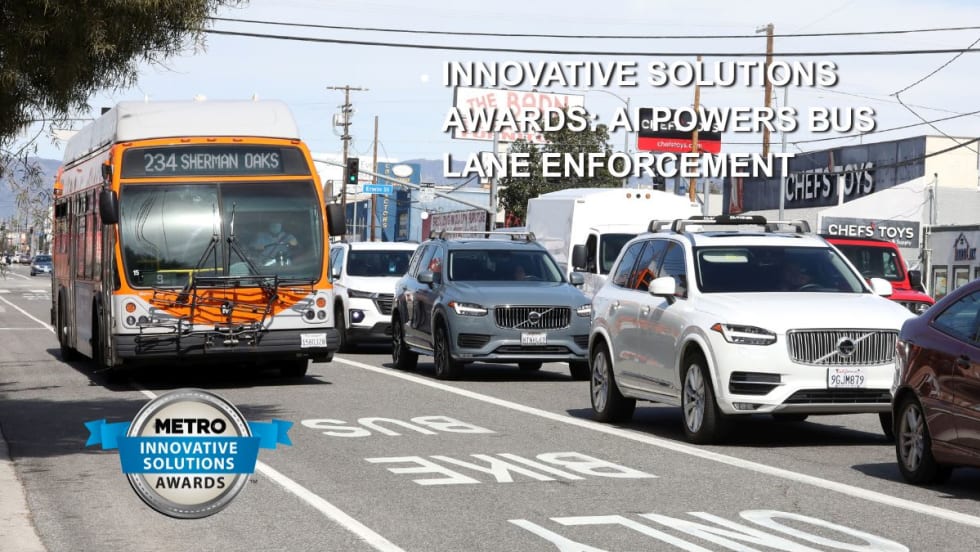
LA Metro, City of West Hollywood, and Partners Advance Smarter Bus Lane Enforcement
The award-winning partnership combines AI-powered detection with human oversight to improve bus reliability, accessibility, and enforcement efficiency.
Read More →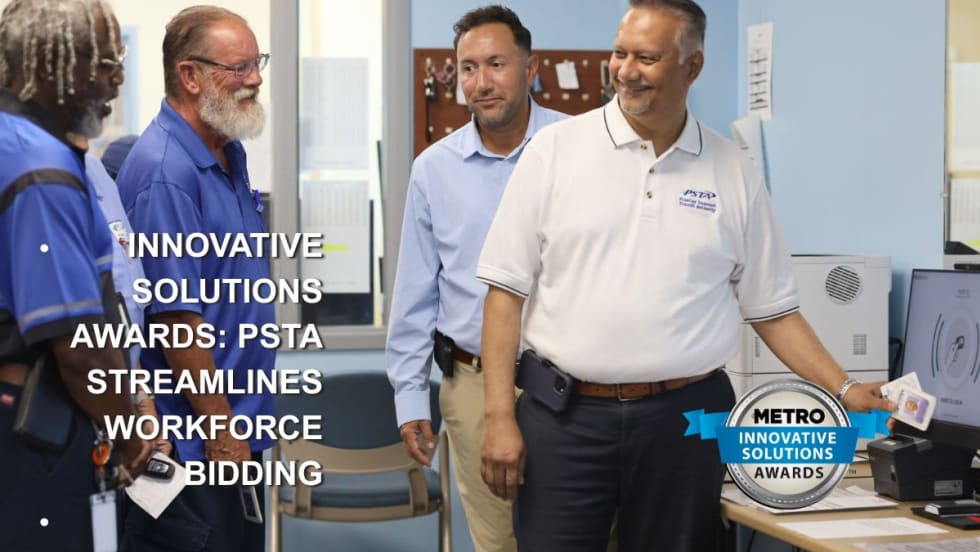
PSTA Modernizes Workforce Management with Digital Bidding System
The award-winning Workforce Transit Modernization project replaced paper bidding with a transparent digital platform, cutting administrative effort while improving access for operators.
Read More →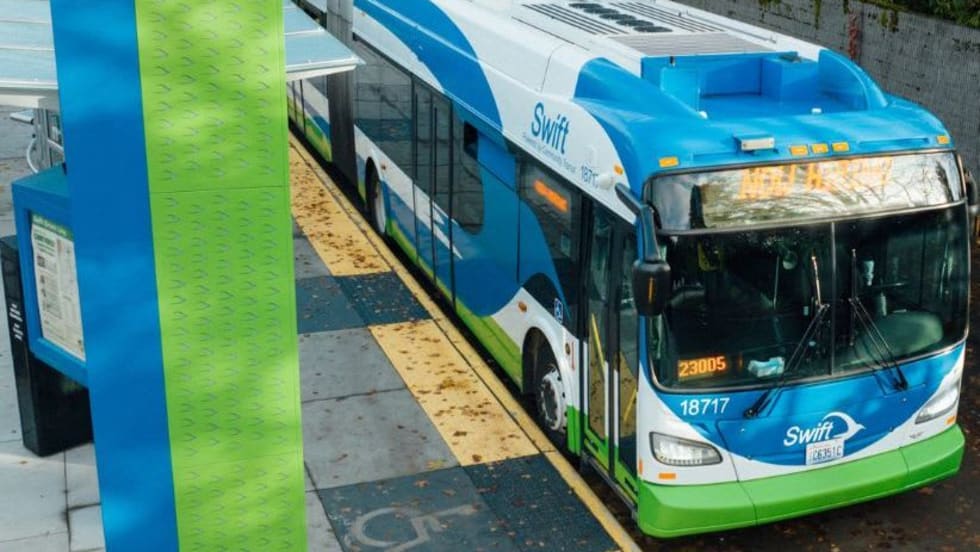
Washington's Community Transit Sets Six-Year Roadmap for Growth, Expansion
Approved TDP targets more bus service, new mobility options, Swift BRT expansion, and a potential Everett Transit annexation.
Read More →
DART Customer Satisfaction Reaches Six-Year High
Overall satisfaction rose to 74.9%, while the agency’s Net Promoter Score reached a record 33.7.
Read More →
How DART's GoPass Is Redefining Regional Mobility
Serving 14 transit agencies, GoPass simplifies multimodal travel by allowing riders to plan, pay for, and manage an entire trip through one app.
Read More →
Biz Briefs: OCTA Taps Clean Energy for Hydrogen Station, Stadler to Supply Via Rail Vehicles, and More
From manufacturers and suppliers to transit agencies and motorcoach operators, these updates offer a snapshot of the projects, partnerships and business moves driving the industry forward.
Read More →
METRO Magazine Announces 2026 Innovative Solutions Awards Winners
Projects Recognized for Advancing Mobility Through Technology, Accessibility, Workforce Innovation, and Operational Excellence
Read More →
Biz Briefs: STV teams with Amtrak, Motorcoach Operators Boost Fleet and Land Contracts, and More
From manufacturers and suppliers to transit agencies and motorcoach operators, these updates offer a snapshot of the projects, partnerships and business moves driving the industry forward.
Read More →
LA Metro Marks Banner Year, Sets Ambitious Goals for New Fiscal Year
Incoming LA Metro Board Chair and Los Angeles Mayor Karen Bass joined outgoing Board Chair Fernando Dutra and LA Metro CEO Stephanie Wiggins to review accomplishments from fiscal year 2026, which included the opening of new rail extensions, advancement of major transit projects, expanded safety programs, and new rider amenities.
Read More →