



Transit Flooring Stands Up to Foot Traffic
Durability is an important feature to consider when purchasing flooring products as it can help drastically reduce maintenance costs.
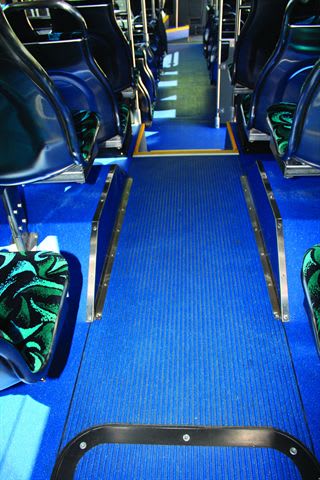
R.C.A. Rubber's flooring is a combination of natural rubber and SBR, an abrasion-resistant synthetic rubber copolymer.
[IMAGE]MET1flooring-Altrotransflor-2-2.jpg[/IMAGE]With so many elements to consider when designing a transit system, bus and railcar flooring products may seem like an afterthought. Subject to almost nonstop foot traffic, environmental degradation and harmful chemicals agents, why should it matter what you put under your passengers' feet?
But, these factors are precisely why your choice of flooring does matter. Transit flooring must be able to withstand the demands of strenuous everyday use without breaking down. A good transit flooring product will require minimal maintenance but provide maximum strength. It will keep your passengers safe by being fire, chemical and slip resistant — and it will safely guide them up stairs or to designated wheelchair, scooter and mobility device areas.
In addition, a great transit floor will give you all this in a stylish package with high visual impact and an acceptable price tag. METRO spoke with four flooring companies to determine what options are available when it comes to functional, attractive transit flooring.
Durability factor
You'd be hard pressed to find flooring that takes more abuse than the vinyl, laminate and rubber under the feet of travelers in a bus or railcar. Millions of commuters track dirt and grime onto public transportation vehicles every day and, slowly, the heavy traffic will wear away the surfaces underfoot.
"If you're in the maintenance end of the [transportation] business, you want to not have to worry about replacing flooring or repairing flooring as the years go by," says Don E. Bullock, sales manager of transit products at R.C.A. Rubber Co. "You want to put the floor down and forget about it."
R.C.A.'s transit flooring products are made from a combination of natural rubber and Styrene-Butadiene rubber (SBR), a synthetic rubber copolymer that is abrasion resistant. Bullock says that the company's Transit-Flor PGF is a great option for heavy traffic areas, as its homogeneous design allows for even wear from top to bottom.
"You can wear it basically down to the subfloor, if you so desired, and you'd have the same appearance as far as color," he explains.
Durability is one of the most important requirements of transit flooring. Each of the representatives from the companies featured named durability in their list of things for transit authorities to consider before selecting a flooring material. More durable flooring products can help drastically reduce maintenance costs.
Besides purchasing top-to-bottom wear products, transit authorities can also invest in durability by purchasing flooring that tolerates temperature fluctuations and resists chemicals. Koroseal Transit Products are resistant to ultraviolet light and ozone, — to prevent color fade — and Altro Transflor makes vinyl transit flooring products that can withstand bacteria and temperature fluctuation, as well as indentations from heavy use.
Koroseal's One Piece flooring allows installers "to eliminate the metal trim normally associated with flooring installation and provide a seal to keep moisture away from the plywood subfloor," says Jack Woodyard, GM at Koroseal. Keeping the subfloor dry will prevent damage and extend the life of the flooring.
Meanwhile, Altro's Original Easyclean Technology allows for quick cleanup without compromising durability, contributing to the ease of overall transit maintenance.
"[Transit authorities] should look for a one piece floor system with heat welded seams that promotes hygiene," suggests Transit Manager of the Americas at Altro Transflor, Dan Lee.
Similarly, the natural rubber flooring solutions produced by nora systems Inc. do not require waxing or polishing — instead, the company promotes sustainable maintenance practices like their nora pro clean system. The system uses only water, eliminating the use of harsh chemicals and detergents, and ultimately reducing cleaning supply costs.
[PAGEBREAK][IMAGE]MET1flooring-RCARubber-2.jpg[/IMAGE]Safety First
Unless transit flooring is safe under changing conditions like weather and foot traffic, its durability and ease of maintenance won't matter. This is why manufacturers must concentrate their efforts on providing flooring that will keep passengers comfortable and safe.
Altro Transflor has been focused on safety flooring for 90 years. It produced a non-slip floor tile containing aluminum trioxide grains before inventing slip resistant vinyl flooring in 1954.
The company's Tungsten flooring for railway, tramway, light rail and metro applications is fire resistant, hygienic and slip resistant — even in wet conditions. Under U.K. Slip Resistance Guidelines, which rates flooring based on pendulum test value (PTV), Altro Transflor's flooring is rated greater than or equal to 36 - or "low slip potential."
Similarly, R.C.A. Rubber's latest transit product, Transit-Flor LGF, is safer as well as lighter than previous products.
"[Transit-Flor LGF has] a better coefficient of friction," explains Bullock. This means passengers are less likely to slip on its surface. "It's actually a more durable product; a longer-wearing product because of the higher content of natural rubber."
R.C.A. Rubber's transit flooring is also dimensionally stable, meaning it does not expand or contract under varying weather conditions.
"In a vinyl construction where vinyl is more susceptible to the changes in temperature, the expansion and contraction of that product can cause problems with seam integrity," adds Bullock. Damaged seams can be dangerous to passengers who might trip and fall due to irregularities in the floor surface.
To combat slippage, Koroseal offers flooring and step treads in a number of different surface textures, each with a high coefficient of friction.
"Our nonmetallic Pebble Tread represent a new product innovation for us," explains Woodyard. "They are routinely praised in the marketplace for dramatically reducing passenger and driver slip-and-fall events, while their bonded construction provides for long life without the corrosion normally associated with the step well."
Flooring can also be customized to include safety-related visuals. Inlays can allow transit authorities to define passenger walkways, add way-finding graphics, and highlight the edges of stairs or other risers.
Nora provides its clients with the option to incorporate custom floor inlays for safety or aesthetic purposes.
"Some things that are becoming more important are inlays and luminescence," says Tom Hume, market segment manager for nora's industry and transportation segments in North America. "This includes wheelchair inlays; we can mark our flooring for wheelchair or bicycle luminescence strips."
Colorful inlays can also cultivate a more agreeable and visually interesting environment for rail and bus passengers.
[PAGEBREAK][IMAGE]MET1flooring-Koroseal-3-2.jpg[/IMAGE]Aesthetically Pleasing
Even if your bus or railcar is safe and durable, it can still be lacking visually. Transit equipment can be used to promote community identity and increase ridership through logos, colors, decals and slogans; flooring is no exception.
"I know a lot of people are putting more money into aesthetics — more visual enhancement of the interior of the vehicles," Lee points out. "We are kind of getting away from the old style interiors and looking for more modern, state-of-the-art products and finishes."
Manufacturers are looking to fabricate products that better appeal to their clients' design preferences. Altro Transflor recently introduced a windmill pattern for use with its Meta and Chroma flooring ranges. The minimalist design allows for the incorporation of a coordinating color into the flooring in a windmill shape.
In January 2011, Altro Transflor will be unveiling Timbersafe II, a bus flooring that looks like typical hardwood floor. It will be available in oak, cherry and walnut finishes. Lee says that it is already extremely popular among clients.
Stylized flooring can help transit authorities achieve a variety of looks with their equipment. R.C.A. Rubber makes its Transit-Flor PGF available in an array of colors and finishes. Clients can choose marbleized, granite and terrazzo style floors. The company's new LGF flooring product is also available in a wide selection of colors and finishes.
According to Hume, however, standard color selection is not nearly as important as custom options to the typical transit authority.
"Transit is rather unique in that it's very rare for a transit authority or railway to use a standard product," explains Hume. "They'll use standard compounds but then they will make up their own design or match, of course, the interior seat colors and other accents.
"I would say one of the sole exceptions is Amtrak — we've been using our standard design for a good part of 20 years with them," he continues. "But, the individual transit authorities will have their own design ideas."
[PAGEBREAK][IMAGE]MET1flooring-nora-samples-2.jpg[/IMAGE]Cutting Costs
Investing in functional, safe and attractive transit flooring can be surprisingly affordable, thanks to cost-saving measures manufacturers are taking.
"Of course, the [transit] car builders are always looking to reduce costs," says Hume. "Because of that, we started working with a particular subfloor provider to provide the builder with a total flooring system. That way, the builder doesn't have to install the floor at their facility any more.
"In the future, a builder can order a floor from a subfloor provider and they will provide the whole floor system with our product already installed," he explains.
With easily customized solutions like Koroseal's step trends, which can be quickly manufactured in any size or configuration, transit authorities have no need to spend extra to fit or refurbish awkward spaces.
Reducing shipping costs can also go a long way in cutting the expense of installing transit flooring solutions. R.C.A. Rubber formulated its Transit-Flor LGF to better serve customers through a sizable weight reduction.
"Transit-Flor LGF has a higher content of natural rubber, which is a lighter material than what it has replaced," Bullock clarifies. "It gives us a 40-plus percent reduction in weight for a kit or a set of bus flooring. It's going to reduce shipping costs for the OEMs throughout the U.S. and Canada."
Bullock says that the decreased weight will also provide financial benefits to the end user.
With the reduced weight, "you're pretty much taking a body off that bus," he continues. "I know it doesn't sound like a lot — but especially with the low-floor buses, weight becomes a larger issue as time goes by. Also, the cost of fuel has made weight a critical issue."
R.C.A. Rubber also saves money by producing everything locally.
"We're trying to make this a win-win situation for us as a company and for the OEM and end user."
More Bus

People Movement: Dan Dipert Coaches Adds Third-Generation Leader, Keolis Names New Valley Metro VP/GM, and More
In this edition, we also cover recent appointments and announcements at the Wabtec, SilverRide, HNTB, and more, showcasing the individuals helping to shape the future of transportation.
Read More →
New York MTA Plans Largest Bus Fleet Upgrade in More Than a Decade
The agency is seeking manufacturers for 650 new CNG buses to replace aging vehicles, improve reliability, and advance its broader fleet modernization strategy.
Read More →
Building a Flexible Path to Transit Electrification
John Hroncich discusses BAE Systems’ modular and scalable approach, lessons learned from decades of real-world operations, and how agencies can identify electrification strategies that fit their fleets.
Read More →
Bus Tech Talk: Keeping Transit Technicians Ahead of the Technology Curve
LA Metro’s Obed Mejia discusses technician training, evolving maintenance technology, fleet replacement, and strategies for getting the most out of today’s transit fleets.
Read More →
Biz Briefs: RIPTA Unveils New Frontrunners, Clevland RTA Adds New Siemens, and More
In METRO's latest installment, we take a look at recent news from Siemens, Prevost, Dodge, and more partnerships making headlines across the transportation sector.
Read More →
People Movement: Holly Arnold Joins Transdev and More
In this edition, we also cover recent appointments and announcements at Pace, CamTran, MCI, and more, showcasing the individuals helping to shape the future of transportation.
Read More →
The High Cost of Transit Buses: Industry Leaders Look to Procurement Reform
Transit leaders and policymakers examine how standardized bus designs, streamlined procurement, and predictable funding could help agencies stretch budgets and deliver better service.
Read More →
The Business Voice Behind Public Transportation
As chair of APTA’s Business Members Board of Governors, Ray Melleady explains how more than 850 business members are partnering with transit agencies to advance funding, innovation, and industry-wide collaboration.
Read More →
From Surviving to Thriving: Building Stronger Transportation Organizations
Bus Business Consultants founder Brian Dickson shares lessons on leadership, organizational health, and creating options for long-term success in a changing transportation industry.
Read More →
Finding the ‘Happy Medium’: Optimizing Maintenance Without Sacrificing Reliability
The key to maintenance optimization isn’t doing less work—it’s doing the right work at the right time on the right assets.
Read More →