



Transit Taps Resources to Enhance Emergency Response Role
The development and execution of a comprehensive transit emergency response plan can be optimized by training all levels of personnel, participating in practice exercises, and pursuing local and federal resources.
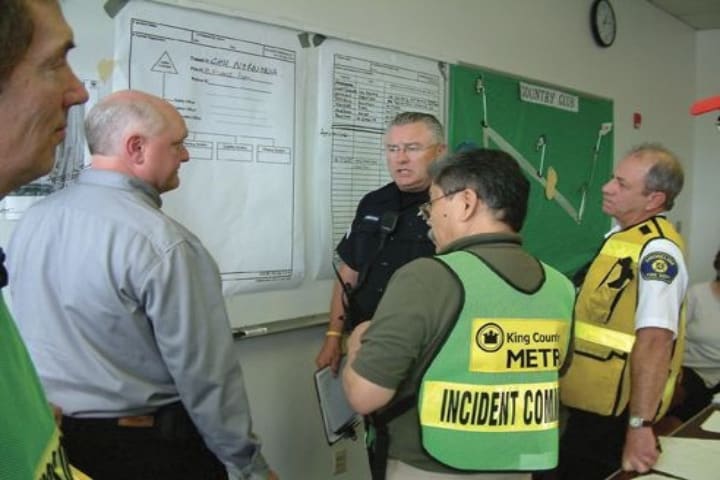
[IMAGE]MET6response.jpg[/IMAGE]Because of the sheer volume of people riding transit each day, transportation systems are vulnerable in emergency situations. And according to the Federal Transit Administration's (FTA) Security and Emergency Preparedness Planning Guide, transit systems are inherently "open" environments, and therefore, difficult to protect. Whether it's a hurricane, terrorist attack or vehicle collision that occurs, transit systems need to have extensive emergency response plans in place to prevent loss of life.
"We're responsible for a lot of people every day, and I wanted to make sure that everybody, including our employees, is safe," says Jeanne Krieg, CEO Tri Delta Transit in Antioch, Calif.
Perhaps the most pressing threat since 2001 is that of terrorism. As federal agencies have continued to emphasize, transit systems are potential targets for terrorist attacks. The most deadly attacks on transit systems to occur in recent years were the March 11, 2004, bombing of multiple trains in Madrid that left 191 people dead and 1,500 injured, and the July 7, 2005 attacks on trains and buses in London, which killed 35 and injured 1,000.
With this level of danger as a possibility, transit agencies have used guidelines and directives from the federal government as well as resources from state and local agencies to compile emergency response plans and execute disaster drills.
Drafting the plan
Krieg began her career at Tri Delta Transit in 1991. When she became general manager four years later, she felt it was important to implement a comprehensive emergency response plan. Director of Administrative Services Ann Hutcheson was assigned to be the point person for the project and worked with Krieg to pull together resources and information.
Hutcheson referred to FTA and the American Public Transportation Association (APTA) for guidelines in developing the plan, as well as the Oregon Department of Transportation and other transit agencies in the area. Tri Delta Transit also consulted with agencies within Antioch, attending quarterly meetings held at the emergency operations center run by the police department. "That's how I met people and gathered information," she says. "The Red Cross people were there, the county OES (Office of Emergency Services) people were there."
In addition, the city's Office of Emergency Services, in partnership with a contractor hired by the FTA Office of Security, provided a threat assessment at no charge that identified vulnerabilities to the transit system. Those vulnerabilities were then addressed in the development of the emergency response plan.
The end result was the compilation of Tri Delta Transit's Security and Emergency Preparedness Program (SEPP). FTA regulations require all rail transit systems to have such plans in place, and the agency provides resources through its Safety and Security Webpage at http://transit-safety.volpe.dot.gov/default.asp.
Hutcheson says the biggest challenge in putting the plan together was taking on such a comprehensive project while trying to take care of her regular job duties at the same time. "From a small operator's perspective, it is kind of a lot of work because the bigger guys have one staff person that does just this. And of course, they have all these other things that we just don't have, like tunnels. So it does take some time - you can't just cookie-cutter it. You have to go through the information and find what would apply to you," she explains.
The Tri Delta Transit plan outlines the responsibilities of various leaders and officers within the agency, as well as information for all personnel. It also addresses bomb threat response, biological and chemical agents, use of a transit vehicle as a weapon, network failure and cyber attacks, weapons of mass destruction, violent incidents and hostage situations, how to identify suspicious activity, loss of power, and emergency closing and evacuations.
On the other end of the spectrum, King County Metro Transit, headquartered in Seattle, is one of the largest transit systems in the country, with a dedicated emergency program staff position. Homeland Security Program Manager Mike DeCapua has an extensive background in law enforcement, including service as a chief of police, SWAT team commander and member of the Department of Homeland Security's Target Capability List Working Group.
DeCapua's goal in creating King County Metro's emergency plan was to improve upon federal requirements and create an all-hazards response plan. "The plan deals at the tactical level and demonstrates how our incident command system within Metro meshes with public safety incident command, and also describes what each of our responding sections would do at 15 different types of emergencies," he says. In 2008, the Transportation Security Administration recognized the agency's plan and corresponding training and exercise program as an industry best practice.
DeCapua is also the founding associate of Public Safety Consultants Northwest LLC, and oversees the company's Homeland Security training and consulting programs.
[PAGEBREAK]
Putting plan into practice
After the emergency response plan has been drafted, reviewed and published, transit officials distribute copies to key staff and train personnel according to the plan's guidelines. It is also crucial to perform or participate in disaster drills to ensure that the plan works.
At King County Metro, DeCapua says that the all-hazards response plan was vetted by members of the local public safety community and they helped design, construct and execute various emergency exercises. As part of the agency's training and exercises program, tabletop exercises are performed quarterly at the seven bus bases, and full-scale exercises are performed at least annually, in partnership with law enforcement agencies in the 39 cities the system serves. "We've run a number of tabletop exercises, functional exercises and full-scale exercises using transit security grant program monies," he says. "I will tell you this: we could not have done this program from a planning, training and exercise standpoint without the transit security grant program."
The Federal Emergency Management Agency's (FEMA) transit security grant program (TGSP) will provide $348.6 million in funding in the 2009 fiscal year for urban bus, ferry and rail systems. Eligibility is determined by FEMA based on risk analysis and the Urban Areas Security Initiative.
Application kits, reporting templates and other application materials were made available on the FEMA Website at www.fema.gov/government/grant/tsgp/index.shtm. Applicants for the 2010 fiscal year should check the Website for updates.
Tri Delta Transit works with the local police agencies and performs SWAT drills every year, Krieg reports. "They do emergency rescues out of our vehicles. They learn how to do emergency shut-off on the vehicles and how to get in and out of the different exits, and so on," she explains. The agency also participates in regional earthquake drills along with other Bay Area transit agencies.
All Tri Delta employees receive a copy of the complete SEPP. The agency also provides annual training on safety and security topics as well as periodic in-services as needed. "For example, there was a rash of bomb threats locally, so we went over again what you do if you receive one," Krieg says.
King County Metro provides emergency training in its initial operator course, including an orientation on incident command and homeland security issues. DeCapua says a similar block of instruction is included in the agency's refresher training course. "We've also conducted our own incident command training for over 250 of our first-line supervisors, who would be in a potential incident commander role," he says.
The development of an emergency response plan is an ongoing process that doesn't end with the initial draft. "Every year I meet with Jeanne and the rest of the managers," Hutcheson says. "They know ahead of time that the meeting's coming and to bring any updates or changes that they have. Or if FTA sent out particular changes or updates, we include those too."
In addition, any lessons learned after participating in a disaster drill should be incorporated into the plan. "After each training and exercise, we do an after-action report with all the stakeholders," DeCapua says. "We look at our plans and our checklists and make any modifications that we feel are necessary, and then publish those. Then, on an annual basis, we review the whole program."
Notify the public
Besides making emergency procedures known to transit staff, it is also critical to communicate them to transit passengers. The Pittsburgh-based Port Authority of Allegheny County provides a brochure to bus and light rail passengers that lists basic safety rules and details vehicle safety features, as well as what to do in various emergency situations.
Boston's Massachusetts Bay Transportation Authority (MBTA) has partnered with the Boston chapter of the American Red Cross to educate the public about emergency preparedness via 300 cards posted in MBTA vehicles. The public awareness campaign focuses on general disaster preparedness, but transit systems stand to benefit from partnering with agencies like the Red Cross in order to promote transit safety.
Resources
The National Transportation Safety Board (NTSB) offers courses in accident investigation and related topics for the aviation, highway, marine and rail sectors. In 2009, NTSB is offering five sessions on transportation disaster assistance. One of the courses is geared toward transit professionals and emergency responders in the event of a transportation disaster. The Family Assistance course (TDA301) is scheduled for October and teaches transportation officials how to work with victims and their families.
"We actually have them practice doing briefings to get a flavor of how difficult that is," says Erik Grosof, assistant to the director for operations at the NTSB's Office of Transportation Disaster Assistance.
Attendees also learn about the legal aspects of family assistance. "For aviation and rail accidents, lawyers can't solicit family members for 45 days following the accident, but family members can certainly call a lawyer immediately if they want," Grosof says. The course includes a panel discussion with family members of accident victims who tell their stories for attendees. "That's very helpful because it puts it in perspective to hear it from a family member - what they need and what they don't need [from transit officials]," he explains.
Courses also instruct on how to take care of yourself if you are a responder to a disaster scene, how and why site visits are done, victim identification and jurisdiction issues. "We teach people there's no such thing as closure," Grosof says. "A lot of the skills here can also be used during man-made disasters or terrorist attacks. There are certainly differences if it's a crime - other agencies are involved - but the same basic premises are used."
For more information, visit http://ntsb.gov/Academy/sched_courses.htm to view the course schedule - click on course names for details on attending each session.
APTA maintains an online Safety Management Resource Center at http://apta.com/services/safety/. In addition to listing events, checklists, government resources and other tools and programs, the Webpage links to the Emergency Response and Preparedness Program (ERPP), a joint program developed by APTA and the U.S. Department of Transportation.
ERPP works as an online database in which transit systems log in to volunteer their personnel, equipment or vehicles to others in the event of an emergency situation, such as a natural disaster. They can also request resources as part of their emergency preparedness planning or in the wake of an unexpected emergency. To learn more, visit www.aptaerpp.com/.
[PAGEBREAK]
BART responders perform regular drills
Emergency drills for the San Francisco Bay Area Rapid Transit (BART) system are planned by the System Safety Department and focus on such scenarios as a derailing or hazardous material spill. The drills are held during non-revenue hours - usually on Sunday mornings before 8 a.m.
Local agencies, including the fire and transportation departments, are involved, as is BART's own police force. Chief of Police Gary Gee says the Police Department's role in such drills includes providing perimeter security, search and rescue, and conducting a police investigation when a criminal act is suspected.
The BART Police Department is comprised of 296 personnel, of which 206 are sworn peace officers. To prepare for major emergencies, critical incidents and tactical responses, the department is a signatory to the Bay Area's mutual-aid pacts and has teams of officers trained for tactical response and crisis negotiations.
Most officers are assigned to the Patrol Bureau and become eligible for specialized assignments, which include canine handler, SWAT (Special Weapons and Tactics) operator, detective, bicycle patrol, crime analyst, FBI Joint Terrorism Task Force investigator, and undercover anti-vandalism and special-enforcement teams.
The department's 20-member SWAT Team trains once a month, often with SWAT teams from area law-enforcement agencies.
In order to better prepare against the threat of terrorism, the department hosts drills for the region's first-responders and participates in local, state and federal counterterrorism working groups. An officer is assigned full-time to the FBI Joint Terrorism Task Force and a command officer is designated as the department's mutual-aid, counter-terrorism and homeland-security liaison. In addition, all of BART PD's canines are trained and certified to detect explosives.
More Bus

New York MTA Plans Largest Bus Fleet Upgrade in More Than a Decade
The agency is seeking manufacturers for 650 new CNG buses to replace aging vehicles, improve reliability, and advance its broader fleet modernization strategy.
Read More →
Building a Flexible Path to Transit Electrification
John Hroncich discusses BAE Systems’ modular and scalable approach, lessons learned from decades of real-world operations, and how agencies can identify electrification strategies that fit their fleets.
Read More →
Bus Tech Talk: Keeping Transit Technicians Ahead of the Technology Curve
LA Metro’s Obed Mejia discusses technician training, evolving maintenance technology, fleet replacement, and strategies for getting the most out of today’s transit fleets.
Read More →
Biz Briefs: RIPTA Unveils New Frontrunners, Clevland RTA Adds New Siemens, and More
In METRO's latest installment, we take a look at recent news from Siemens, Prevost, Dodge, and more partnerships making headlines across the transportation sector.
Read More →
People Movement: Holly Arnold Joins Transdev and More
In this edition, we also cover recent appointments and announcements at Pace, CamTran, MCI, and more, showcasing the individuals helping to shape the future of transportation.
Read More →
The High Cost of Transit Buses: Industry Leaders Look to Procurement Reform
Transit leaders and policymakers examine how standardized bus designs, streamlined procurement, and predictable funding could help agencies stretch budgets and deliver better service.
Read More →
The Business Voice Behind Public Transportation
As chair of APTA’s Business Members Board of Governors, Ray Melleady explains how more than 850 business members are partnering with transit agencies to advance funding, innovation, and industry-wide collaboration.
Read More →
From Surviving to Thriving: Building Stronger Transportation Organizations
Bus Business Consultants founder Brian Dickson shares lessons on leadership, organizational health, and creating options for long-term success in a changing transportation industry.
Read More →
Finding the ‘Happy Medium’: Optimizing Maintenance Without Sacrificing Reliability
The key to maintenance optimization isn’t doing less work—it’s doing the right work at the right time on the right assets.
Read More →
LA Metro, City of West Hollywood, and Partners Advance Smarter Bus Lane Enforcement
The award-winning partnership combines AI-powered detection with human oversight to improve bus reliability, accessibility, and enforcement efficiency.
Read More →