



Related: San Diego MTS offers free video-on-demand services on trolleys
University Branding Agreements Boost Funding for Transit Agencies in San Diego, Denver
For transit agencies in San Diego and Denver seeking additional funding, recently completed naming rights agreements with local universities promise a consistent source of income.
by Adam Pringle
October 5, 2015
Denver RTD
3 min to read
Denver RTD
For transit agencies in San Diego and Denver seeking additional funding, recently completed naming rights agreements with local universities promise a consistent source of income.
The San Diego Metropolitan Transit System (MTS) agreed to a 30-year naming rights agreement with UC San Diego Health, while Denver’s Regional Transportation District (RTD) finalized a branding agreement with the University of Colorado.
Along with potentially serving as additional revenue streams for the transit agencies, these agreements also promise extra visibility opportunities for the universities involved.
Under MTS’ agreement with UC San Diego Health, the agency’s Blue Line trolley system will be renamed the UC San Diego Blue Line. MTS is currently working with the San Diego Association of Governments, the California Department of Transportation, elected officials, and other stakeholders to develop and complete an 11-mile Blue Line extension from Old Town to University Town Center by 2021.
UC San Diego Health will also receive naming rights to an existing Blue Line station at Old Town, along with planned stations at the UC San Diego main campus and at the health campus in La Jolla — including UC San Diego Jacobs Medical Center, which is scheduled to open in 2016.
Over a 30-year period, MTS will receive an annual fee that starts at $675,000, with subsequent increases based on completion of the Blue Line expansion project and the local consumer price index.
“Clearly, it gives us a sustainable piece of revenue — it’s non-fare revenue, and not impacted by state decisions. In the past, the state of California has reduced funding for transit, but this portion of money is immune to that,” said Rob Schupp, director, marketing and communications, for MTS.
The agreement also promises additional exposure opportunities for UC San Diego Health, which is particularly crucial in the competitive hospital industry, according to Schupp.
“Not only do they get the Blue Line named for them, but they’re also going to get trolley wraps, and they have the opportunity to do events at our stations to promote their health systems,” Schupp said. “It’s a good kind of advertising buy for them — we’re creating lots of impressions at a very competitive price.”
MTS and UC San Diego have worked together to promote public transit use since 1969.
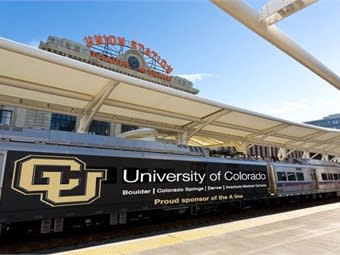
RTD’s agreement with the four-campus University of Colorado system covers the A Line commuter rail from Union Station to Denver International Airport, which is the first of five new transit lines RTD plans to launch in 2016.
In addition, the branding and naming rights agreement includes advertisements on the Flatiron Flyer bus rapid transit line that runs from Union Station to Boulder, along with exterior ads on the rail and bus vehicles, and the use of the University of Colorado’s name and logo on RTD digital and print materials related to the A Line.
RTD will receive $5 million under the five-year deal, with a provision for a five-year extension upon agreement of both parties.
According to Scott Reed, assistant GM, communications, for RTD, the agreement benefits the agency from a financial and community image standpoint while providing additional brand visibility for the university.
“It gives the university an extremely visible presence from Denver International Airport, for travelers and businesses from all over the world. Plus, the line will be identified as the ‘University of Colorado A Line’ in all of our maps and online information,” Reed said.
Ultimately, Reed believes that RTD’s agreement with the university will lead to more interest from businesses and institutions.
“A lot of times, people are hesitant to be the first to participate in a naming rights program, and, since the University of Colorado has jumped in with both feet in a big way, we think that this will get a little bit of competition going because there are a limited number of highly visible opportunities within our system,” Reed said.
Subscribe to Our Newsletter
More Management

METRO Opens Submissions for 2026 Motorcoach Awards
Nominations are now being accepted for METRO Magazine’s Operator of the Year and Innovative Operator of the Year awards.
Read More →
New York MTA Advances Final Contract for Second Avenue Subway Expansion
Contract Four is the largest in the Second Avenue Subway Phase 2 project and includes construction of station infrastructure, tracks, and signals for the subway expansion, MTA officials said. Work on Contract Four will begin in 2027.
Read More →
Transit Agencies Highlight Safety Gains at National Summit
Leaders from 15 major transit systems shared crime-reduction results and safety initiatives while discussing the role of continued federal support.
Read More →

NITA Names New Leadership, Expands Reduced-Fare Program at First Board Meeting
The new regional transit authority appointed its first board chair and interim executive director while extending reduced fares across CTA, Metra, and Pace for eligible riders.
Read More →
Beyond the Checklist: A Structured Approach to Transit Maintenance
Reliability-Centered Maintenance helps transit agencies move beyond routine checklists to focus limited resources on the assets and failures that have the greatest impact on safety, reliability, and service.
Read More →
APTA 2026 Nominating Committee Selects Leadership Slate, Names Chair and Vice Chair Nominees
Leadership changes will help shape the association’s priorities and its representation of the transportation industry during the 2026–2027 term.
Read More →
DART Launches Major Security, Fare Enforcement Initiative
The 90-day demonstration will deploy coordinated security teams at five light rail stations while testing controlled access and gathering data to guide future investments.
Read More →
Sponsored•September 9, 2026
Advancing Fare Collection Through Technology and Innovation
Learn about delivering 1300 gates at 91 stations while managing fare evasion. Explore the large scale deployment, solution customization and real-world results that affect the region. Prepare for deployment in your region now.
Read More →
Game Day in Motion: Moving Millions During the 2026 World Cup
Between packed transit stations and team motorcoaches, see how agencies and operators across North America tackled the transportation demands of the 2026 FIFA World Cup.
Read More →
Surface Transportation Extension Averts Shutdown, Leaves Transit Funding Gap
The stopgap keeps federal transportation programs moving, but missing advance funding could complicate the transit and rail projects agencies are planning next.
Read More →