



Victor Valley Transit Cultivates Services 'Connecting Community to Opportunity'
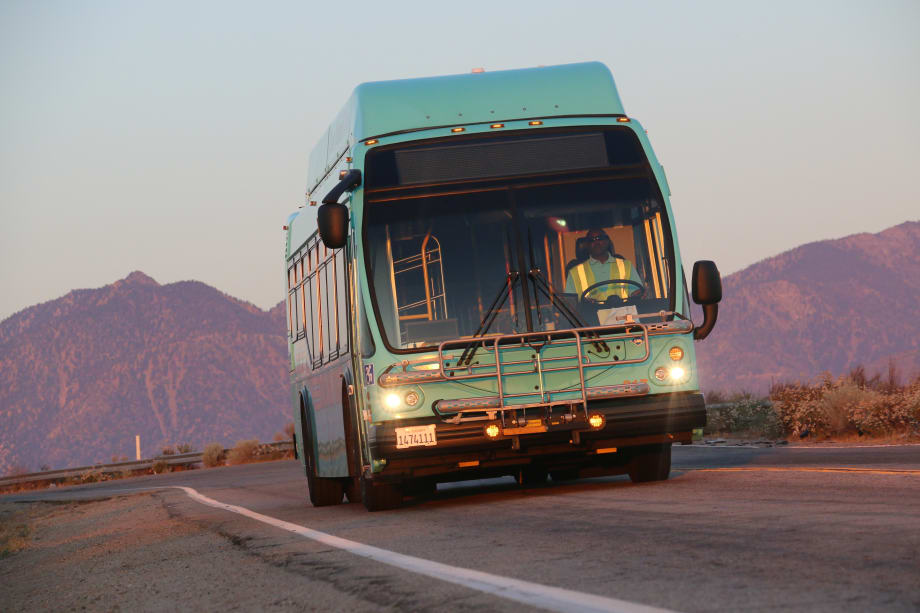
The agency’s Route 15 service linking Barstow to Victorville has gone from being a three-day-a-week “lifeline” providing access to medical services to a six-day-a-week intercity route, which recently began using 40-foot, ENC-branded CNG buses to accommodate demand.
All photos: VVTA/Fidel Gonzales
All photos: VVTA/Fidel Gonzales
Staying true to its mission statement, Victor Valley Transit Authority (VVTA) is working diligently to “connect community to opportunity.” Located in the High Desert of California’s San Bernardino County, the agency and designated Consolidated Transportation Services Agency (CTSA) offers fixed-route, commuter bus, paratransit, intercity and vanpool services to meet the needs of a nearly 1,000-square-mile service area, which includes the cities of Adelanto, Apple Valley, Barstow, Hesperia and Victorville, and unincorporated San Bernardino County.
Providing service to such an expansive region, which is primarily suburban and rural, with a vast majority of its customer base being transit dependent, is challenging, according to VVTA Executive Director Kevin Kane. To that end, VVTA identifies where the greatest needs are for service and develops specialized routes and programs to provide residents vital access to employment and community services.
Lifeline routes
A few years ago, VVTA launched a bus service linking Victorville to the city of Barstow — famously known for being the midway point between Los Angeles and Las Vegas — to provide customers access to medical facilities. “We identified that there were no oncology services in Barstow, so we tried to coordinate with the area medical facilities here in Victorville and Apple Valley to see what days of the week most of their patients came in from Barstow,” Kane explains.
The “lifeline” route, which initially started out running three days a week, has since grown to six days a week, with exponential ridership growth. “Over the first two years, [ridership] grew over 1,000 percent because it grew from a small base,” Kane says. “It was not meant to be a regular route, but now we are calling it Route 15.”
To accommodate the ridership growth on this route, VVTA took delivery of three ENC (ElDorado National) compressed natural gas (CNG) Axess buses (See sidebar pg. 26) in April. “We were using 30-passenger cutaway buses [on the service], so we ended up having people standing in the aisles for the 40-mile trip,” says Ron Zirges, VVTA’s director, maintenance and facilities. “With the Axess, we can seat up to 40 people and we’ve solved our overcrowding.”
Recently, VVTA launched another vital route — the Needles Link — to fill a much-needed service gap accessing the court systems in Barstow and Victorville. Because there are no courts in the city of Needles, residents were making the more-than-350-mile round trip in a personal vehicle, if they had one, borrowed a vehicle to use, or were driven by a friend or family member, according to San Bernardino County Board of Supervisors Vice Chair Robert Lovingood, who requested the route.
“We met with the presiding judge of the San Bernardino County court system and worked out an agreement where they schedule all of their court cases from Needles on Fridays,” Kane says. While the new bus route was created to provide alternate transportation to the courts in Barstow and Victorville, anyone can ride the service, which launched in June. Response from residents to the new service is very positive, Kane adds.
“During our ribbon cutting, several local residents came to us and said this was going to be incredible because it would help them access medical services not available in the area.”
When asked about lessons learned from developing these specialized routes, Kane says, “If you find a need in a very rural community, and you try to meet that need, you start out very small,” he explains. “We started out very small; we didn’t try to overdo anything. And, as the demand grew, we followed the demand.”
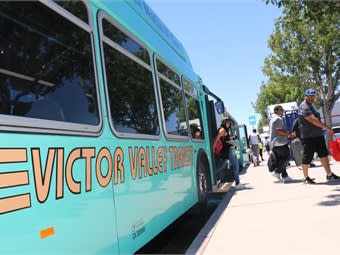
VVTA plans to upgrade all of its bus stop signs to include QR codes, so customers can use their smartphones to scan the code for next-bus info.
Vanpool
Development of VVTA’s vanpool service also was prompted by identifying community needs. The transit agency currently has about 185 vanpools that either begin or end in Victor Valley or Barstow, says Kane. Prior to the vanpools, the agency ran a commuter service into San Bernardino Valley “that wasn’t working very well,” he explains. After discontinuing the service, VVTA conducted a survey and found that commuters needed to make connections in other adjoining counties: Riverside, Los Angeles and Orange. Seeing how ineffective commuter service was for this area, the agency decided that vanpools would be a good alternative. VVTA contracted with two vendors, Enterprise RideShare and vRide, as a turnkey operation to provide vehicles and maintenance. “We subsidize the vanpools for 50 percent, up to $400 dollars a month,” Kane says.
Sustainability goals
In the past five years, the agency has experienced numerous changes and momentous growth, according to Kane. Within that time frame, the agency “went from working out of cramped offices with a gravel lot, one maintenance bay and a Conex container converted to an office” to a new state-of-the-art administrative and maintenance facilities.
In October 2015, the transit agency earned the coveted Leadership in Energy and Environmental Design (LEED) Gold certification from the U.S. Green Building Council for the environmental-friendly design and construction of two separate buildings on its 10-acre facility. Key building features include an underground storm water treatment and retention system. The centerpiece of the 10-acre facility is a one-megawatt photovoltaic solar system, which produces in excess of 100% of the electricity used on the campus, Kane explains. The solar canopies double as shaded parking, reducing air conditioning cooling time during daytime bus start up. This also reduces fleet fuel use and emissions.
In keeping with its sustainability initiatives, VVTA’s vehicle fleet is comprised of 65 compressed natural gas (CNG) commuter and transit buses. And, the agency is moving toward 12 of its 37 cutaway vehicles and 7 out of 21 support vehicles operating on CNG. The agency operates a buffer CNG fuel station with three 300 hp compressors to fuel buses. It also offers a public fuel island to supply CNG to local waste collection companies and other private companies.
BAT merger
In addition to the LEED certification, last fall also brought about another big change — the formalization of VVTA’s merger with Barstow Area Transit. “Two years ago, the City of Barstow came to us and said basically, ‘we don’t want to run [BAT] anymore, do you think you can run it for us,” Kane says.
The merger proved beneficial for both agencies, according to VVTA. BAT revealed a significant operational cost savings and both agencies demonstrated favorable administrative cost savings following the merger.
The year leading up to the merger, VVTA operated BAT through an intergovernmental agreement. During that period, VVTA performed upgrades to the maintenance facility, improved amenities at bus stops and upgraded fare boxes. Transdev, which provides contracted vehicle operation and maintenance for VVTA, is also managing the BAT fleet.
For the immediate future, both VVTA and BAT will maintain their own branding. Some time in the next year, the combined agency will seek to rebrand itself, Kane says. “They are already part of VVTA, we’re just basically operating them as a separate division,” Kane explains, adding that the agency took over operation of BAT’s CNG fueling station and recently bought property in Barstow to build a modest bus facility.
With the merger, VVTA saw the expansion of its service area grow from 425 square miles to almost 1,000 square miles. The challenge has been doing all this with an administrative staff of 17 people, which includes the Barstow services and LCNG station. “A lot of us wear several hats,” says Kane. “Our finance director is also our HR director and our clerk of the board is also basically customer service and my assistant,” he adds.
Future Projects
Looking ahead, Kane says the agency plans to upgrade all of its bus stop signs in the next couple of months to include QR codes. This will allow riders to take a picture of the code with their smartphone and be able to find out when the next buses will come by that particular stop in real time, he adds. Additionally, the agency will extend Wi-Fi coverage to more of its commuter bus fleet serving Fort Irwin’s National Training Center.
More New Mobility

From Hardware to Digital Partner: Luminator Charts Its Next Chapter
CEO Magnus Friberg discusses Luminator’s shift toward becoming a digital partner, the growing importance of software and interoperability, and how AI can help agencies improve operations and passenger experience.
Read More →
Biz Briefs: Alstom Lands Canadian Contract, LYT to Supply California TSP, and More
In METRO's latest installment, we take a look at recent news from Complete Coach Works, Beep, FlixBus, and more partnerships making headlines across the transportation sector.
Read More →
CharterUP’s Armir Harris on Technology, AI, and the Future of Group Mobility
In a recent episode of METROspectives, CharterUP Founder/CEO Armir Harris discussed the company’s evolution from an online charter bus marketplace into a technology platform supporting public- and private-sector mobility and much more.
Read More →
Jacksonville’s NAVI Project Charts a New Course for Autonomous Public Transportation
Through its NAVI program, JTA is showing how autonomous vehicles, intelligent infrastructure, and coordinated operations can work together to deliver everyday public transportation.
Read More →
Biz Briefs: Luminator Marks Milestone and More
From manufacturers and suppliers to transit agencies and motorcoach operators, these updates offer a snapshot of the projects, partnerships and business moves driving the industry forward.
Read More →
New Tricks for Old Bureaucracies: Joshua Schank on Making Transit Innovation Stick
Former LA Metro Chief Innovation Officer Joshua Schank discusses why good ideas aren't enough, how transit agencies can overcome resistance to change, and why today's challenges demand more innovation.
Read More →
How DART's GoPass Is Redefining Regional Mobility
Serving 14 transit agencies, GoPass simplifies multimodal travel by allowing riders to plan, pay for, and manage an entire trip through one app.
Read More →
Biz Briefs: OCTA Taps Clean Energy for Hydrogen Station, Stadler to Supply Via Rail Vehicles, and More
From manufacturers and suppliers to transit agencies and motorcoach operators, these updates offer a snapshot of the projects, partnerships and business moves driving the industry forward.
Read More →CharterUP Expands Into New Mobility and Autonomous Transportation
Vice President of New Mobility Stephen Joos discusses how CharterUP is leveraging its nationwide transportation network, technology platform, and autonomous vehicle partnerships to expand into workforce mobility, campus shuttles, and transit solutions.
Read More →
METRO Magazine Announces 2026 Innovative Solutions Awards Winners
Projects Recognized for Advancing Mobility Through Technology, Accessibility, Workforce Innovation, and Operational Excellence
Read More →