



Village Travel motorcoach co. vaults ahead with rebrand, expansion
Wichita, Kan.-based fleet evolved from offering ski tours to what is now a full-service transportation company.
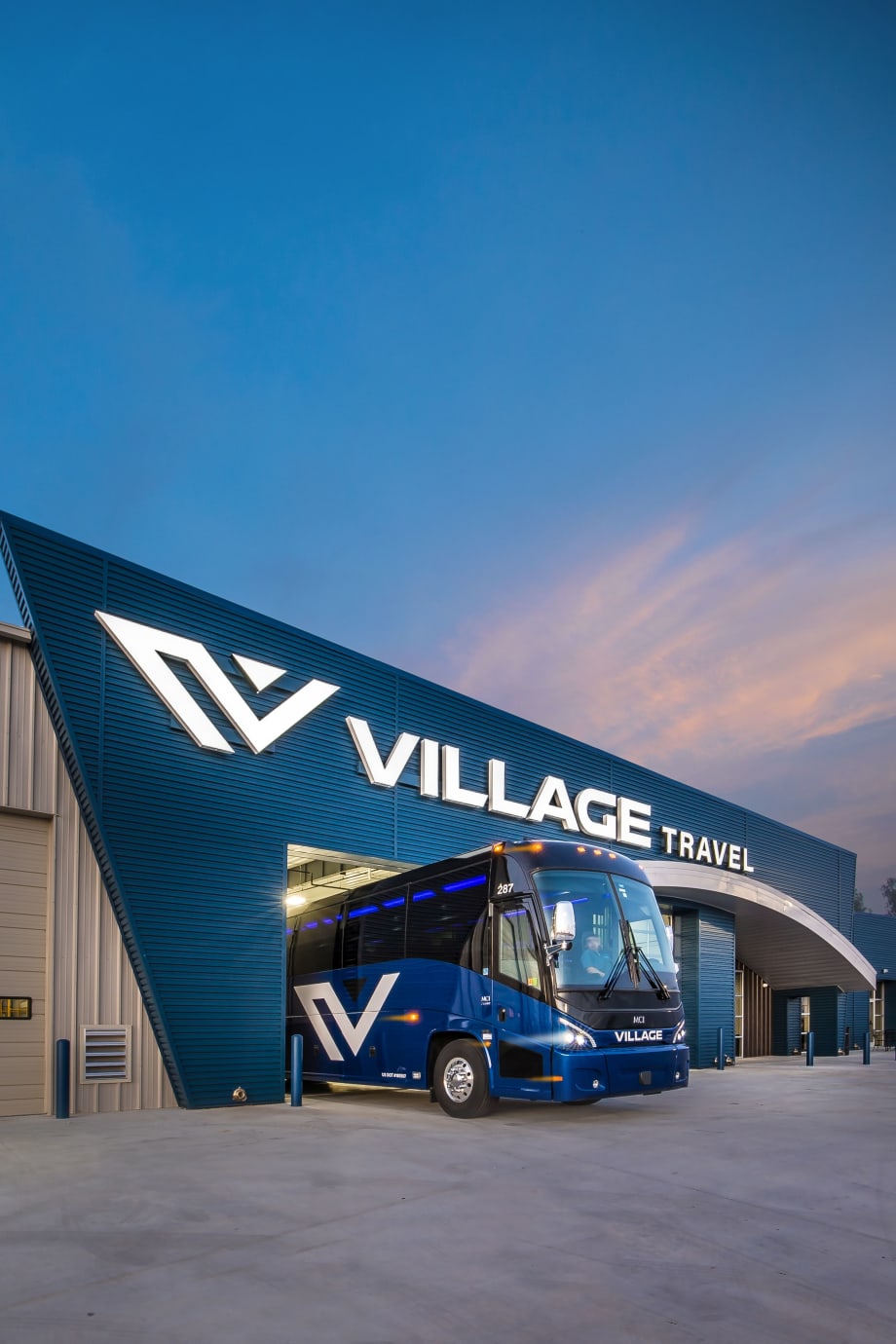
After going through a rebrand, Village Travel is looking forward to celebrating its 40th anniversary in 2020.
Milt Mounts
After going through a rebrand, Village Travel is looking forward to celebrating its 40th anniversary in 2020.
Milt Mounts
Uniquely enough, Wichita, Kan.-based Village Travel didn’t begin as a motorcoach operation, but rather as a ski tour company, scheduling trips for folks who wanted to fly from Kansas to hit the slopes in the Denver region. The business grew so much that soon the original owners bought their first bus to shuttle customers from the airport in Denver to the mountains, with the business evolving again once the ski season was over.
“When the original owners brought that first bus back to Wichita, they started doing charters and day trips out to Kansas City to watch the Royals play,” explains current owner Jeff Arensdorf, who bought the company from its original family owners with his father in 2000. He adds that eventually the company’s plane trips became luxury motorcoach ski trips, with the company adding sleeper seats on late-model equipment.
From there, the company started providing different types of charters and tours, growing at a conservative pace of about one coach a year, explains Arensdorf. By 1999, Village had a fleet of 15 motorcoaches, but the original owners decided to embark on a different business venture.
‘Explore opportunities’
Just a couple of years out of college and working in the corporate world, Arensdorf was looking to start his own business, so he enlisted the help of his father and together they began to explore opportunities.
“My dad had a relationship with the family because he was their fuel and lubricant provider, so he called on them often,” he says. Soon that relationship would lead to a chance meeting at a church breakfast fundraiser and then a more formal meeting to discuss the possibility that the Arensdorfs acquire the business.
In May 2000, the Arensdorfs closed the deal for the operation and began their departure down the road of motorcoach company ownership, “hoping not to break anything” along the way, since the company was already a success, Arensdorf explains.
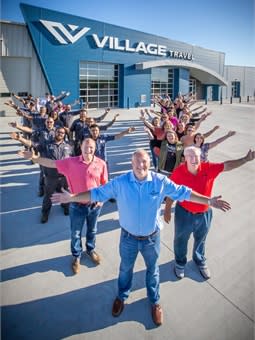
Jeff Aresndorf with employees from Wichita at the operation's new building.
Milt Mounts
Once they negotiated the learning curve, the Arensdorfs continued to grow Village at the same conservative pace as the former owners, adding a bus or two a year, before expanding to Oklahoma City in 2005. In 2011, Village had an opportunity to acquire a business in Salina, Kan., and since then its growth began to snowball.
“Since 2011, we have either expanded our business into another market or made an acquisition every year,” says Arensdorf. “At the end of the day, our rapid growth over the last nine years has led to us being in seven different markets with a fleet of 139 motorcoaches.” Village Travel’s fleet is comprised almost entirely of MCI and Prevost coaches.
Re-establish identity
Heading into his 20th year of ownership, Arensdorf is poised to celebrate the company’s 40th anniversary in 2020. In anticipation of the event, as well as looking at a way to re-establish its identity, Village recently completed a rebrand of its company and fleet.
“The company started out as Alpine Village Tours, but when it bought its first bus, they painted Village Charters on it and the company operated primarily as Village Charters in the public eye for several years,” explains Arensdorf. “Then, they started using Village Tours for all their advertising and by the mid-'90s had some buses running around branded as Village Charters, while some other buses had the Village Tours branding.”
Trying to make some sense of all the names they inherited, Arensdorf explains they eventually decided to focus on Village Tours and Travel as a company, while using the Village Tours logo on its fleet. Soon, Village began to question whether tours was a true representation of the services the company provided. Enter a local marketing and branding company.
“I laid out everything for them — all of our logos and company names in the past — and they eventually came back with Village Travel,” Arensdorf says. “We thought the word travel worked great because it encompassed everything we are doing, which is moving people.”
He adds the move to Village Travel brings a dynamic that gives the company the chance to continue charging ahead.
“I feel like every 20 years or so, it’s a good idea for a company to reinvent itself and get an influx of new ideas coming in to drive growth,” Arensdorf.
In addition to the rebrand, Village Travel just opened a new 47,000-square-foot corporate headquarters in Wichita.
Randy Tobias
Expanded headquarters
In addition to the rebrand, Village Travel also opened a new 47,000-square-foot corporate headquarters in Wichita.
“The original founders built a building literally in the back of a wheat field when they had just four coaches," Arensdorf explains. “That building had been expanded three times over the years to about 20,000 square feet with five bays, so we just outgrew it. Plus, the town exploded with growth, and we were located on the third-busiest intersection in the city, so it was hard to get coaches in and out.”
Village’s new headquarters not only houses most of its administrative staff and motorcoach fleet, it also includes a new “departure center,” which includes two covered, heated bays and a lounge area that seats up to 100 people.
“Our customers pull up along that bay area, unload their luggage, and then park their cars before walking over to the center to check in for their trip and meet their tour guide,” Arensdorf says. “It’s a real nice setup and our customers really love it.”
Village’s new headquarters is completely paved and has parking for up to 17 coaches indoors and an additional 52 coaches outside, in an area that also includes block heaters and shore power for its entertainer coaches.
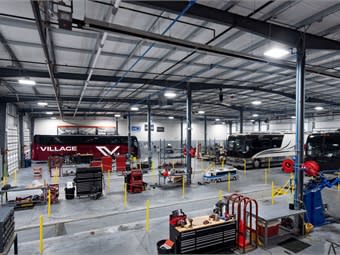
In addition to using its used waste oil for heating the shop, Village’s new facility also includes four pits, space for ample parts inventory, a wash bay that can accommodate two coaches at a time, and eventually a body shop and paint booth so the operation can do its own repairs, as well as potentially open up a new revenue stream by offering services to other fleets in the area.
For staff, Village’s new headquarters includes a drivers lounge that is open 24/7, as well as two “hotel” rooms that drivers can check out at no charge to get rest before or after a trip.
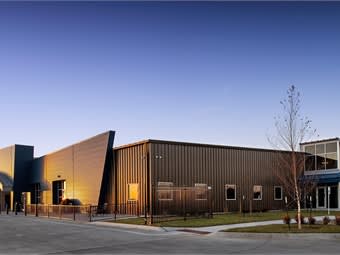
Village’s new facility includes four pits, space for ample parts inventory, a wash bay that can accommodate two coaches at a time, and eventually a body shop and paint booth.
Randy Tobias
Looking ahead
Looking down the road, Village Travel has begun to bring in new management personnel who are fresh to the industry, with Arensdorf saying he has been willing to cede control to allow them to try out their ideas, new or old, to see if they can be successful.
“Even if it’s something we’ve tried before and it didn’t work, I’m willing to give it a try again, because I want to remain receptive and don’t want to discourage them,” he says. “I also don’t mind taking a risk, as long as it’s a calculated risk and it is something that can help transform and add value to the way we do things here.”
Arensdorf adds that Village Travel’s business diversification has been one if its keys to lasting success.
“We have multiple locations and market segments, including tours, charters, fixed-line service, a travel agency, and an entertainer line, so we essentially have five income streams in seven locations,” he says. “Our business diversification has been very nice, and it helps me sleep well at night because all of our eggs aren’t just in one basket.”
More Motorcoach

METRO Opens Submissions for 2026 Motorcoach Awards
Nominations are now being accepted for METRO Magazine’s Operator of the Year and Innovative Operator of the Year awards.
Read More →
Biz Briefs: Alstom Lands Canadian Contract, LYT to Supply California TSP, and More
In METRO's latest installment, we take a look at recent news from Complete Coach Works, Beep, FlixBus, and more partnerships making headlines across the transportation sector.
Read More →
Biz Briefs: RIPTA Unveils New Frontrunners, Clevland RTA Adds New Siemens, and More
In METRO's latest installment, we take a look at recent news from Siemens, Prevost, Dodge, and more partnerships making headlines across the transportation sector.
Read More →
People Movement: Holly Arnold Joins Transdev and More
In this edition, we also cover recent appointments and announcements at Pace, CamTran, MCI, and more, showcasing the individuals helping to shape the future of transportation.
Read More →
ABA Report: Motorcoach Travel Generates $161.6B Economic Impact
The 2025 analysis finds motorcoach travel supported nearly 900,000 jobs and generated $28 billion in federal, state, and local taxes.
Read More →
CharterUP’s Armir Harris on Technology, AI, and the Future of Group Mobility
In a recent episode of METROspectives, CharterUP Founder/CEO Armir Harris discussed the company’s evolution from an online charter bus marketplace into a technology platform supporting public- and private-sector mobility and much more.
Read More →
People Movement: ABC Names John Walsh as Chief Commercial Officer
In this edition, METRO also covers recent appointments and announcements at the DART, STV, and more, showcasing the individuals helping to shape the future of transportation.
Read More →
From Surviving to Thriving: Building Stronger Transportation Organizations
Bus Business Consultants founder Brian Dickson shares lessons on leadership, organizational health, and creating options for long-term success in a changing transportation industry.
Read More →
Biz Briefs: Luminator Marks Milestone and More
From manufacturers and suppliers to transit agencies and motorcoach operators, these updates offer a snapshot of the projects, partnerships and business moves driving the industry forward.
Read More →
ABAF Study Reveals Growing Insurance Crisis for Motorcoach Operators
Preliminary findings show 98% of operators faced premium increases over the past five years, while shrinking insurer participation is putting added pressure on businesses and customers.
Read More →