



What to Consider When Planning Campus Transportation
BusOps spoke with consultant Bob Bourne of Bourne Transit Consulting LLC about some things colleges and universities should consider when building routes, as well as some of the issues they may experience when embarking on the process of creating a transportation network on campus.
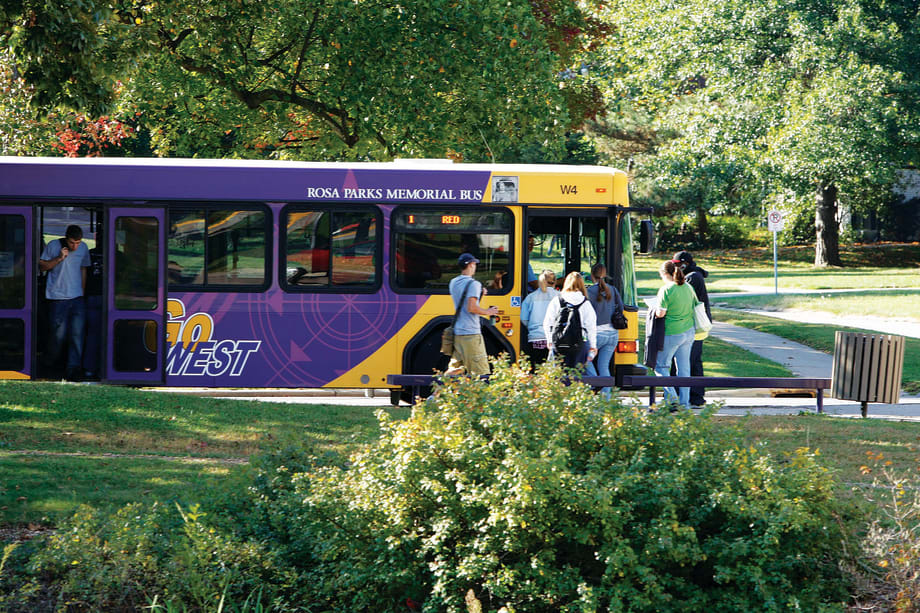
Western Illinois University
Western Illinois University
This story appears in METRO's BusOps supplement. To view the digital edition of the full issue, click here.
With college and university populations continuing to swell, space often becomes constrained, forcing many to choose between building more parking lots or more buildings. When the decision is made to expand its facilities over adding parking, many colleges and universities are left with finding ways to transport students from the lots, as well as from surrounding housing, satellite campuses and more, to their classes.
BusOps spoke with consultant Bob Bourne of Bourne Transit Consulting LLC about some things colleges and universities should consider when building routes, as well as some of the issues they may experience when embarking on the process of creating a transportation network on campus.
Planning the System
Bourne explains there are several issues to consider when planning routes for campus systems:
1) What are you trying to accomplish?
The first step is clearly the biggest and that is addressing where you want to go.
“Some systems just want circulation to and from housing and parking lots to the classrooms,” Bourne explained. “If it’s a really big university, some want circulation in between campuses and other offsite, university-owned buildings.”
Bourne added that many colleges and universities may also want circulation off campus in high residential density not owned by the school, for example, to reduce shorter trips people may be taking in their personal vehicles.
2) Parking Demand
With parking lots often a pretty sizable distance from the actual classrooms, it’s important for colleges and universities to provide transportation to and from their parking lots, Bourne explained. In conjunction, if a school is aiming to reduce the amount of vehicles coming to campus, it is also critical to provide transportation options to and from student housing facilities, and again, high density residential areas surrounding the campus, as well.
3) Who will run it?
Does the city, or whoever provides public transportation services in the area, contract with the university or is the university contracting with the city to provide service? If they both have their own individual systems, do they have a joint management agreement with separate policy boards?
“Setting up the route system is one part of the equation, but who will run it is the other important part,” Bourne said.
4) What are the fares going to be?
Along with who is going to run the system, the last part is who is going to pay for it?
As Bourne explained, if they are university-owned buses, chances are students will ride for free. However, if they are setting up a partnership with the city or local transportation agency, an agreement must be struck as to who will be paying the fares and how. Will the students ride for free and pay a fee when they register, or will they ride for a reduced fare?
Things to Consider
One possible pitfall colleges and universities may want to look out for when planning routes, is underestimating demand and planning poor service levels, according to Bourne.
“A weakly designed system might have buses running from a parking lot to campus every 20 to 30 minutes, but it may take 10 to 15 minutes to make the same trip on foot,” he said. “In that case, it probably makes more sense to just walk than to take the bus, which really defeats the purpose.”
Another pitfall Bourne often sees is those planning the system might not spend time examining student travel data.
“[What you can do is] take the student population and the number of student rides per year and that gives you the number of rides per capita,” said Bourne. “Healthy systems might have 170 to 180 rides per capita, per year. Other schools might see the numbers are like 20 rides per capita. If you have a school of 10,000 students and you are providing 200,000 rides a year, that’s an indicator you are not meeting demand.”
In short, without examining that data, school officials may not be aware how much frequency they may need. Additional data on travel patterns of students will help determine demand for on-campus and off-campus trips. Social media and campuswide surveys are also effective ways to get student input on their travel patterns.
More Bus

New York MTA Plans Largest Bus Fleet Upgrade in More Than a Decade
The agency is seeking manufacturers for 650 new CNG buses to replace aging vehicles, improve reliability, and advance its broader fleet modernization strategy.
Read More →
Building a Flexible Path to Transit Electrification
John Hroncich discusses BAE Systems’ modular and scalable approach, lessons learned from decades of real-world operations, and how agencies can identify electrification strategies that fit their fleets.
Read More →
Bus Tech Talk: Keeping Transit Technicians Ahead of the Technology Curve
LA Metro’s Obed Mejia discusses technician training, evolving maintenance technology, fleet replacement, and strategies for getting the most out of today’s transit fleets.
Read More →
Biz Briefs: RIPTA Unveils New Frontrunners, Clevland RTA Adds New Siemens, and More
In METRO's latest installment, we take a look at recent news from Siemens, Prevost, Dodge, and more partnerships making headlines across the transportation sector.
Read More →
People Movement: Holly Arnold Joins Transdev and More
In this edition, we also cover recent appointments and announcements at Pace, CamTran, MCI, and more, showcasing the individuals helping to shape the future of transportation.
Read More →
The High Cost of Transit Buses: Industry Leaders Look to Procurement Reform
Transit leaders and policymakers examine how standardized bus designs, streamlined procurement, and predictable funding could help agencies stretch budgets and deliver better service.
Read More →
The Business Voice Behind Public Transportation
As chair of APTA’s Business Members Board of Governors, Ray Melleady explains how more than 850 business members are partnering with transit agencies to advance funding, innovation, and industry-wide collaboration.
Read More →
From Surviving to Thriving: Building Stronger Transportation Organizations
Bus Business Consultants founder Brian Dickson shares lessons on leadership, organizational health, and creating options for long-term success in a changing transportation industry.
Read More →
Finding the ‘Happy Medium’: Optimizing Maintenance Without Sacrificing Reliability
The key to maintenance optimization isn’t doing less work—it’s doing the right work at the right time on the right assets.
Read More →
LA Metro, City of West Hollywood, and Partners Advance Smarter Bus Lane Enforcement
The award-winning partnership combines AI-powered detection with human oversight to improve bus reliability, accessibility, and enforcement efficiency.
Read More →