Director
Department of Transportation and Public Works
Miami-Dade County, Fla.


 MENU
MENU SEARCH
With a bachelor’s degree in civil engineering and a master’s in business administration, Alice Bravo graduated and hit the ground running. She began her professional career at design firm PBS&J (now called Atkins) in 1991 as a bridge designer and highway engineer.
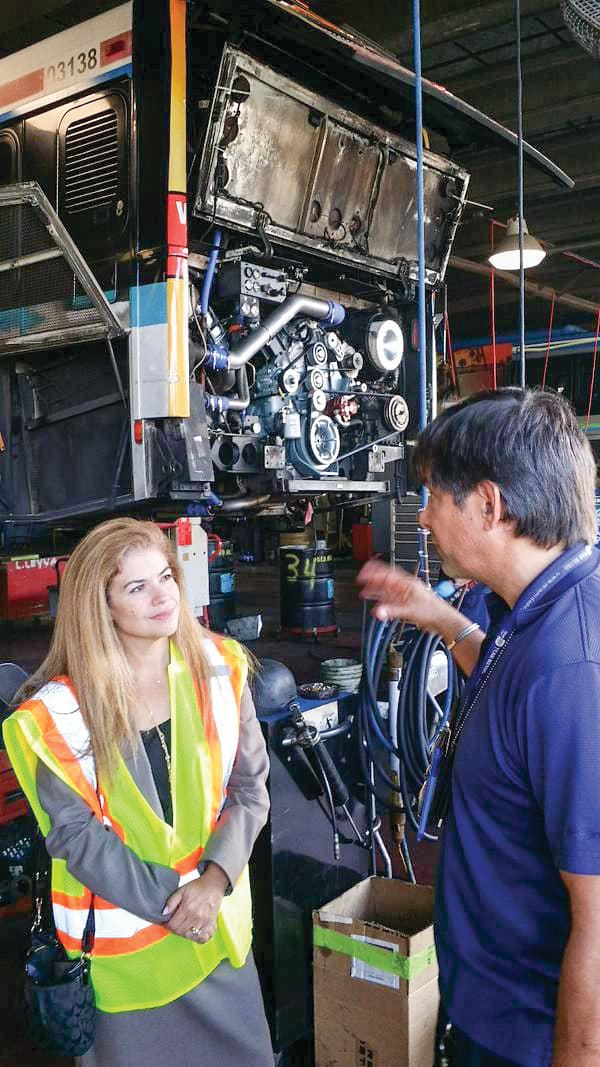
Bravo finds changing the culture around public transit use rewarding.
With a bachelor’s degree in civil engineering and a master’s in business administration, Alice Bravo graduated and hit the ground running. She began her professional career at design firm PBS&J (now called Atkins) in 1991 as a bridge designer and highway engineer.
A few years in, she was assigned to do a study for a multi-modal corridor that involved highway improvements and new transit lines. Bravo stayed on the project from beginning to end. While she had always seen herself designing high-rises and skyscrapers, Bravo credits this project for sparking a newfound passion for major transportation planning.
Bravo finds changing the culture around public transit use rewarding.
EXPERIENCE. Bravo went on to become the District Six director of transportation and systems development for the Florida Department of Transportation (FDOT). There, she worked on transformative transportation projects, including the innovative I-95 Express Project and the $1 billion PortMiami Tunnel.
She then went on to serve as the deputy city manager for the City of Miami, where she was born and raised. She oversaw six departments, from capital improvements and transportation to real estate asset management. During her time with the city, she had a foot in numerous high-budget projects. Some of her biggest endeavors feature a $573 million capital-improvement program and the state road 836-interchange reconstruction project. She was also responsible for implementing the city’s trolley circulator system. These developments have radically improved commuter mobility throughout the area.
FRESH CHALLENGES. Working at the state and municipal levels helped prepare Bravo for her current position. She now directs the Department of Transportation and Public Works in Miami-Dade County, which operates the 15th largest public-transit system in the U.S., and the largest in Florida.
“One of the most challenging yet rewarding aspects of my job is trying to change the culture around the use of public transportation,” says Bravo. “With all the technological tools available, such as our Miami-Dade Tracker app, anyone can plan a trip via mobile device, see when the next bus or train is approaching, or even send us a comment about their experience.”
NEW IDEAS. Bravo has watched many new ideas become realities in her years working for the county. Recently, the transit system starting offering mobile ticketing, and just last year, the department introduced the first AC bus shelter in Florida.
Bravo and her team also plan to implement the installation of about 300 adaptive traffic signals. These signals can detect where traffic is becoming congested and continuously adjust their own timing to improve traffic flow.
This year under Bravo’s leadership, the department will place in service the first of 136 new railcars that will eventually replace the current Metrorail fleet. Over the next two years, the county will see the arrival of 300 compressed natural gas buses, 30 electric buses, and a new fueling facility.
KEY PROJECT. Bravo’s chief project at the moment is the Strategic Miami Area Rapid Transit (SMART) Plan, which is an infrastructure investment program that will significantly improve transportation mobility in Miami-Dade County. The SMART plan will expand transit options in Miami-Dade County along six critical corridors that are linked to local, regional, national, and global economic markets.
According to Bravo, another critical component of the SMART Plan will be a network of Express Buses — known as Bus Express Rapid Transit (BERT) — that will connect the SMART rapid transit corridors on limited access facilities. This will promote the active expansion of South Florida’s Express Lanes network with the implementation of six identified BERT express lane concepts.
“This innovative approach effectively expands the reach of transit in Miami-Dade County and beyond,” says Bravo.
Bravo’s passion for all things transit is even apparent when she is on vacation.
“I love to ride all the different transit options when I go to other cities both domestically and in other countries,” says Bravo. “I just went on a vacation to Spain and all over southern France this year and got to compare and contrast.”

Nominations are now being accepted for METRO Magazine’s Operator of the Year and Innovative Operator of the Year awards.
Read More →
Contract Four is the largest in the Second Avenue Subway Phase 2 project and includes construction of station infrastructure, tracks, and signals for the subway expansion, MTA officials said. Work on Contract Four will begin in 2027.
Read More →
Leaders from 15 major transit systems shared crime-reduction results and safety initiatives while discussing the role of continued federal support.
Read More →
The new regional transit authority appointed its first board chair and interim executive director while extending reduced fares across CTA, Metra, and Pace for eligible riders.
Read More →
Reliability-Centered Maintenance helps transit agencies move beyond routine checklists to focus limited resources on the assets and failures that have the greatest impact on safety, reliability, and service.
Read More →
Leadership changes will help shape the association’s priorities and its representation of the transportation industry during the 2026–2027 term.
Read More →
The 90-day demonstration will deploy coordinated security teams at five light rail stations while testing controlled access and gathering data to guide future investments.
Read More →
Learn about delivering 1300 gates at 91 stations while managing fare evasion. Explore the large scale deployment, solution customization and real-world results that affect the region. Prepare for deployment in your region now.
Read More →
Between packed transit stations and team motorcoaches, see how agencies and operators across North America tackled the transportation demands of the 2026 FIFA World Cup.
Read More →
The stopgap keeps federal transportation programs moving, but missing advance funding could complicate the transit and rail projects agencies are planning next.
Read More →