Director of Transit
Knoxville Area Transit
Knoxville, Tenn.


 MENU
MENU SEARCH
Dawn Distler’s involvement in the transportation industry began serendipitously.
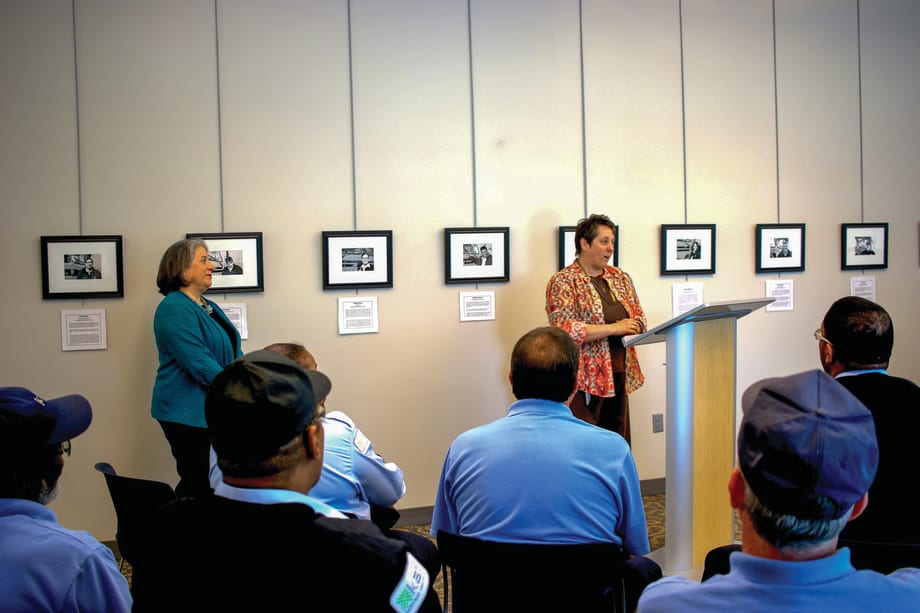
Distler’s first foray in the industry was as a part-time bus operator.
Dawn Distler’s involvement in the transportation industry began serendipitously. Growing up in Akron, Oh., she had an affinity for sports and music, and aspired to coach softball. She worked a plethora of jobs from 1987 to 1998, including as a little league umpire, a waitress, a nursing assistant, and a disc jockey. After Distler found herself laid off from a job at General Ionics, a water conditioning company, she tried to figure out what to do next. A friend and fellow softball player suggested that Distler become a bus driver.
The first time Distler applied, she was rejected for not having a chauffer’s license.
“I left the office, drove to the DMV, took the test and was back in less than two hours with my license,” she says. “They hired me on the spot. The rest is history.”
Distler’s first foray in the industry was as a part-time bus operator.
Distler worked as a bus driver in Akron for 10 years before becoming a paratransit operations manager. From there, she went to Nashville, working as the GM of operations, safety, and maintenance for the Metropolitan Transit Authority (MTA) and the Regional Transportation Authority.
CHALLENGES. She was the operations manager in 2010 when a large flood hit Nashville. Distler and other members of the MTA had to act fast to ensure the safety of passengers, employees, and the fleet. Distler worked 32 hours non-stop in the emergency operations center, managing her team on the ground.
“It was a time that really tested us all, and my team really came through,” Distler says. “I’m proud of how we handled that one.”
LEADERSHIP. As Knoxville’s director of transit, Distler acts as the CEO for Knoxville Area Transit (KAT). She leads her team to grow and get others to invest in public transit in the city.
“I get to sell KAT to the public, developers, the city, to everyone,” she says. “We come up with new ideas for partnerships and ways to grow the system, and try to clear the road to allow that growth to happen.”
Distler’s leadership has helped KAT implement free Wi-Fi on fixed-route buses and at Knoxville station, scheduling via Google Transit, and a new website that provides riders with text and email alerts for their routes. The initiatives are part of a five-year plan to improve Knoxville transit through services and amenities, including late night, increased weekend, and more frequent service. According to Distler, the team has nearly met all of its planned goals. The team’s efforts earned KAT an Outstanding Public Transportation System award from APTA in 2017.
Distler emphasizes the importance of working with a tight-knit team. She says she loves being able to work together with others, watching teammates grow, and share a common vision with other members of KAT.
“The energy and enthusiasm becomes contagious,” she says. “I get to work with amazing people doing what they do best and together we provide a service that assists people in bettering their lives, in remaining independent, and in providing a better world for those that come after us.”
KEY PROJECT. Distler and her team are currently working on an Accelerated Bus Corridor, a pathway featuring frequent buses and traffic signal prioritization — the first ever in Knoxville. The plan is to compete with traffic through limited stops and enhanced boarding locations. The corridor will also be populated with all-electric vehicles, which would also be new for Knoxville. KAT is aiming to implement the project by 2019.
Other projects on tap for the agency are a technology RFP to address a multitude of issues, including fare collection, AVL, and real-time passenger information.
In her free time, Distler still follows her childhood passions of sports and music, but transit always plays a part in her life, too.
“I am in heaven during women’s basketball season. My wife and I go to the Final 4 tournaments almost every year,” she says. “We love to travel and take transit in other cities — I guess work never leaves me in that regard.
In this edition, we also cover recent appointments and announcements at the Wabtec, SilverRide, HNTB, and more, showcasing the individuals helping to shape the future of transportation.
Read More →
Nominations are now being accepted for METRO Magazine’s Operator of the Year and Innovative Operator of the Year awards.
Read More →
Contract Four is the largest in the Second Avenue Subway Phase 2 project and includes construction of station infrastructure, tracks, and signals for the subway expansion, MTA officials said. Work on Contract Four will begin in 2027.
Read More →
Leaders from 15 major transit systems shared crime-reduction results and safety initiatives while discussing the role of continued federal support.
Read More →
The new regional transit authority appointed its first board chair and interim executive director while extending reduced fares across CTA, Metra, and Pace for eligible riders.
Read More →
Reliability-Centered Maintenance helps transit agencies move beyond routine checklists to focus limited resources on the assets and failures that have the greatest impact on safety, reliability, and service.
Read More →
Leadership changes will help shape the association’s priorities and its representation of the transportation industry during the 2026–2027 term.
Read More →
The 90-day demonstration will deploy coordinated security teams at five light rail stations while testing controlled access and gathering data to guide future investments.
Read More →
Learn about delivering 1300 gates at 91 stations while managing fare evasion. Explore the large scale deployment, solution customization and real-world results that affect the region. Prepare for deployment in your region now.
Read More →
Between packed transit stations and team motorcoaches, see how agencies and operators across North America tackled the transportation demands of the 2026 FIFA World Cup.
Read More →