




Related: Focus on Coaching to Raise Driver Training Effectiveness
Training Bus Chatter: Keep it Performance Focused with New Candidates
As we all have experienced, chatter regarding topics other than performance-based basic skill development, such as current events, sports or one’s families, will develop onboard and can break the tension that candidates are experiencing in attempting to do their best. This tension breaker may do good for them, but this should occur during non-development drive time.
April 6, 2016

Photo courtesy Omnitrans
3 min to read
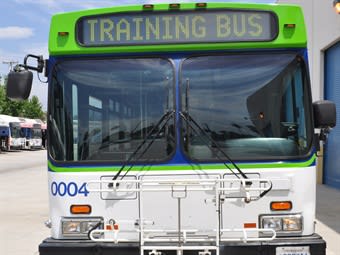
Photo courtesy Omnitrans
This month I will be touching on the instructor’s role in setting the tone between instructor and new bus operator student candidates with regard to keeping training bus chatter focused on the tasks ahead.
The instructor is the “captain of his ship." Aside from having to posses the ability to demonstrate, and then, teach a student candidate to successfully operate safely in passenger service, they take upon themselves the responsibility of having to make the right call to terminate or advance them forward.
The training bus will be the “classroom on wheels” throughout the basic skill development phase. With that comes the possibility of getting too personal with your students. Beware, this can come back to bite you. Topics that have no place on the training bus may possibly offend someone. The recipient of your statement may not immediately make it known to you at that time. You can be sure that the moment you inform the student candidate that they failed to successfully complete the training program, whatever you may have said that may have offended them will surface. This just may be enough with or without legal assistance to get an additional round of training. It usually sounds something like this: “I felt offended by what the instructor said and it affected my ability to satisfactorily complete the training program.” Remember that it’s possible that your actions may have very well offended them so keep that in mind.
As we all have experienced, chatter regarding topics other than performance-based basic skill development, such as current events, sports or one’s families, will develop onboard and can break the tension that candidates are experiencing in attempting to do their best. This tension breaker may do good for them, but this should occur during non-development drive time.
Even then, carefully monitor what topics are discussed and remain disciplined about what you say. During the one-on-one daily post training evaluations, never raise your voice, talk down or compare the performance of another more advanced student to your subject. It can have the same devastating effect as if doing it to your children. It is not a good practice to tell a student that “you are sure to pass this training program" or “you only need one or two more days." Stay neutral. If they ask if you think they will pass the program simply state “keep giving 100% of your efforts and an evaluation will be made at the completion of the program.”
Likewise, if you don’t believe they will satisfactorily complete the training program, then refrain from telling them before they have exhausted all available training days. Telling them they won’t pass before the completion of training will provide them with reason to accuse you of discouraging them from performing well for the remaining training days and pre-judging the remaining training efforts based on their performance thus far.
Another conflict can occur when they claim that other instructors they may have had during basic skill development were inconsistent in their teachings. That is why I have always said that your instructional staff must be on the same page with what they are teaching. Trainer inconsistency is a step in the wrong direction for your training program. When putting pen to paper, be sure that your documentation can be clearly understood by your student candidate and others who may need to refer back to it at a future date. Proper documentation is critical in the case of a student candidate operator who may attempt to dispute a dismissal and may want to protest and pursue some type of legal options to challenge an instructor’s final evaluation. Where an “Unsatisfactory” check-off is warranted, be sure to document include a brief statement as to what occurred behind the wheel that justified the “Unsatisfactory” performance.
In closing, set guidelines, keep the chatter productive, watch what you say and set the example.
Louie Maiello is a sr. consultant (transit training & simulation), L-3/DPA; independent consultant, Bus Talk Surface transit Solutions; and writes a monthly blog for metro-magazine.com.
Subscribe to Our Newsletter
More Blog Posts
Improving Transit Accessibility by Offering Assistive Listening
Did you know that there are literally tens of millions of people worldwide with hearing loss, many of whom will use some form of public transit at some point?
Read More →
35 Years of the ADA, Making Travel Easier for Seniors
Thirty-five years after the passage of the Americans with Disabilities Act of 1990 (ADA), the impact of this landmark piece of civil rights legislation cannot be overstated.
Read More →
Driving Performance with Purpose: How I Lead One of Greyhound’s Top Teams
Safety, on-time performance, and customer experience are critical elements in intercity bus operations. But getting them right doesn’t come down to plans or protocols alone. It comes down to execution. How well your team performs on the ground, in real time, is what defines success.
Read More →
Navigating Emerging Privacy Laws: A Call to Action for Service Providers in Mass Transit
With Data Privacy Day Jan. 28, I want to spotlight a critical challenge faced by service providers in the mass transit sector: managing personal information responsibly in an era of rapidly evolving privacy regulations.
Read More →
Human Trafficking Awareness: What Public Transportation Can Do?
January is National Slavery and Human Trafficking Prevention Month in the U.S., and January 11 is National Human Trafficking Awareness Day.
Read More →
Want to Improve Transit Safety and Operations? Break Down the Silos
Retrieving and reviewing data and video can be a cumbersome process for fleet managers. Each system or tool provides a piece of the puzzle, but seeing the complete picture requires tedious manual synchronization.
Read More →
Ensuring Public Transit Cybersecurity Through Robust Protective Measures
In today’s highly connected world, cybersecurity is of utmost importance, particularly for transportation agencies overseeing transit bus systems that rely increasingly on sophisticated technologies, including the use of data analytics in traffic signal networks, to manage and operate their systems.
Read More →
How Advances in Thermal Management Revolutionize Urban Mobility
In the daily hustle and bustle of city life, transit buses serve as the backbone of urban transportation, allowing millions of city dwellers to get from point A to point B each day reliably.
Read More →
The Evolution of Bus Design
Thirty years ago, drivers not only had to drive the bus and navigate heavy traffic, but they were also responsible for tasks like supervising passenger loading and unloading, selling tickets, and providing passengers with various kinds of information, all while sitting in an often ill-fitting workstation.
Read More →
What 'Transit Safety 101' Really Means
Safety, Safety, Safety. This word is used repeatedly, and in many contexts, without most people understanding what it actually means.
Read More →