



Big Blue Bus making real-time signs, lighting, and Wi-Fi upgrades
The advancements are underway and expected to be completed by mid-2019.

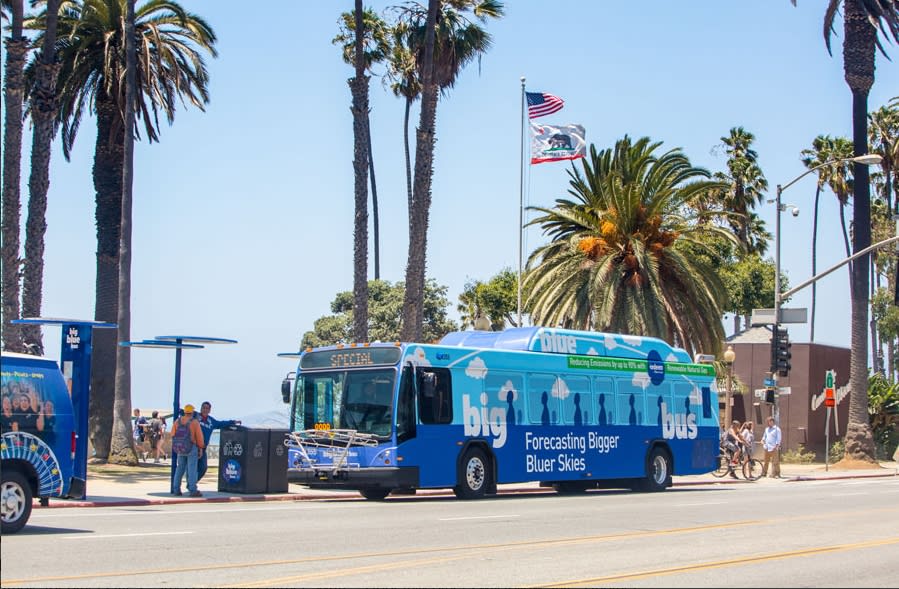
More than 500 BBB customers participated in an online survey that enabled them to vote for upgrades at their preferred bus stop locations.
Photo via BBB/Clean Energy
More than 500 BBB customers participated in an online survey that enabled them to vote for upgrades at their preferred bus stop locations.
Photo via BBB/Clean Energy
Santa Monica, California’s Big Blue Bus (BBB) announced the retrofit of 190 high-volume bus stops with solar-powered real-time signs and LED lights. The advancements are underway and expected to be completed by mid-2019.
Also, BBB customers can now access free Wi-Fi onboard 19 of its newest 40-foot buses. BBB plans to retrofit additional buses and moving forward, Wi-Fi will be standard on all new buses.
“Through our community engagement efforts, our customers helped us prioritize investments, which included Wi-Fi, improved bus stop safety through lighting and the addition of real-time information,” said Ed King, director, transit services. “In revamping the 190 high-volume stops, we aim to enhance the customer experience by taking the guesswork out of riding transit. The new additions combined with existing real-time signs means that 76 percent of all Big Blue Bus customers will soon have access to bus arrival information.”
The solar-powered real-time signs with LED lights will be installed at 166 City of Los Angeles bus stops and 10 City of Santa Monica large bus shelters. Additionally, solar-powered LED lights will be added to 14 small bus shelters in Santa Monica. In total, these stops average 26,908 daily pick-ups — each weekday, improving the bus stop experience for 61% of all customers systemwide.
More than 500 BBB customers participated in an online survey that enabled them to vote for upgrades at their preferred bus stop locations. Customers provided substantial feedback on safety and performance. In addressing an essential need for improved safety, reliability of information, and convenience in BBB’s service area, customers can look forward to the following:
Enhanced Customer Safety
Equipped with two push-button activated LED lights.
Increased customer safety and enhanced customer visibility in low light conditions.
Greater Access to Real-Time Information
Bus arrival information can be easily read in daylight.
When the push-button is activated, a text-to-speech audio annunciator will inform customers when the next bus is arriving.
Information displayed will be compliant with the Americans with Disabilities Act character size requirements.
Signs will be programmed to display timely information about detours and bus stop closures.
The real-time signs, lights and audio are powered by renewable energy, which is generated through solar panels located above each sign. The signs are fully manufactured in the U.S., using recycled aluminum and non-toxic batteries.
More Bus

New York MTA Plans Largest Bus Fleet Upgrade in More Than a Decade
The agency is seeking manufacturers for 650 new CNG buses to replace aging vehicles, improve reliability, and advance its broader fleet modernization strategy.
Read More →
Building a Flexible Path to Transit Electrification
John Hroncich discusses BAE Systems’ modular and scalable approach, lessons learned from decades of real-world operations, and how agencies can identify electrification strategies that fit their fleets.
Read More →
Bus Tech Talk: Keeping Transit Technicians Ahead of the Technology Curve
LA Metro’s Obed Mejia discusses technician training, evolving maintenance technology, fleet replacement, and strategies for getting the most out of today’s transit fleets.
Read More →
Biz Briefs: RIPTA Unveils New Frontrunners, Clevland RTA Adds New Siemens, and More
In METRO's latest installment, we take a look at recent news from Siemens, Prevost, Dodge, and more partnerships making headlines across the transportation sector.
Read More →
People Movement: Holly Arnold Joins Transdev and More
In this edition, we also cover recent appointments and announcements at Pace, CamTran, MCI, and more, showcasing the individuals helping to shape the future of transportation.
Read More →
The High Cost of Transit Buses: Industry Leaders Look to Procurement Reform
Transit leaders and policymakers examine how standardized bus designs, streamlined procurement, and predictable funding could help agencies stretch budgets and deliver better service.
Read More →
The Business Voice Behind Public Transportation
As chair of APTA’s Business Members Board of Governors, Ray Melleady explains how more than 850 business members are partnering with transit agencies to advance funding, innovation, and industry-wide collaboration.
Read More →
From Surviving to Thriving: Building Stronger Transportation Organizations
Bus Business Consultants founder Brian Dickson shares lessons on leadership, organizational health, and creating options for long-term success in a changing transportation industry.
Read More →
Finding the ‘Happy Medium’: Optimizing Maintenance Without Sacrificing Reliability
The key to maintenance optimization isn’t doing less work—it’s doing the right work at the right time on the right assets.
Read More →
LA Metro, City of West Hollywood, and Partners Advance Smarter Bus Lane Enforcement
The award-winning partnership combines AI-powered detection with human oversight to improve bus reliability, accessibility, and enforcement efficiency.
Read More →