




RELATED: Omniride to test double-decker bus on commuter route
Hyundai debuts electric double-decker bus with 186-mile range
The 42-foot vehicle can accommodate up to 70 passengers.
June 3, 2019

Hyundai's all-new electric double-decker bus debuted at the ‘Land, Infrastructure and Transport Technology Fair’ held in Korea May 29 to 31, 2019.
Hyundai
2 min to read
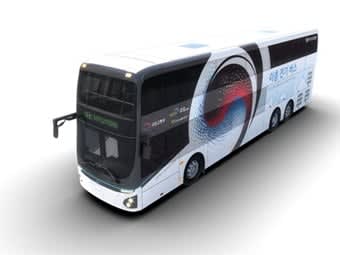
Hyundai's all-new electric double-decker bus debuted at the ‘Land, Infrastructure and Transport Technology Fair’ held in Korea May 29 to 31, 2019.
Hyundai
Hyundai Motor unveiled the company's first electric double-decker bus, which has a 186-mile driving range on a single charge.
To develop the company’s first electric double-decker bus, Hyundai worked for 18 months on a project supported by the Korean Ministry of Land, Infrastructure, and Transport, which began in 2017.
The bus allows up to 70 passengers ― 11 seats on the first floor and 59 seats on the second floor ― 1.5 times as many passengers as compared to that of a regular bus.
Through the implementation of two fixed-in-space wheelchairs, an automatic sliding ramp and low-floor design, the double-decker bus secures added accessibility for disabled and mobility impaired passengers.
As part of the company’s effort to increase efficiency and to reduce vehicle emissions, Hyundai equipped the all-new bus with a 384 kWh water-cooled high-efficiency polymer battery, with a maximum 186-mile driving range on a single charge. A full charge can be completed in 72 minutes.
The vehicle is 42 feet long and 13 feet high. It runs on an independent suspension system in the first driving axle for a more comfortable ride, and a 240kW wheel-motor axle combined with a motor in the second axle that minimizes loss of electricity.
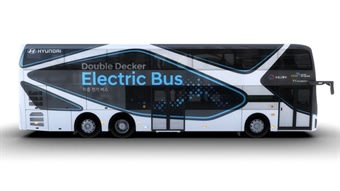
Hyundai's double-decker electric bus is 42 feet long and can accommodate up to 70 passengers.
Hyundai
A rear-wheel steering system works in coherence with the steering system of the first axle, optimizing steering performance.
Various advanced safety features are also equipped on the bus to ensure the safety of the passengers:
Vehicle Dynamic Control (VDC) helps identify the driver's intended driving direction and maintain the vehicle in control.
Forward Collision-Avoidance Assist (FCA) uses the car’s front-facing camera to help detect an imminent collision and avoid impact or minimize damage by braking autonomously.
Lane Keeping Assist (LKA) helps prevent accidental lane departure by sensing road markings.
More Bus

New York MTA Plans Largest Bus Fleet Upgrade in More Than a Decade
The agency is seeking manufacturers for 650 new CNG buses to replace aging vehicles, improve reliability, and advance its broader fleet modernization strategy.
Read More →
Building a Flexible Path to Transit Electrification
John Hroncich discusses BAE Systems’ modular and scalable approach, lessons learned from decades of real-world operations, and how agencies can identify electrification strategies that fit their fleets.
Read More →
Bus Tech Talk: Keeping Transit Technicians Ahead of the Technology Curve
LA Metro’s Obed Mejia discusses technician training, evolving maintenance technology, fleet replacement, and strategies for getting the most out of today’s transit fleets.
Read More →
Biz Briefs: RIPTA Unveils New Frontrunners, Clevland RTA Adds New Siemens, and More
In METRO's latest installment, we take a look at recent news from Siemens, Prevost, Dodge, and more partnerships making headlines across the transportation sector.
Read More →
People Movement: Holly Arnold Joins Transdev and More
In this edition, we also cover recent appointments and announcements at Pace, CamTran, MCI, and more, showcasing the individuals helping to shape the future of transportation.
Read More →
The High Cost of Transit Buses: Industry Leaders Look to Procurement Reform
Transit leaders and policymakers examine how standardized bus designs, streamlined procurement, and predictable funding could help agencies stretch budgets and deliver better service.
Read More →
The Business Voice Behind Public Transportation
As chair of APTA’s Business Members Board of Governors, Ray Melleady explains how more than 850 business members are partnering with transit agencies to advance funding, innovation, and industry-wide collaboration.
Read More →
From Surviving to Thriving: Building Stronger Transportation Organizations
Bus Business Consultants founder Brian Dickson shares lessons on leadership, organizational health, and creating options for long-term success in a changing transportation industry.
Read More →
Finding the ‘Happy Medium’: Optimizing Maintenance Without Sacrificing Reliability
The key to maintenance optimization isn’t doing less work—it’s doing the right work at the right time on the right assets.
Read More →
LA Metro, City of West Hollywood, and Partners Advance Smarter Bus Lane Enforcement
The award-winning partnership combines AI-powered detection with human oversight to improve bus reliability, accessibility, and enforcement efficiency.
Read More →