




RELATED: Lextran extends Transdev contract
Q&A with Lextran GM Carrie Butler
METRO Magazine’s Managing Editor Alex Roman spoke to Butler about Lextran’s day-to-day challenges, its alternative-fuels program, and how the lack of federal funding could impact the agency and the community it serves.
March 19, 2018
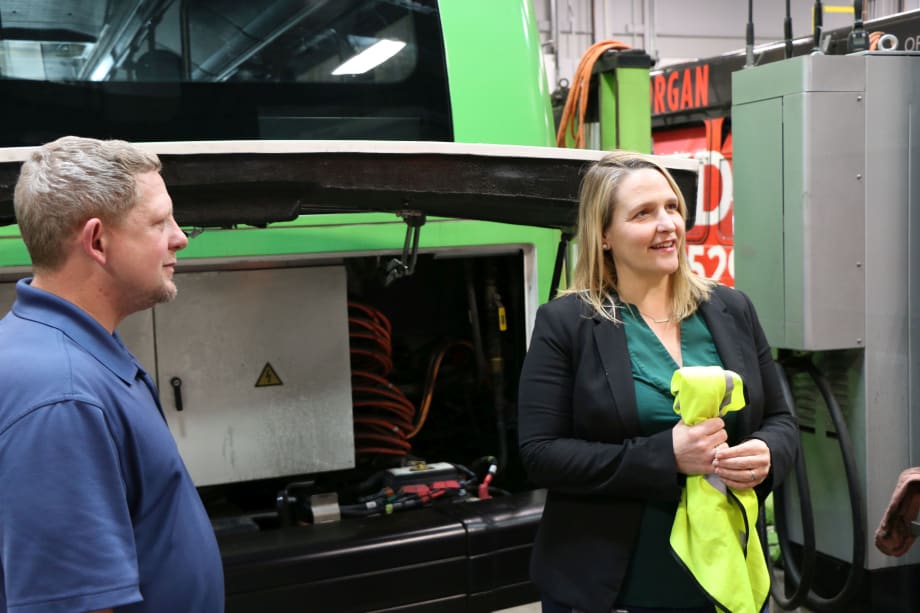
During Butler’s tenure, Lextran moved to a new headquarters and added both CNG and electric buses to the agency’s fleet.
Photos courtesy Lextran
7 min to read

Carrie Butler joined Lextran (The Transit Authority of Lexington, Ky.) as GM through its contractor Transdev in 2015. Butler is a seasoned professional in public transit and served in planning, project management, and senior operational management roles in various organizations. Prior to joining Transdev, Butler spent eight years at the Transit Authority of River City in Louisville, where she served as director of planning.
METRO Magazine’s Managing Editor Alex Roman spoke to Butler about Lextran’s day-to-day challenges, its alternative-fuels program, and how the lack of federal funding could impact the agency and the community it serves.
Besides funding, what is your agency’s greatest challenge and how are you trying to overcome it?
Our immediate day-to-day challenge at the moment is hiring and recruiting. Bus operators are one challenge, but we are also seeing a similar need in our maintenance department with mechanics, or maintenance technicians. We have a number of our mechanics who have been here for decades and are retiring, and we are just not seeing the same level of interest that we did maybe 10 or 15 years ago for that particular job.
We have tried a couple of different things with regards to hiring and recruiting. One is to take more advantage of online job search engines. Long gone are the days of putting a want ad in the newspaper, and going through more online avenues has definitely helped extend our reach. With regard to mechanics or maintenance technicians, we have reached out to the trade schools or vocational schools in the area to look at ways to maybe build a pipeline. That is hard, however, because we don’t necessarily have a class of say 10 mechanics that we hire each year, so making that pipeline with the technical schools can be a challenge. Additionally, it’s a different job. The perception of what a mechanic was in 1950 is very different than what a mechanic or maintenance technician does now. Therefore, the next pieces we are going to work on is to help change the perception and communicate what the job really is, and hopefully, that will help with recruiting people.
Are you exploring partnerships with Uber/Lyft, ridesharing, or bikesharing groups to provide more options?
We are working on a bikeshare project with our local folks and the University of Kentucky, which will be happening here very soon. We have had a very long-term relationship with the American Red Cross, where they provide our paratransit service, which is called Wheels. Through our contract with them, we are looking at supplementary service with taxicabs and have thought about TNCs or taxicabs as a way to provide the service differently. Right now, we are not really breaking any ground on that one, but it is something that we are aware of and want to look at, as well as other opportunities, to be more effective and efficient.
We actually have one of the most reasonable per-trip prices for paratransit service, and I think that is in part because it serves the Red Cross mission, as well as ours. It has been a long-term partnership that we are definitely proud to have. Certainly, paratransit is a big piece of our budget, and we know that there are some real advantages to having other providers, or other ways to serve and provide paratransit service, to get more service out there for people who have transportation limitations.
Discuss your focus on alternative fuels and electric buses.
We have in our fleet right now Proterra battery-electric buses and CNG buses from Gillig, as well as hybrid-diesel buses, and even gasoline for our smaller cutaway vehicles. We don’t have hydrogen or propane, but I feel between those five, we are fairly well diversified. Really, our primary reason for diversification was looking at ways to manage fluctuations in diesel fuel cost, so if that cost goes up, we don’t have all of our eggs in one basket, which allows us to manage our budget a little bit better. So the first part was really diversification, from a budget and finance standpoint, but we are also excited that we can meet sustainability goals with the zero-emission buses. We have been pleased with our electric buses, and we are still looking at if we want to keep with that diversification strategy or if we want to focus on one energy source over the other for the long term. The CNG and electric buses are relatively new, and I think we still want to see how they each perform before we make a recommendation to our board to go all-in either way.

How would the federal government’s decision to not fund public transit impact your agency?
It would be a big change for us and a detriment to the people who live here in Lexington or throughout the region. What federal funding allows us to do is really build our capital program and to try other vehicles, like we are doing with CNG and electric. If we don’t have those federal dollars, we can’t plan as well for what we want to do in the future. Our funding comes from the locality here through property tax, so if we need to replace five buses in a year, that is money we can’t use for operations, which impacts the service we can put on the street.
That capital piece is really important for us, and in turn, it is important for the people who are using the service, or the people who are benefitting from the other people using the service. Sometimes people think public transit service is for somebody else, but if you go somewhere, whether it’s shopping, eating, or dining, somebody that is working there probably took the bus to get to work. So, public transportation really makes an impact not only on an individual scale, but also on a community scale, that people sometimes forget about, and it all ties back to capital funding.
What do you think has been your greatest accomplishment during your tenure and where would you like to see Lextran in the next five years?
I am not really comfortable bragging about myself, but I am comfortable enough to say that I am really proud of what we did since I have been here. We are not a huge agency, so our team has had to really pull together on a lot of critical projects. We moved to a new headquarters, which was a ground-up construction project — brand new campus, new administration building, and new maintenance building — and at the same time, we took delivery of both the electric and CNG vehicles, which have different fueling infrastructure. We accomplished quite a bit in a short amount of time and that was on top of running our usual day-to-day operations. We also expanded our partnership with the University of Kentucky, where we provide campus service through a pre-paid fare agreement. The thing I think I’m most personally proud of, though, is that we did two collective bargaining agreements since I’ve been here. Even though our collective bargaining agreements are three-years long, I negotiated two of them, because when I started we were six to eight months delayed on coming to an agreement. This summer, however, we got a contract negotiated on time before the previous contract expired. I was proud of that because we made some progress in growing our relationship with our labor union and we got the deal done in a very efficient and fair way.
In the next five years, I would love for our agency to grow a little bit, keeping in pace with Lexington and its population. We see there is a forecasted growth in our senior population, so we definitely recognize that whether its paratransit or another type of service provision, such as autonomous vehicles, TNCs, shared use, or mobility as a service, we want to be in the mix for those opportunities mostly because it’s a better way to serve the community. And, we will continue down the path of sustainable environmental commitments through different energy choices and to make those necessary improvements on our main corridor.
Subscribe to Our Newsletter
More Management
Bipartisan BUSES Act Seeks Changes to New York City's Bus Idling Enforcement Program
Backed by motorcoach operators, the legislation seeks to balance emissions goals with passenger safety by allowing limited idling for inspections, accessibility needs and extreme weather conditions.
Read More →
DOT: Brightline Corridor Incidents Fall 30% Following Federal Safety Upgrades
Safety improvements funded through a $25 million federal investment are credited with reducing trespassing and train-vehicle collisions along the Brightline Florida corridor.
Read More →
D Line Expansion Fuels Growth Across LA Metro's Rail System
Weekend rail ridership was especially strong, soaring 18% as riders embraced expanded access to jobs, entertainment, dining, and cultural destinations, said the agency. Total system ridership for May, including bus and rail, was 26,966,657.
Read More →
Q4 Travel Data Reveals Drop in Vehicle Traffic to Manhattan Congestion Zone
NYMTC’s quarterly Travel Patterns Report provides a snapshot of travel activity throughout New York City, Long Island, the Lower Hudson Valley, and northern New Jersey using data collected from the agencies operating the region’s bridges, tunnels, and public transit systems.
Read More →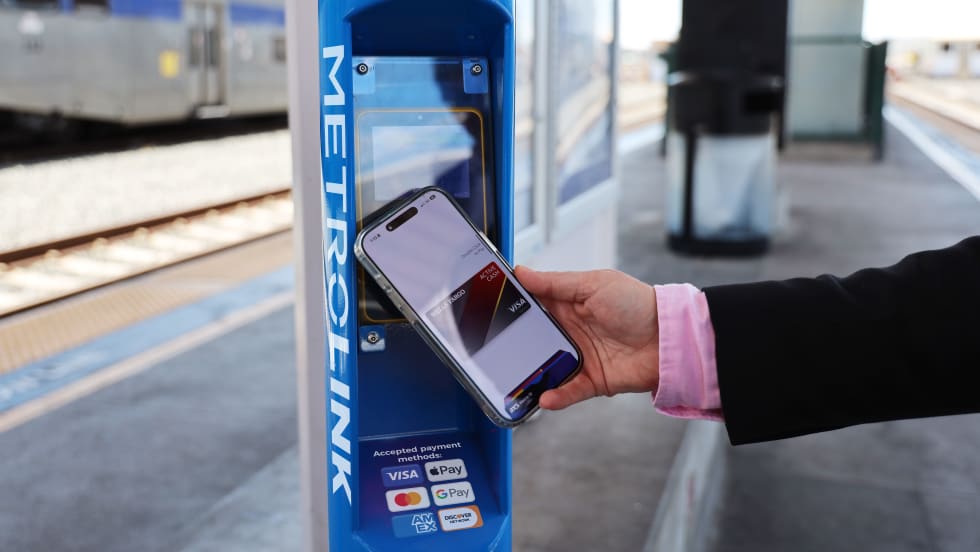
Southern California's Metrolink Debuts Contactless Fare Payment Pilot
Customers traveling between Redlands and Los Angeles can now tap their preferred payment method, including a credit or debit card, mobile wallet, or wearable device, at station validators before boarding and again while exiting.
Read More →
California's BART Approves FY27 Budget While Maintaining Service Levels
The budget covers July 1, 2026, through June 30, 2027, a period when pandemic emergency funds run out, the District faces a structural deficit of $375 million, and a regional transit funding measure may appear on the November ballot.
Read More →
STL Metro Transit To Launch Next-Generation Fare Collection and Security Gates
The St. Louis transit agency will begin the phased rollout of gated station access and integrated fare technology to improve security and the customer experience.
Read More →
CATS FY27 Budget Prioritizes Safety, Service
New investments in security, service expansion, and rail development aim to improve the rider experience while keeping fares flat.
Read More →
Transit Agencies Nationwide Gear Up to Move World Cup Crowds
As millions of fans prepare to descend on host cities, transit leaders are turning a month-long global event into a proving ground for the future of customer experience, mobility, and crowd management.
Read More →
OCTA Approves $2 Billion Budget for FY 2026-27, Prioritizing Transit Investments
More than half of the agency’s upcoming spending plan is dedicated to transit as OCTA balances infrastructure investment with fiscal stability.
Read More →