



TARC Turns to tech to become an integrated mobility solutions provider
Customer amenities continue to set the agency apart and take it closer to its larger goal of becoming the mobility manager for the region.


With TARC’s recently created LouLift service — its downtown and tourist destination circulators — the agency has enhanced connectivity for over
24 million annual visitors.
Photos courtesy TARC
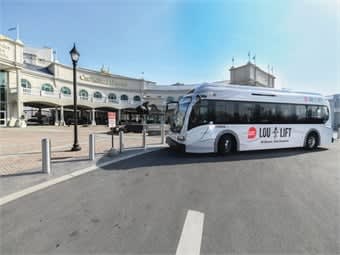
With TARC’s recently created LouLift service — its downtown and tourist destination circulators — the agency has enhanced connectivity for over
24 million annual visitors.
Photos courtesy TARC
The Transit Authority of River City (TARC) was founded in 1974 when Louisville voters approved a tax increase to fund mass transit. Mayor Harvey Sloane championed the campaign at a time when private mass transit operators — unable to provide adequate service — were going out of business. With the help of federal funding, TARC purchased the Louisville Transit Co., bought new buses, reduced fares, and expanded service. Fast forward to today, the agency is celebrating its 45th year as an industry leader. In the push to offer Mobility as a Service (MaaS), TARC continues to ensure the ride “from where you are, to where you want to be” is more convenient, more productive, and most importantly, more enjoyable, says TARC Executive Director Ferdinand L. Risco Jr.
Embracing tech advances
In pursuit of these goals, TARC is focused on embracing state-of-the-art technological advancements that improve the customer experience and provide the service today’s customers demand. Offerings include, Wi-Fi on every bus, charging stations for mobile devices, bus rapid transit service to downtown (coming January 2020), and a dynamic trip planner. Customer amenities, such as the recent move away from paper tickets to an electronic-fare system (MyTARC) and its new TARC mobility app, continue to set the agency apart and take it closer to its larger goal of becoming the mobility manager for the region.
The TARC mobile app, the first of its kind to be introduced to customers by any transit agency, is a crucial next step in this process. “As an integrated mobility platform, it enables our customers to plan trips across multiple modes of travel, including TARC, Uber, Lyft, Bird Scooters, and LouVelo Bike Share,” says Risco Jr.
By integrating a seamless payment solution to the multimodal trip planner (coming later this year), riders will be able to plan and pay for multiple mobility modes, including ride-shares and public transit, all in one place.

Risco Jr.
“This app positions TARC as a leader in MaaS, and moves forward our transformation from a transit agency to an integrated mobility solutions provider,” Risco Jr. explains.
In addition to the various mobility modes available to choose from, the app also streams activities, entertainment, landmarks, and parking availability throughout the Greater Louisville Region, all in real-time. Ensuring residents and visitors alike move freely throughout the community.
Electric circulator system
Downtown Louisville — the hub of TARC’s service area and its larger community — is experiencing a historic boom in terms of its ever-increasing tourism industry. With TARC’s recently created LouLift service — its downtown and tourist destination circulators — the agency has enhanced the connectivity for over 24 million annual visitors, providing easily accessible transportation and helping to generate the additional economic success necessary to move Louisville and the region forward.
“The relationship between resident prosperity and visitor experience, with over 26,000 tourism related jobs, is closely tied to the ease in which guests to the city use our service,” Risco Jr. says.
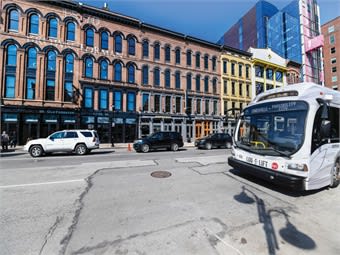
With one of the largest and fastest-growing electric fleets in the country, TARC continues to pursue its city’s goal of an 80% cut to greenhouse emissions by 2050.
These all-electric circulators are a benchmark of service for the organization. And, with one of the largest and fastest-growing electric fleets in the country, TARC continues to pursue its city’s goal of an 80% cut to greenhouse emissions by 2050. Thanks to additional funding recently awarded by the Congestion Mitigation and Air Quality (CMAQ) program to purchase two new electric vehicles, TARC is able to continue to decrease its reliability on diesel-dependent vehicles and move closer to a sustainable all-electric fleet.
“Whether customer trips are 100% TARC-reliant or it is just a piece of their larger transportation needs, as we celebrate our 45th year of service, our dedication to expanding service, providing innovative mobility solutions, and connecting communities throughout our region by offering an enjoyable, convenient, and productive experience is stronger than ever before,” Risco Jr. says.
TARC’s mission is to explore and implement transportation opportunities that enhance the social, economic, and environmental well-being of its service area. This includes connecting residents of and visitors to the region with 102 paratransit vehicles and 223 buses traveling 43 fixed routes to locations within five counties across two states.
More Management

METRO Opens Submissions for 2026 Motorcoach Awards
Nominations are now being accepted for METRO Magazine’s Operator of the Year and Innovative Operator of the Year awards.
Read More →
New York MTA Advances Final Contract for Second Avenue Subway Expansion
Contract Four is the largest in the Second Avenue Subway Phase 2 project and includes construction of station infrastructure, tracks, and signals for the subway expansion, MTA officials said. Work on Contract Four will begin in 2027.
Read More →
Transit Agencies Highlight Safety Gains at National Summit
Leaders from 15 major transit systems shared crime-reduction results and safety initiatives while discussing the role of continued federal support.
Read More →

NITA Names New Leadership, Expands Reduced-Fare Program at First Board Meeting
The new regional transit authority appointed its first board chair and interim executive director while extending reduced fares across CTA, Metra, and Pace for eligible riders.
Read More →
Beyond the Checklist: A Structured Approach to Transit Maintenance
Reliability-Centered Maintenance helps transit agencies move beyond routine checklists to focus limited resources on the assets and failures that have the greatest impact on safety, reliability, and service.
Read More →
APTA 2026 Nominating Committee Selects Leadership Slate, Names Chair and Vice Chair Nominees
Leadership changes will help shape the association’s priorities and its representation of the transportation industry during the 2026–2027 term.
Read More →
DART Launches Major Security, Fare Enforcement Initiative
The 90-day demonstration will deploy coordinated security teams at five light rail stations while testing controlled access and gathering data to guide future investments.
Read More →
Advancing Fare Collection Through Technology and Innovation
Learn about delivering 1300 gates at 91 stations while managing fare evasion. Explore the large scale deployment, solution customization and real-world results that affect the region. Prepare for deployment in your region now.
Read More →
Game Day in Motion: Moving Millions During the 2026 World Cup
Between packed transit stations and team motorcoaches, see how agencies and operators across North America tackled the transportation demands of the 2026 FIFA World Cup.
Read More →
Surface Transportation Extension Averts Shutdown, Leaves Transit Funding Gap
The stopgap keeps federal transportation programs moving, but missing advance funding could complicate the transit and rail projects agencies are planning next.
Read More →