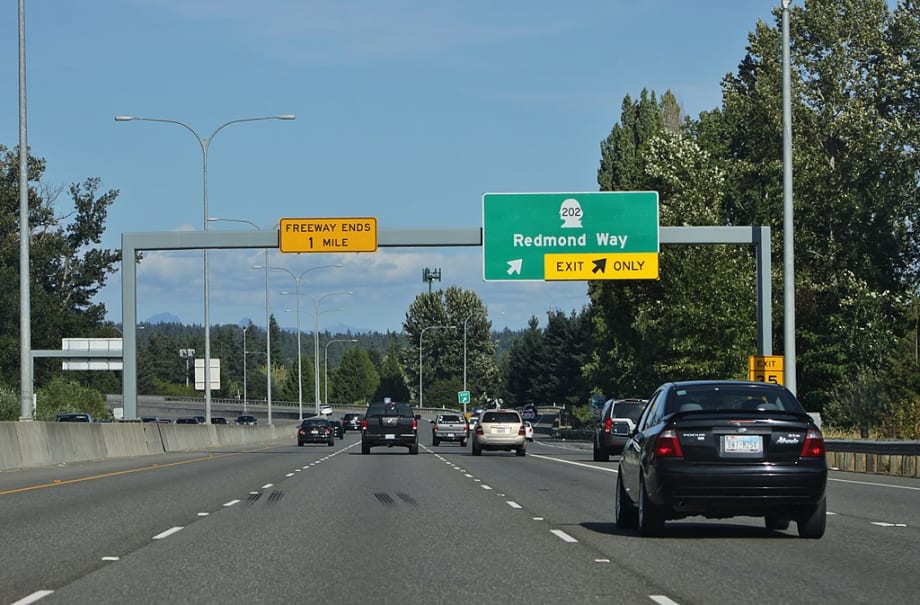
The Washington State Transportation Commission recommends the state begin its initial move away from fuel taxes to avoid long-term issues with financing the increasing and evolving needs of our modern highway system.
A new report by the state of Washington highlights the necessity and benefits of moving away from fuel taxes and transitioning to a Vehicle Miles Traveled (VMT) system to fund the state’s highway system.
The Washington State Transportation Commission, after an extensive investigation, analysis, and pilot phase, recommends the state begin its initial move away from fuel taxes to avoid long-term issues with financing the increasing and evolving needs of our modern highway system.
Ad Loading...
According to the report on a potential transition to a VMT, or Road Usage Charge (RUC), system, “With the gas tax already declining, adoption of cleaner and alternative fuel vehicles accelerating, and RUC systems and technologies ready for implementation, the state must act now to avoid a predictable transportation funding crisis later…. RUC policy, public acceptance, and system capabilities are mature enough to implement a RUC system that will serve as a foundation for a larger-scale, new highway funding system in the future.”
Among the report’s key findings:
Beginning the transition to a VMT system now will help avoid a predictable, preventable revenue crisis associated with continuing to rely on the gas tax. A transition can also ensure that drivers do not pay both a gas tax and a VMT.
Continued reliance on the gas tax will continue to shift the burden of paying for the road system onto an increasingly smaller number who drive older vehicles with low MPG and may not be able to afford newer, more fuel-efficient vehicles, and rural drivers, who on average drive less fuel-efficient cars compared to urban drivers and already pay a larger share of gas taxes due to driving greater distances.
Rural drivers, generally speaking, would likely pay less under a VMT system while urban drivers would pay more than under current fuel rates.
Using the rates tested in the pilot, hybrid drivers, for example, would likely pay more under a VMT system, while drivers of older, less fuel-efficient pickup trucks would likely pay a third less than they pay under the current fuel tax rate.
Under the pilot program, 71% of respondents supported implementation of a VMT as a replacement to the gas tax. 68% preferred VMT over the gas tax or preferred it equally.
There is now a pathway toward replacing the gas tax that is fiscally sustainable and fair.
It is possible to transition to a VMT system that protects privacy, preserves equity, and can be implemented at a reasonable cost.
The report noted a transition can begin while some key issues continue to be addressed, such as issues of privacy, simplicity for users, equity, and collection costs. Several other states are also involved in analyzing and piloting VMT systems with the assistance of federal transportation grants authorized in the FAST Act.
The agreement restores full commuter rail service after a three-day shutdown disrupted travel for hundreds of thousands of riders across the New York region.
Following its 2024 acquisition, ENC is upgrading operations, expanding capacity, and aligning its approach to meet agency demand for reliability and on-time delivery. METRO spoke to John Obert, vice president of transit sales, to find out more.
Officials said the ridership gains recorded in February, March, and April signal renewed public confidence in transit and reinforce AC Transit’s vital role in connecting East Bay residents with jobs, schools, healthcare, shopping, and recreational destinations.
A new study found commuters in several major U.S. cities could save hundreds of dollars each month by taking public transit instead of driving, with Los Angeles ranking as the nation’s most expensive city for car commuters.
HDR’s transit program management lead discusses the challenges of overseeing large capital projects, adapting to cost and supply chain pressures, and the capabilities agencies need to build for the future.
Over the three days, PRT recorded 485,000 rides, reflecting the extraordinary number of trips taken as people traveled throughout the region for Draft events, work, and daily life.
Garo Hovnanian explores how agencies can better navigate competing priorities, strengthen decision-making, and prepare for a future shaped by electrification and emerging mobility.
The plan includes investments in cleaner vehicles and upgraded stations, NJT LiveView to provide real-time GPS tracking of train and light rail service, enhanced safety initiatives through a new Real Time Crime Center, and the debut of a redesigned NJ TRANSIT mobile app.
ABQ RIDE Forward is the first transit system overhaul in more than 25 years. This latest phase marks 15% completion of the 16-phase rollout, which will continue over the next several years.