



RELATED: Easy Mile, partners to integrate driverless tech into full-size bus
Driverless vehicles and the future of public transit
To remain relevant, transit agencies must have a vision for the future, including the role that driverless technology will play.
by Lauren Isaac
December 28, 2017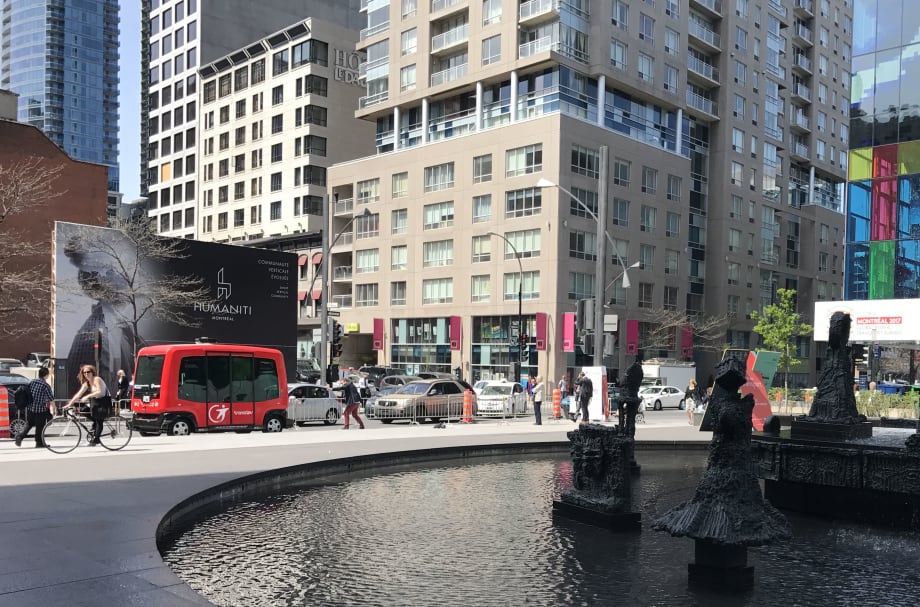
Autonomous vehicle demonstrations were featured during the 2017 UITP Summit held in May in Montreal. Transdev and its vehicle developer partner, EasyMile, showcased their electric vehicle (pictured in red), which shuttled people along Montreal’s Olympic Park.
5 min to read

Autonomous vehicle demonstrations were featured during the 2017 UITP Summit held in May in Montreal. Transdev and its vehicle developer partner, EasyMile, showcased their electric vehicle (pictured in red), which shuttled people along Montreal’s Olympic Park.
The advent of driverless technology gives rise to a number of daunting questions: Will driverless passenger vehicles make public transit obsolete? Will mobility options become increasingly privatized as driverless technology is broadly adopted? Should transit agencies stop investing in their future fleets, as driverless vehicles subsume demand for public transit?
To remain relevant, transit agencies must have a vision for the future, including the role that driverless technology will play. Because emerging technologies and concepts that may not even exist today could impact this vision, transit agencies should also prepare for a variety of scenarios and outcomes.
Here are some potential components of what such a “vision” may entail:
Trip-planning information is integrated across modes and agencies (public and private), so the general public has the ability to evaluate their travel options with comprehensive information on travel time, cost, environmental impact, and more.
Real-time schedules for all transportation modes are centrally available.
Vehicles and transit schedules are “right-sized” so fleets are used effectively and there are no more empty buses.
Fare payment is made electronically and only one payment is needed for each whole trip.
Travel times are generally predictable and well-communicated.
Lower income and people with disability populations have access to all of these services.
Generally speaking, public transit agencies have two key goals: (i) to enhance mobility throughout their respective regions, and (ii) to provide reasonable access to transportation to all their respective constituents. For decades, transit agencies have addressed these goals by operating bus and/or train systems that are subsidized by the federal, state, and local government.
In recent years, while public transit agencies operated these traditional services, the private sector introduced new, technology-enabled transportation options that are now household names. Specifically, transportation network companies, such as Uber and Lyft, commuter buses like Chariot, dynamic vanpools like Via), carpooling apps like Scoop, and employer-provided buses have taken on more and more prominent roles all over the U.S. and abroad. Even before driverless technology, the private sector has already disrupted the traditional public transit business model.
Many of the private companies listed above are investing in or developing driverless technology, and further disruption is likely imminent. These companies are providing hints as to how driverless technology will be introduced: with both on-demand and fixed-route services. Driverless mobility options may be shared and they will likely be priced accordingly (i.e., the more people in a vehicle, the less an individual pays). These services will be branded and targeted in order to maximize that company’s market impact.
Importantly, private transportation companies are providing services that support public transit agencies’ goals, without any of the limitations that are generally associated with public entities reliant on subsidies and public funding. Private companies are able to leverage the latest advances in technology, invest significantly in marketing, and evolve and respond to customer demands at a seemingly rapid pace.
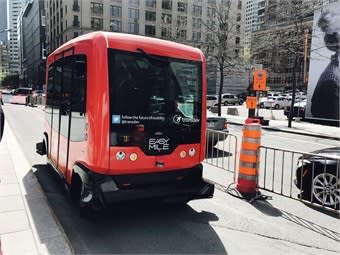
Driverless shuttles can integrate with other transportation modes for more rider efficiency.
As a result, a key component to every public transit agency’s vision for the future must be to form partnerships with private sector transportation companies, where appropriate. In doing so, public transit agencies will have the opportunity to leverage the advances of the private sector, both in technology and operating models, while still preserving the true mission of public transit. For example, a transit agency could partner with a private company to introduce driverless shuttles as a first/last mile solution. Both parties stand to benefit: the private company would charge either the passengers or the transit agency for this service, and the transit agency would increase transit ridership and reduce a bus or metro station’s parking requirements.
Once these partnerships are established, it will be important for public transit agencies to re-think what existing operations are still necessary and how they are provided. Some of the ways that public transit is likely to be impacted by driverless vehicles in its early stages are as follows:
Transit schedules may need to be altered to address changes in demand.
Paratransit services may be much less costly to provide to riders.
Fixed-route vehicles, such as buses, could be replaced with autonomous vehicles (and, in fact, may be likely contenders for early adoption).
The public transit labor force may change drastically (e.g., bus operators may be less in demand, while security enforcement personnel and data mining specialists needs may grow).
Transit fares may need to be modified to stay competitive with alternate providers.
Now is the time for transit agencies to develop pilots and plans that re-imagine public transportation. The driverless technology offers many benefits to transit agencies, including increased safety and mobility options, while also furthering the agencies’ goals. And, in fact, driverless shuttles are available today and many pilot programs are underway globally. Now is the time to consider a driverless shuttle pilot to introduce this technology (as both shared and electric) to public transit agencies and their constituents.
Driverless shuttles introduce a shared, electric, and autonomous solution for transit agencies to leverage today. They can operate in contained environments such as campuses, airports, and employment centers and they can provide a first/last mile solution to augment public transit networks, allowing individuals to reduce or eliminate their parking requirements, and increase mobility in a specific area.
Finally, driverless shuttles provide the potential for immediate adoption: state and local governments can already partner with driverless shuttle companies to provide additional public transit alternatives to their constituents.
Here are just a few examples of where driverless shuttles are being utilized around the world today:
In the Bay Area, the Contra Costa Transportation Authority (in partnership with the Livermore Amador Valley Transit Authority and other local agencies) are aiming to leverage driverless shuttles as a first/last mile transporter to the Bay Area Rapid Transit (BART) stations.
In the city of Arlington, Texas, driverless shuttles will be transporting people between their sports stadium and a parking lot.
In Paris, EasyMile’s driverless shuttles transported people between two train stations for a few month demo.In Singapore, EasyMile’s driverless shuttles are transporting people around Gardens by the Bay, a botanical garden.
While many automakers and private technology continue to develop their autonomous solutions, driverless shuttles introduce a driverless transportation option that can support public transit agency goals today. Driverless shuttles can improve safety, reduce greenhouse gas emissions, augment mobility options, and integrate with other transportation modes for more rider efficiency.
Lauren Isaac is the director of Business Initiatives for the North American operation of EasyMile (www.easymile.com).
Subscribe to Our Newsletter
More New Mobility

From Hardware to Digital Partner: Luminator Charts Its Next Chapter
CEO Magnus Friberg discusses Luminator’s shift toward becoming a digital partner, the growing importance of software and interoperability, and how AI can help agencies improve operations and passenger experience.
Read More →
Biz Briefs: Alstom Lands Canadian Contract, LYT to Supply California TSP, and More
In METRO's latest installment, we take a look at recent news from Complete Coach Works, Beep, FlixBus, and more partnerships making headlines across the transportation sector.
Read More →
CharterUP’s Armir Harris on Technology, AI, and the Future of Group Mobility
In a recent episode of METROspectives, CharterUP Founder/CEO Armir Harris discussed the company’s evolution from an online charter bus marketplace into a technology platform supporting public- and private-sector mobility and much more.
Read More →
Jacksonville’s NAVI Project Charts a New Course for Autonomous Public Transportation
Through its NAVI program, JTA is showing how autonomous vehicles, intelligent infrastructure, and coordinated operations can work together to deliver everyday public transportation.
Read More →
Biz Briefs: Luminator Marks Milestone and More
From manufacturers and suppliers to transit agencies and motorcoach operators, these updates offer a snapshot of the projects, partnerships and business moves driving the industry forward.
Read More →
New Tricks for Old Bureaucracies: Joshua Schank on Making Transit Innovation Stick
Former LA Metro Chief Innovation Officer Joshua Schank discusses why good ideas aren't enough, how transit agencies can overcome resistance to change, and why today's challenges demand more innovation.
Read More →
How DART's GoPass Is Redefining Regional Mobility
Serving 14 transit agencies, GoPass simplifies multimodal travel by allowing riders to plan, pay for, and manage an entire trip through one app.
Read More →
Biz Briefs: OCTA Taps Clean Energy for Hydrogen Station, Stadler to Supply Via Rail Vehicles, and More
From manufacturers and suppliers to transit agencies and motorcoach operators, these updates offer a snapshot of the projects, partnerships and business moves driving the industry forward.
Read More →CharterUP Expands Into New Mobility and Autonomous Transportation
Vice President of New Mobility Stephen Joos discusses how CharterUP is leveraging its nationwide transportation network, technology platform, and autonomous vehicle partnerships to expand into workforce mobility, campus shuttles, and transit solutions.
Read More →
METRO Magazine Announces 2026 Innovative Solutions Awards Winners
Projects Recognized for Advancing Mobility Through Technology, Accessibility, Workforce Innovation, and Operational Excellence
Read More →