



Facility Expansion to Boost USSC's Production
The company’s new 300,000-square-foot manufacturing facility is ISO 14001-certified.
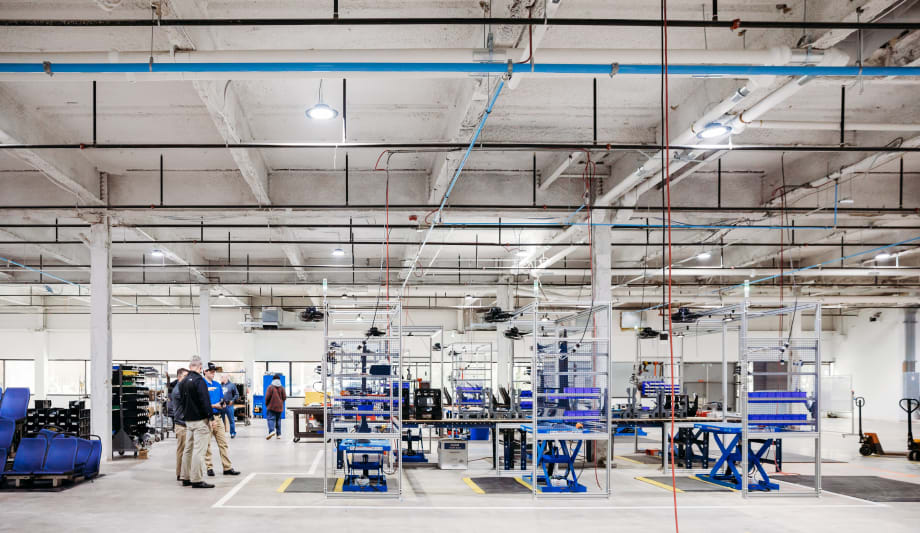
The acquisition and renovation of the new facility, located across the street from its original site, took just 10 months and is on track to construct an additional building, which will add 200,000 more square feet to the company’s footprint.
USSC Group
The acquisition and renovation of the new facility, located across the street from its original site, took just 10 months and is on track to construct an additional building, which will add 200,000 more square feet to the company’s footprint.
USSC Group
Employees, customers, and partners of seating manufacturer USSC Group, all gathered in Exton, Pennsylvania, in November, to celebrate the grand opening of its new 300,000-square-foot manufacturing facility. The acquisition and renovation of the new facility, located across the street from its original site, took just 10 months and is on track to construct an additional building, which will add 200,000 more square feet to the company’s footprint. The move was prompted by high growth across all of the company’s product lines, including operator and passenger seating for bus and rail, as well as its Fogmaker fire suppression systems.
With the opening of this new facility, the company will add more than 200 manufacturing jobs in Chester County. We spoke with USSC President/CEO Joe Mirabile to get more insight about expansion and the company’s products.
What differentiates this facility from the original?
We’ve invested around $50 million into machinery, the buildout of the building itself, and improvement to the plant. We are also putting in place a significant amount of personnel and robotics equipment to better serve our customer and lower our lead times and improve quality. So, things like [the use of] semiautonomous laser tube cutting machines, which was originally a 30-minute process, is now down to a 15-second process.
What new technologies have you implemented in the facility?
We invested heavily in inventory management systems as our inventory and product portfolio continues to grow and we continue to expand our part numbers and offerings to our different customers. [We’ve] implemented a forklift system, basically a racking system that uses GPS to geo-locate different products in the facility. Using these types of forklifts and high-level machines that geo-locates a product makes it much easier for employees to pick up that product and take it to the production areas.

Joe Mirabile
Does it employ sustainability or worker well-being elements?
We dedicated a lot of [the facility design] to worker safety and their working experience. All areas have floor-to-ceiling windows to allow a lot of natural light in. In addition to being well-lit, it is very comfortable. We wanted to build a world class technologically -based manufacturing facility here.
We are ISO 14001-certified, which is very near and dear to our hearts at the company. We follow environmentally-sustainable practices including going to a largely paperless office and moving more and more digital every day.
The facility includes a full employee gym. We also provide several employee health and wellness events each month. That can include everything from nutrition and cooking classes, to financial education classes.
What new trends, technologies are impacting USSC's products?
We have a [firm] focus on health and safety for drivers and reducing full-body vibration. [That led to] our recent acquisition of the exclusive rights to [ClearMotion’s active suspension seat technology, formerly known as Bose Ride,] which cancels road disturbances and reduces whole-body vibration and fatigue for drivers by up to 94%.
We are able to nearly eliminate the dangers of full-body vibration, such as neck and back injuries and injuries to internal organs.
We’re also continuing to develop the lightest, most durable passenger seating to support the rise of E-buses and fuel economy focus. Just recently, we developed the only three-point seatbelt-capable seating options out there.
How is the company evolving in light of autonomous vehicles?
We still believe a lot of these vehicles will have operators in them, so some of the technologies that we’ve developed, such as the Bose technology, surrounding that driver, or ambassador. Some bus companies talk about having ambassadors onboard. Just because a vehicle is autonomous doesn’t mean it will not have an operator. So, we are thinking about what that future seating position looks like and how we can assist in making it the safest and most comfortable position. That's what we focus on.
More New Mobility

From Hardware to Digital Partner: Luminator Charts Its Next Chapter
CEO Magnus Friberg discusses Luminator’s shift toward becoming a digital partner, the growing importance of software and interoperability, and how AI can help agencies improve operations and passenger experience.
Read More →
Biz Briefs: Alstom Lands Canadian Contract, LYT to Supply California TSP, and More
In METRO's latest installment, we take a look at recent news from Complete Coach Works, Beep, FlixBus, and more partnerships making headlines across the transportation sector.
Read More →
CharterUP’s Armir Harris on Technology, AI, and the Future of Group Mobility
In a recent episode of METROspectives, CharterUP Founder/CEO Armir Harris discussed the company’s evolution from an online charter bus marketplace into a technology platform supporting public- and private-sector mobility and much more.
Read More →
Jacksonville’s NAVI Project Charts a New Course for Autonomous Public Transportation
Through its NAVI program, JTA is showing how autonomous vehicles, intelligent infrastructure, and coordinated operations can work together to deliver everyday public transportation.
Read More →
Biz Briefs: Luminator Marks Milestone and More
From manufacturers and suppliers to transit agencies and motorcoach operators, these updates offer a snapshot of the projects, partnerships and business moves driving the industry forward.
Read More →
New Tricks for Old Bureaucracies: Joshua Schank on Making Transit Innovation Stick
Former LA Metro Chief Innovation Officer Joshua Schank discusses why good ideas aren't enough, how transit agencies can overcome resistance to change, and why today's challenges demand more innovation.
Read More →
How DART's GoPass Is Redefining Regional Mobility
Serving 14 transit agencies, GoPass simplifies multimodal travel by allowing riders to plan, pay for, and manage an entire trip through one app.
Read More →
Biz Briefs: OCTA Taps Clean Energy for Hydrogen Station, Stadler to Supply Via Rail Vehicles, and More
From manufacturers and suppliers to transit agencies and motorcoach operators, these updates offer a snapshot of the projects, partnerships and business moves driving the industry forward.
Read More →CharterUP Expands Into New Mobility and Autonomous Transportation
Vice President of New Mobility Stephen Joos discusses how CharterUP is leveraging its nationwide transportation network, technology platform, and autonomous vehicle partnerships to expand into workforce mobility, campus shuttles, and transit solutions.
Read More →
METRO Magazine Announces 2026 Innovative Solutions Awards Winners
Projects Recognized for Advancing Mobility Through Technology, Accessibility, Workforce Innovation, and Operational Excellence
Read More →