



Alstom launches maintenance tool, ERTMS systems at Innotrans
HealthHub, a predictive maintenance tool monitors the health of trains, infrastructure and signaling assets, while the Atlas 400 and 500 scalable ERTMS systems are applicable for resignalling upgrades or a new-build project.


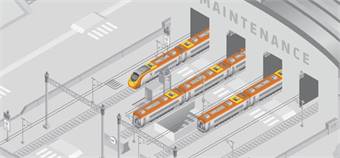
Alstom launched a new predictive maintenance tool, HealthHub, which is able to monitor the health of trains, infrastructure and signalling assets, as well as new scalable ERTMS systems at InnoTrans, the world’s biggest railway tradeshow taking place in Berlin Sept. 23-26.
HealthHub is an innovative approach designed to shift from traditional mileage-based maintenance to condition-based predictive maintenance, thus reducing the lifecycle cost for the operator, according to the company.
HealthHub is supported by various high technology data capture solutions such as TrainScanner, an automated diagnostics portal capable of measuring the condition of three key consumables of a train as it moves through the portal: wheels, brake pads and pantograph carbon strips.
It allows up to 15% of material costs to be saved by replacing them only on an as-needed basis. For infrastructures, TrackTracer will allow similar monitoring of the track and catenaries.
Additionally, Alstom launched Atlas 400 and 500 scalable ERTMS systems for traffic density from 6 to 600 trains per day, whether on passenger, freight or mixed traffic lines. They are applicable for a resignalling upgrade or a new-build project. The scalability or configurable deployment in accordance with customer needs is achieved with modular software applicable to the same onboard and trackside computer equipment.
Atlas 400 has been specifically designed for low density lines. With Atlas 400, train detection is performed by the trains themselves, which reduces the need for trackside equipment, providing investment savings from 12% to 16% and up to 30% on maintenance cost. It is designed to be operated with satellite positioning and various radio bearers.
Atlas 500 has been designed for high density lines and increases headway performance by up to 25% for customers. Trains can follow each other very closely thanks to the accurate braking curve. It also reduces the time for station stops. Atlas 500 combines ATO [1] and moving block functionalities without adding extra equipment – and so does not increase the cost of ownership. Furthermore, Atlas 500 uses GPRS which allows communication with more trains in dense traffic areas.
More Management

METRO Opens Submissions for 2026 Motorcoach Awards
Nominations are now being accepted for METRO Magazine’s Operator of the Year and Innovative Operator of the Year awards.
Read More →
New York MTA Advances Final Contract for Second Avenue Subway Expansion
Contract Four is the largest in the Second Avenue Subway Phase 2 project and includes construction of station infrastructure, tracks, and signals for the subway expansion, MTA officials said. Work on Contract Four will begin in 2027.
Read More →
Transit Agencies Highlight Safety Gains at National Summit
Leaders from 15 major transit systems shared crime-reduction results and safety initiatives while discussing the role of continued federal support.
Read More →

NITA Names New Leadership, Expands Reduced-Fare Program at First Board Meeting
The new regional transit authority appointed its first board chair and interim executive director while extending reduced fares across CTA, Metra, and Pace for eligible riders.
Read More →
Beyond the Checklist: A Structured Approach to Transit Maintenance
Reliability-Centered Maintenance helps transit agencies move beyond routine checklists to focus limited resources on the assets and failures that have the greatest impact on safety, reliability, and service.
Read More →
APTA 2026 Nominating Committee Selects Leadership Slate, Names Chair and Vice Chair Nominees
Leadership changes will help shape the association’s priorities and its representation of the transportation industry during the 2026–2027 term.
Read More →
DART Launches Major Security, Fare Enforcement Initiative
The 90-day demonstration will deploy coordinated security teams at five light rail stations while testing controlled access and gathering data to guide future investments.
Read More →
Advancing Fare Collection Through Technology and Innovation
Learn about delivering 1300 gates at 91 stations while managing fare evasion. Explore the large scale deployment, solution customization and real-world results that affect the region. Prepare for deployment in your region now.
Read More →
Game Day in Motion: Moving Millions During the 2026 World Cup
Between packed transit stations and team motorcoaches, see how agencies and operators across North America tackled the transportation demands of the 2026 FIFA World Cup.
Read More →
Surface Transportation Extension Averts Shutdown, Leaves Transit Funding Gap
The stopgap keeps federal transportation programs moving, but missing advance funding could complicate the transit and rail projects agencies are planning next.
Read More →