



American Bus Association Files Lawsuit Against NYC Over Bus Idling Rules
The lawsuit, filed in the U.S. District Court for the Southern District of New York, challenges the City’s use of its Citizens Air Complaint program.

The ABA asserts the program disproportionately targets private motorcoach companies, while exempting publicly owned fleets, including buses operated by the MTA and New York City Transit, from enforcement under the same law.
METRO
- The American Bus Association has initiated a lawsuit against New York City concerning its bus idling regulations.
- The legal action is being pursued in the U.S. District Court for the Southern District of New York.
- The lawsuit disputes the implementation of the City's Citizens Air Complaint program.
*Summarized by AI
The American Bus Association (ABA), joined by leading interstate motorcoach operators, filed a federal lawsuit against New York City and its Department of Environmental Protection (DEP), seeking to halt what it calls an unfair, discriminatory, and costly enforcement regime under the City’s idling law, one that is “driving up costs, disrupting interstate commerce, and threatening a vital sector of the region’s economy.”
The lawsuit, filed in the U.S. District Court for the Southern District of New York, challenges the City’s use of its Citizens Air Complaint (CAC) program.
The ABA asserts the program disproportionately targets private motorcoach companies, while exempting publicly owned fleets, including buses operated by the Metropolitan Transportation Authority (MTA) and New York City Transit, from enforcement under the same law.
Possible Impact on the Industry
The ABA warns that New York City’s current enforcement practices and proposed increases in fines could significantly restrict access to the city for interstate bus operators, with ripple effects for tourism, commuters, and the small businesses that depend on affordable group travel into New York City.
The ABA contends that New York City’s idling enforcement regime is unlawful, arguing that it:
- Violates constitutional protections by treating similarly situated transportation operators differently.
- Unlawfully burdens interstate commerce by increasing the cost and risk of entering and operating in New York City.
- Conflicts with federal safety regulations that often require buses to idle to maintain critical systems, such as air brakes, passenger safety equipment, passenger cabin temperatures, wheelchair accessibility equipment, and emissions-control technology.
“This lawsuit is about ensuring interstate bus operators are treated fairly under the law and that enforcement is applied consistently across all fleets,” said Fred Ferguson, president and CEO of the ABA. “Modern motorcoaches are among the most environmentally efficient forms of passenger transportation, emitting less carbon dioxide per passenger-mile than any other mode and outperforming air, rail, and personal vehicles in energy efficiency.”
An Inordinate Amount of Fines
According to the complaint, private carriers have been issued more than 4,000 idling summonses since 2020, resulting in fines totaling hundreds of thousands of dollars and mounting legal costs.
Meanwhile, the City’s own fleets are routinely exempt from penalties through administrative dismissals and enforcement loopholes, said officials. To make matters worse, the New York City Council has introduced a bill that would increase idling fines by up to 200%, raising the maximum penalty to $6,000 — an amount that could force small operators out of business and deter buses and their passengers from traveling to New York City.
The lawsuit also calls out the City’s “bounty-style” CAC system, which offers financial incentives to private individuals to file idling complaints. Under the CAC program, private citizens can receive a portion of the penalties collected from reported violations. The ABA argues that this structure fosters a predatory enforcement environment driven by profit rather than environmental benefit.
The ABA states that motorcoaches are among the most environmentally efficient forms of transportation available today.
According to research commissioned by the American Bus Association Foundation and conducted in partnership with Oxford Economics, motorcoaches outperform commercial air travel, rail, transit buses, ferries, and personal vehicles in energy consumption and carbon emissions per passenger-mile. The study also found that motorcoaches equipped with Clean Idle technology reduce nitrogen oxide emissions during common loading and rest-stop periods by nearly 50% below the regulatory limit.
“Industry research shows motorcoaches emit less carbon dioxide per passenger-mile than any other major mode of transportation, and many modern fleets are equipped with Clean Idle technology that significantly reduces emissions during the necessary idle period,” said Michelle Petelicki, president of Panorama Tours. “This lawsuit is not about opposing environmental goals. It is about ensuring enforcement is fair, consistent, and grounded in operational realities.”
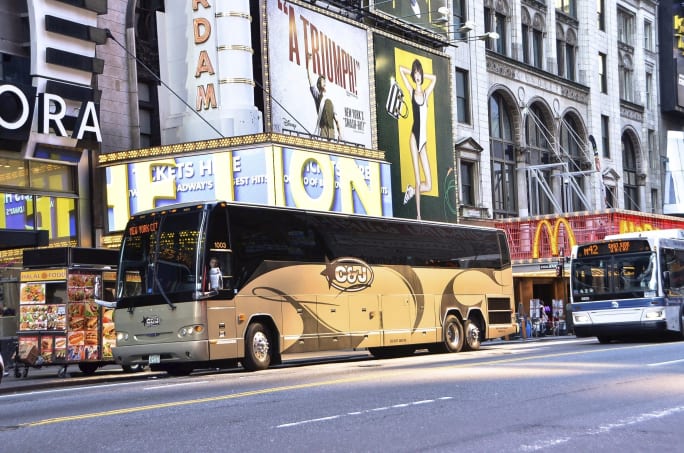
According to the complaint, private carriers have been issued more than 4,000 idling summonses since 2020, resulting in fines totaling hundreds of thousands of dollars and mounting legal costs.
C&J Bus Lines
Operator Feedback
Recent ABA survey data further underscores the growing impact New York City’s idling enforcement policies are having on interstate transportation, tourism, and motorcoach operations.
Operators reported increased financial strain, operational disruptions, delayed citations, and concerns about passenger safety and accessibility. More than 40% of respondents said they have already reduced trips to New York City or declined charters due to the current enforcement environment, and many warned they may further limit or end service to the city if penalties continue to rise.
Survey respondents also described operational challenges ranging from limited layover space and delayed citations to concerns around passenger safety, accessibility, and maintaining temperature-controlled environments for seniors, students, and medically vulnerable passengers.
One respondent noted that “some students depend on temperature-controlled environments due to medical conditions, disabilities, or motion sensitivity,” highlighting concerns that strict idling enforcement may negatively impact passenger well-being and accessibility.
Multiple operators also indicated they are considering reducing or ending trips to New York City entirely due to the current enforcement environment.
The ABA emphasizes that the lawsuit does not challenge clean air objectives or environmental progress. Instead, it seeks equal enforcement, regulatory consistency, and policies that recognize the role motorcoaches already play in reducing congestion and transportation-related emissions.
It further argues that sustainable transportation policy should encourage efficient group travel solutions rather than disproportionately penalize the very operators that help reduce traffic congestion, vehicle volume, and emissions in New York City, said officials.
Through the lawsuit, the ABA and its co-plaintiffs are seeking injunctive relief to stop the City’s enforcement practices, along with a declaration that the current regime is unconstitutional and preempted by federal law.
Quick Answers
The American Bus Association filed a lawsuit against NYC over the City’s use of its Citizens Air Complaint program concerning bus idling rules.
*Summarized by AI
More Motorcoach

From Surviving to Thriving: Building Stronger Transportation Organizations
Bus Business Consultants founder Brian Dickson shares lessons on leadership, organizational health, and creating options for long-term success in a changing transportation industry.
Read More →
Report: Canadian Motorcoach Industry Generates $4.4B in Economic Impact
The 2025 Motorcoach Economic Impact Report finds motorcoach travel supported nearly 25,000 jobs and generated $980 million in federal, provincial, and local taxes.
Read More →
Prevost Opens Expanded Chicago-Area Service Center
The $8.1 million Elk Grove Village investment nearly triples facility space while adding service capacity, parts storage, and customer amenities.
Read More →
People Movement: Dan Dipert Coaches Adds Third-Generation Leader, Keolis Names New Valley Metro VP/GM, and More
In this edition, we also cover recent appointments and announcements at the Wabtec, SilverRide, HNTB, and more, showcasing the individuals helping to shape the future of transportation.
Read More →
METRO Opens Submissions for 2026 Motorcoach Awards
Nominations are now being accepted for METRO Magazine’s Operator of the Year and Innovative Operator of the Year awards.
Read More →
Biz Briefs: Alstom Lands Canadian Contract, LYT to Supply California TSP, and More
In METRO's latest installment, we take a look at recent news from Complete Coach Works, Beep, FlixBus, and more partnerships making headlines across the transportation sector.
Read More →
Biz Briefs: RIPTA Unveils New Frontrunners, Clevland RTA Adds New Siemens, and More
In METRO's latest installment, we take a look at recent news from Siemens, Prevost, Dodge, and more partnerships making headlines across the transportation sector.
Read More →
People Movement: Holly Arnold Joins Transdev and More
In this edition, we also cover recent appointments and announcements at Pace, CamTran, MCI, and more, showcasing the individuals helping to shape the future of transportation.
Read More →
ABA Report: Motorcoach Travel Generates $161.6B Economic Impact
The 2025 analysis finds motorcoach travel supported nearly 900,000 jobs and generated $28 billion in federal, state, and local taxes.
Read More →
CharterUP’s Armir Harris on Technology, AI, and the Future of Group Mobility
In a recent episode of METROspectives, CharterUP Founder/CEO Armir Harris discussed the company’s evolution from an online charter bus marketplace into a technology platform supporting public- and private-sector mobility and much more.
Read More →