




Keep Reading: APTA Data Shows Public Transportation Drives Economic Growth
APTA Launches AI Guidance Suite for Public Transit
The industry group’s new reports provide transit agencies with implementation strategies, governance recommendations, and examples of AI in action.
May 15, 2026
According to APTA’s research, customer support and customer analytics are currently the most common areas of AI deployment in public transit.
Credit:
METRO
3 min to read
The American Public Transportation Association (APTA) recently released “Artificial Intelligence (AI) and Machine Learning (ML) in Public Transit: A Primer,” along with four companion AI Guidance Briefs designed to help public transit agencies evaluate and deploy AI and machine learning tools across their operations.
The Primer and Guidance Briefs draw on a survey of transit agencies and staff interviews to document current and planned AI applications across eight functional areas: back office, operations, customer support, maintenance, safety and security, customer analytics, planning, and fares and ticketing.
“Public transit agencies of all sizes are deploying AI to make service more reliable, more efficient, and more responsive to riders,” said Paul P. Skoutelas, APTA president and CEO. “These resources give our member organizations a clear picture of where the industry stands and a practical roadmap for moving forward responsibly — from the largest metro systems to small rural providers.”
According to the research, customer support and customer analytics are currently the most common areas of AI deployment. When including agencies’ future plans, back office and operations functions ranked highest, with 50% and 47% of survey respondents, respectively, indicating current or planned use.
The report also highlights several real-world examples of AI implementation:
- The Metropolitan Transportation Authority in New York increased maintenance productivity by 75% and reduced material costs by 24% using an AI-powered predictive maintenance system for its bus fleet.
- AC Transit in California used AI image recognition for bus lane enforcement, increasing violation citations from 22 to 787 over a comparable two-month period following implementation.
- Riverside Transit Agency in California piloted a disruption management tool that automatically pushes real-time detour updates to riders and operators across multiple channels, cutting response times and improving schedule reliability.
- CapMetro in Texas deployed an AI virtual agent for paratransit trip scheduling, freeing customer service staff to focus on more complex calls.
- Prairie Hills Transit in South Dakota, a paratransit provider, deployed an AI-based dispatch system that automated vehicle assignments and driver scheduling, replacing a process previously managed with handwritten notes.
“What stands out in this research is the breadth of practical applications already underway,” Skoutelas said. “Agencies are piloting, learning, and scaling — and that pragmatic approach is exactly what will help public transit deliver even better outcomes for riders and communities.”
The four AI Guidance Briefs address key implementation challenges agencies face, including technology infrastructure, governance and policy, workforce readiness, and procurement and deployment strategies.
“There is no single path to AI adoption,” Skoutelas said. “What matters is that agencies start from a clear understanding of their needs, have the right governance structures in place, and move forward with transparency and accountability to the riders and communities they serve.”
The Primer and Guidance Briefs were developed with research support from EBP and Foursquare ITP. Findings are based on an online survey of 32 APTA member transit agencies, supplemented by interviews with agency staff and a review of publicly available documentation on agency AI deployments.
More Technology
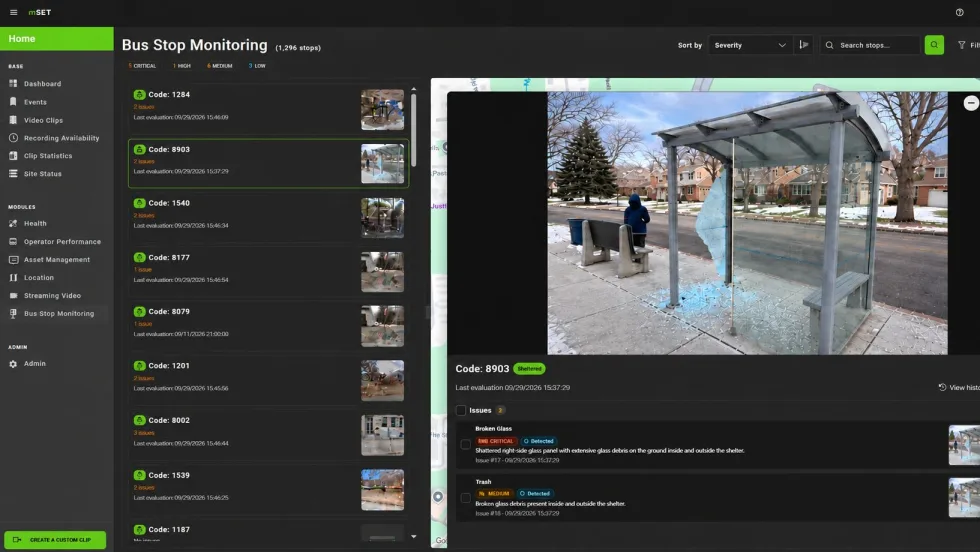
Biz Briefs: Luminator Launches AI Technology to Monitor Bus Stop Conditions and More
In METRO's latest installment, we also take a look at recent news from Masabi, Troman Industries, ioki, CCW, and more partnerships making headlines across the transportation sector.
Read More →
Public Transit Conference Returning to GFX in 2027, Call for Papers Now Open
The Call for Papers is now open, allowing transit agency professionals and industry experts to help shape the PTC educational program by submitting session ideas for consideration.
Read More →
ENC Lands MATA Contract and More in Biz Briefs
In this edition of Biz Briefs, we spotlight the latest developments shaping the future of mobility.
Read More →

Strada360’s Steve Lassey on Turning Transit Data Into Better Decisions
From breaking down data silos to preparing for AI, Strada360 CEO Steve Lassey discusses how transit agencies can use technology to improve operations, customer information, and long-term decision-making.
Read More →
Almaviva Looks to Open Architecture to Advance Transit Technology
Eric Reese discusses how interoperability, open architecture, and modular design can help transit agencies control costs, reduce vendor lock-in, and upgrade technology without starting over.
Read More →
Driving Smarter Paratransit
John Hanlon shares how AlphaRoute is leveraging AI-powered technology to help paratransit providers optimize operations, support frontline staff, and enhance the rider experience.
Read More →
From Hardware to Digital Partner: Luminator Charts Its Next Chapter
CEO Magnus Friberg discusses Luminator’s shift toward becoming a digital partner, the growing importance of software and interoperability, and how AI can help agencies improve operations and passenger experience.
Read More →
Beyond the Checklist: A Structured Approach to Transit Maintenance
Reliability-Centered Maintenance helps transit agencies move beyond routine checklists to focus limited resources on the assets and failures that have the greatest impact on safety, reliability, and service.
Read More →
NJ TRANSIT Advances Bus Technology Upgrades Across Statewide Fleet
More than 1,500 buses now feature upgraded technology designed to improve arrival predictions and provide free Wi-Fi, with deployment expected to reach nearly 2,000 buses by the end of 2026.
Read More →
Building a Flexible Path to Transit Electrification
John Hroncich discusses BAE Systems’ modular and scalable approach, lessons learned from decades of real-world operations, and how agencies can identify electrification strategies that fit their fleets.
Read More →