



Biz Briefs: AECOM, Aira, and More
Biz Briefs covers the latest supplier news in the motorcoach and public transit industries.

In METRO's latest installment, we take a look at the latest news from suppliers including AECOM, Camber, WSP, and more.
Photo: METRO
Biz Briefs covers the latest supplier news in the motorcoach and public transit industries.
In METRO's latest installment, we take a look at the latest news from suppliers including AECOM, Camber, WSP, and more.
AECOM Tapped for Phase 2 Final Design of LA Light Rail Project
AECOM will serve as lead designer under the San Fernando Transit Constructors (SFTC) joint venture team to advance the Phase 2 final design for the Los Angeles County Metropolitan Transportation Authority’s (Metro) East San Fernando Valley Light Rail Transit Project.
The project will feature at-grade light rail tracks and 11 stations, spanning 6.7 miles, to create a more efficient and reliable transit service in the San Fernando Valley area.
As lead designer, AECOM will provide services to manage the design integration for multiple facilities. All project elements will be designed in 3D using (BIM) Building Information Modeling to increase efficiency, enable clash, and design constructability detection.
Once completed, the transit line will create connections with regional transit services, including Metrolink, Amtrak, Metro G Line, Metro B Line, and other planned Metro projects. The project is currently forecasted to open in 2031.
C-TRAN Teams with Aira to Provide Visual Interpretation Services
Vancouver, Wash.’s C-TRAN is partnering Aira to provide complimentary access to Aira Explorer for all blind and low-vision transit riders.
Aira Explorer is an app that provides on-demand, remote visual interpreting services. Clark County transit riders can download the app for free in the iOS or Google Play App Store, tap a button, and connect via secure video call with a professional visual interpreter.
The interpreter uses the caller’s phone camera to assist with navigation, provide description, read aloud signs and maps, and help with any other tasks a rider may be looking to accomplish while traveling within Clark County.
Local access to Aira Explorer went live in Clark County. Users can automatically use the app for free at major hubs in the C-TRAN system, including transit centers, or with a designated access offer in the app while traveling on C-TRAN elsewhere.
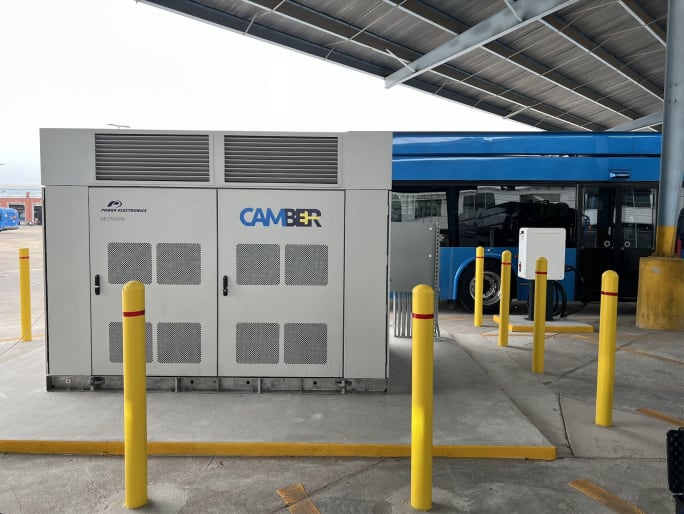
As part of the project, Camber supplied and installed two 1440 kW Camber Charging Systems and 48 Camber Industrial Dispensers.
Photo: Camber
Texas’ CapMetro, Camber Team to Increase EV Charging
Camber unveiled an expansion of its partnership with Austin, Texas’ CapMetro, successfully delivering 2.9 megawatts (MW) of power to the public transit agency’s primary bus depot.
With the ability to charge up to 48 EV buses simultaneously, the installation supports CapMetro’s ongoing efforts to transition its bus fleet to zero-emissions vehicles.
As part of the project, Camber supplied and installed two 1440 kW Camber Charging Systems and 48 Camber Industrial Dispensers.
The company expects to provide CapMetro with its proprietary charger and energy management software, and remote diagnostic tools to manage energy costs and lower the public fleet’s total cost of ownership.
In addition to dispensing power at CapMetro’s primary bus depot, Camber’s EV chargers will also deliver on-route power and range extension, so that buses return to the depot with a higher state of charge to reduce peak power demand at the central site.
WSP, LA Metro Celebrate Construction of Southeast Gateway Line
WSP joined the LA Metro to celebrate the start of construction of its Southeast Gateway Line, a new 14.5-mile light rail transit line that will provide a dependable alternative to driving for two million people.
WSP in the U.S. has been involved with the light rail project since 2016, serving as lead environmental and design consultant. The Southeast Gateway Line will include nine stations between the City of Artesia, located to the south of Los Angeles, and the city’s Slauson A Line station.
WSP performed several planning studies, including completion of the Final Environmental Impact Statement/Environmental Impact Report (EIS/EIR) in March 2024. Metro certified the Final EIR under the California Environmental Quality Act in April 2024, followed by the Federal Transit Administration issuing a federal record of decision in August 2024.
When completed, the Southeast Gateway Line will provide convenient transit access for the cities of Bell, Bellflower, Cerritos, Cudahy, Downey, Florence-Firestone, Huntington Park, Los Angeles, Paramount, South Gate and Vernon. The line will also include a new C Line station on the I-105 freeway.
More Technology

From Hardware to Digital Partner: Luminator Charts Its Next Chapter
CEO Magnus Friberg discusses Luminator’s shift toward becoming a digital partner, the growing importance of software and interoperability, and how AI can help agencies improve operations and passenger experience.
Read More →
Beyond the Checklist: A Structured Approach to Transit Maintenance
Reliability-Centered Maintenance helps transit agencies move beyond routine checklists to focus limited resources on the assets and failures that have the greatest impact on safety, reliability, and service.
Read More →
NJ TRANSIT Advances Bus Technology Upgrades Across Statewide Fleet
More than 1,500 buses now feature upgraded technology designed to improve arrival predictions and provide free Wi-Fi, with deployment expected to reach nearly 2,000 buses by the end of 2026.
Read More →

Building a Flexible Path to Transit Electrification
John Hroncich discusses BAE Systems’ modular and scalable approach, lessons learned from decades of real-world operations, and how agencies can identify electrification strategies that fit their fleets.
Read More →
Biz Briefs: Alstom Lands Canadian Contract, LYT to Supply California TSP, and More
In METRO's latest installment, we take a look at recent news from Complete Coach Works, Beep, FlixBus, and more partnerships making headlines across the transportation sector.
Read More →
From Legacy Silos to Conversational Intelligence
What if transit leaders could ask any operational question and get a trusted answer in seconds? Conversational AI is transforming how agencies use their data.
Read More →
USDOT Announces Rail Vehicle Replacement Grants, Chattanooga AV Shuttle Funding
More than $191 million in federal funding will help three transit agencies replace aging rail vehicles and support a new autonomous shuttle service in Chattanooga.
Read More →
Bus Tech Talk: Keeping Transit Technicians Ahead of the Technology Curve
LA Metro’s Obed Mejia discusses technician training, evolving maintenance technology, fleet replacement, and strategies for getting the most out of today’s transit fleets.
Read More →
Biz Briefs: RIPTA Unveils New Frontrunners, Clevland RTA Adds New Siemens, and More
In METRO's latest installment, we take a look at recent news from Siemens, Prevost, Dodge, and more partnerships making headlines across the transportation sector.
Read More →
Why Simulating Pedestrian Movement Has Become Essential for Modern Rail Stations
Pedestrian microsimulation is helping rail planners identify bottlenecks, test station designs, and prepare complex transit hubs for growing passenger volumes.
Read More →