



Biz Briefs: HDR, Optibus, and More
Biz Briefs covers the latest supplier news in the motorcoach and public transit industries.

In METRO's latest installment, we take a look at the latest news from suppliers including Intersection, HDR, and more.
Photo: METRO
Biz Briefs covers the latest supplier news in the motorcoach and public transit industries.
In METRO's latest installment, we take a look at the latest news from suppliers including Intersection, HDR, and more.
Intersection, CobbLinc Announce Partnership
Intersection, an experience-driven out-of-home media and technology company, has been awarded an exclusive three-year contract to sell advertising for Cobb County, Georgia, on its CobbLinc bus fleet and bus shelters.
The contract commenced on August 1 and includes two one-year options for a total of up to five years.
With the acquisition of the CobbLinc contract, Intersection expands and deepens its position in the Atlanta media market — already operating as the exclusive bus, rail, and station advertising provider for the Metropolitan Atlanta Rapid Transit Authority.
CobbLinc is the public bus transit system in Cobb County. This acquisition broadens Intersection coverage in Greater Atlanta, building continuity between suburban and urban audiences, as well as with commuters across the region, said company officials.
Optibus Expands GenAI Capabilities
Optibus has introduced new capabilities to Optibus AI, the first Generative Artificial Intelligence (GenAI) suite purpose-built for public and private operators and agencies.
Preference Designer for Scheduling is the industry’s first Generative AI agent that uses natural language to create complex scheduling rules.
Building valid, optimized schedules that comply with complex business rules and union agreements has traditionally required configuration expertise and custom coding.
Now, schedulers type preferences in plain language, such as “No more than ten duties over nine hours,” and Optibus instantly generates accurate, ready-to-use logic—no more specialized coding, configuration, or steep learning curves.
Integrated with Optibus’ optimization engine and trained on real-world scheduling data, Preference Designer reduces errors and rule configuration time by up to 70%, the company said. It also improves work quality with less effort, helps quickly onboard new users, and eliminates tedious, repetitive tasks. Planners and schedulers can easily build and test complex rosters while meeting compliance requirements.
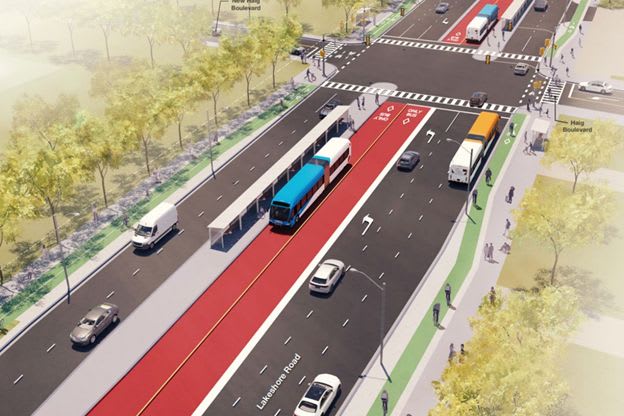
The Lakeshore BRT corridor stretches approximately 1.25 miles along Lakeshore Road from East Avenue to Etobicoke Creek in Mississauga, Ontario, an area with considerable planned growth.
Photo: Rendering via HDR
HDR to Design Mississauga’s Lakeshore BRT Project
HDR, in partnership with GEI Consultants, has been selected by the Canadian City of Mississauga to lead the detailed design and contract administration for the Lakeshore bus rapid transit (BRT) project.
The Lakeshore BRT corridor stretches approximately 1.25 miles along Lakeshore Road from East Avenue to Etobicoke Creek in Mississauga, Ontario, an area with considerable planned growth.
The Lakeshore BRT is a transformative investment in Mississauga’s mobility future, creating a vibrant, multimodal corridor that enhances connectivity, supports sustainable growth, and strengthens access to the waterfront for all users, including pedestrians, cyclists, transit riders, and motorists.
The design will transform the corridor into a complete street, featuring a widened roadway, dedicated center-running bus lanes, and accessible, weather-protected stations. On both sides of the road, new cycle tracks and sidewalks will invite people to move safely and comfortably through the corridor. Beneath the surface, utilities will be strategically engineered to support future development to enable this bold transformation of Mississauga’s waterfront.
According to the company, the HDR team begins the project with a strong understanding of the Lakeshore corridor, gained through its previous work, including environmental assessments and conceptual designs for a BRT on the corridor, as well as the development of a transportation master plan for the project area.
Via Announces Pricing of Initial Public Offering
Via Transportation Inc. announced the pricing of its initial public offering of 10,714,285 shares of its Class A common stock at a public offering price of $46 per share.
Via is offering 7,142,857 shares of Class A common stock, and the selling stockholders are offering 3,571,428 shares of Class A common stock.
In addition, Via has granted the underwriters a 30-day option to purchase up to an additional 1,607,142 shares of Class A common stock at the initial public offering price, less underwriting discounts and commissions.
The shares of Class A common stock are expected to begin trading on the New York Stock Exchange on September 12, under the ticker symbol “VIA.”
More Technology

From Hardware to Digital Partner: Luminator Charts Its Next Chapter
CEO Magnus Friberg discusses Luminator’s shift toward becoming a digital partner, the growing importance of software and interoperability, and how AI can help agencies improve operations and passenger experience.
Read More →
Beyond the Checklist: A Structured Approach to Transit Maintenance
Reliability-Centered Maintenance helps transit agencies move beyond routine checklists to focus limited resources on the assets and failures that have the greatest impact on safety, reliability, and service.
Read More →
NJ TRANSIT Advances Bus Technology Upgrades Across Statewide Fleet
More than 1,500 buses now feature upgraded technology designed to improve arrival predictions and provide free Wi-Fi, with deployment expected to reach nearly 2,000 buses by the end of 2026.
Read More →

Building a Flexible Path to Transit Electrification
John Hroncich discusses BAE Systems’ modular and scalable approach, lessons learned from decades of real-world operations, and how agencies can identify electrification strategies that fit their fleets.
Read More →
Biz Briefs: Alstom Lands Canadian Contract, LYT to Supply California TSP, and More
In METRO's latest installment, we take a look at recent news from Complete Coach Works, Beep, FlixBus, and more partnerships making headlines across the transportation sector.
Read More →
From Legacy Silos to Conversational Intelligence
What if transit leaders could ask any operational question and get a trusted answer in seconds? Conversational AI is transforming how agencies use their data.
Read More →
USDOT Announces Rail Vehicle Replacement Grants, Chattanooga AV Shuttle Funding
More than $191 million in federal funding will help three transit agencies replace aging rail vehicles and support a new autonomous shuttle service in Chattanooga.
Read More →
Bus Tech Talk: Keeping Transit Technicians Ahead of the Technology Curve
LA Metro’s Obed Mejia discusses technician training, evolving maintenance technology, fleet replacement, and strategies for getting the most out of today’s transit fleets.
Read More →
Biz Briefs: RIPTA Unveils New Frontrunners, Clevland RTA Adds New Siemens, and More
In METRO's latest installment, we take a look at recent news from Siemens, Prevost, Dodge, and more partnerships making headlines across the transportation sector.
Read More →
Why Simulating Pedestrian Movement Has Become Essential for Modern Rail Stations
Pedestrian microsimulation is helping rail planners identify bottlenecks, test station designs, and prepare complex transit hubs for growing passenger volumes.
Read More →