




Report: Best (and Worst) Cities for Commuting on Public Transportation in the U.S.
BRT Systems Named Best Bus Lines in the U.S.
Los Angeles, Cleveland, Las Vegas, Eugene, Ore., and Pittsburgh were rated as the nation’s leading cities for bus-based transportation because of their high-quality bus rapid transit systems.
May 27, 2011
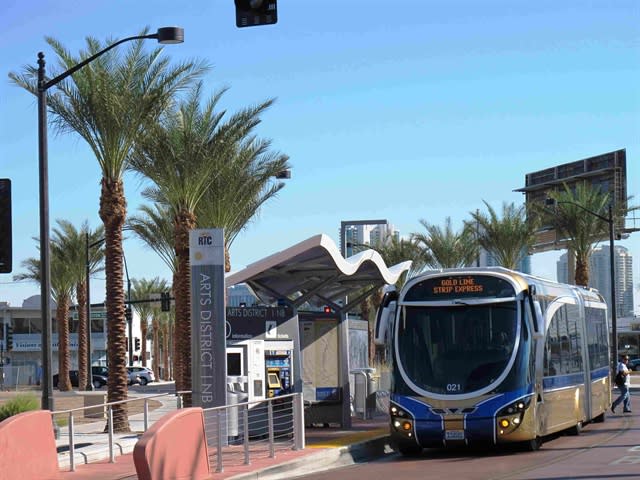
The Regional Transportation Commission of Southern Nevada's MAX bus rapid transit system connects downtown Las Vegas, the Las Vegas Convention Center, the Strip, Henderson and North Las Vegas.
Photo: MAX
4 min to read
Los Angeles; Cleveland; Las Vegas; Eugene, Ore.; and Pittsburgh were rated as the nation’s leading cities for bus-based transportation because of their high-quality bus rapid transit systems (BRT), according to a new independent study, issued by the Institute for Transportation and Development Policy (ITDP).
BRT combines the flexibility of buses with the speed and priority of light rail, but at a fraction of the cost of rail. The study rates three new BRT systems currently in planning in the San Francisco Bay Area; Montgomery County, Md.; and Chicago as the best prospects to achieve an even higher “gold-standard” BRT, something that does not currently exist in the U.S.
“These systems are poised to redefine how Americans see and use buses, critical at a time of increasingly scarce transportation funding,” says Walter Hook, ITDP executive director. “But based on what we’ve seen in our work in cities around the world, we think there’s still more that could be done. Getting at least one truly world-class BRT system built in the U.S. could inspire cities around the country to rethink the way they use buses in the fight against increasing traffic congestion and rising fuel prices.”
Transit ridership in the U.S. is at a five-decade record high, with buses accounting for over half of those trips. But according to APTA, U.S. buses travel at a nationwide average speed of 12.5 mph, with passengers often having to contend with limited service frequency and with buses that don’t always run according to schedule.
These unforeseen delays and slow speeds are a result of a number of factors including traffic congestion and boarding delays, but as shown in ITDP’s new report, "Recapturing Global Leadership in Bus Rapid Transit," they can be addressed, making buses a fast and efficient mode of transportation once more.
The report finds that some U.S. cities already have high-quality BRT including:
Los Angeles: The Orange Line offers a separated busway, off-board fare collection, and buses arriving every four minutes in rush hour to provide high-quality service and attract new passengers, carrying 22,000 passengers a day.
Cleveland: The HealthLine has dedicated bus lanes, off-board fare collection, and at-level boarding, and has resulted in average time savings of 12 minutes from end-to-end of the route. Ridership is up 60 percent as compared to the bus line that previously served the corridor and it is spurring new development along the corridor.
Eugene, Ore.: The Emerald Express (EmX) has off-board fare collection and near-level boarding making it quicker and easier to hop on. Dedicated right-of-way through Eugene’s most congested areas, signal priority, improved station design and wide stop spacing make buses 30 percent faster than before.
Las Vegas: A network of BRT routes connects residents from low-density neighborhoods to jobs and destinations in the busy downtown, using dedicated bus lanes. The entire system has off-board fare collection and high-quality station design, making it an attractive option.
Pittsburgh: The East Busway is a separated busway, enabling buses to reach speeds of up to 35 mph. It is unique in that it includes multiple routes (both local and express) that minimize transfers, resulting in bus frequencies of every two minutes during peak hours.
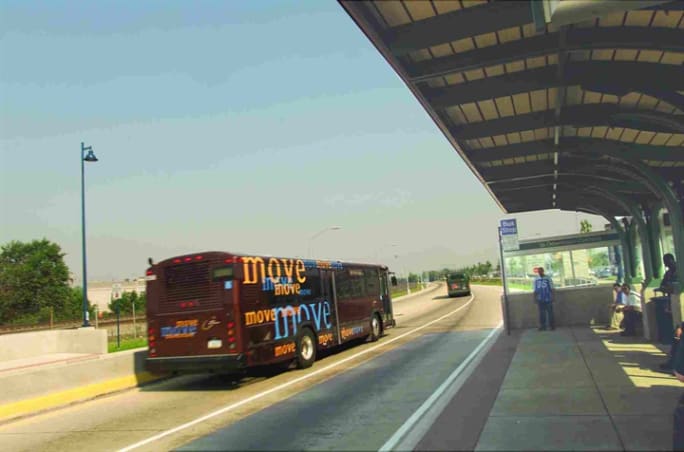
The Port Authority of Allegheny County's Martin Luther King Jr. East Busway has been providing BRT service to Downtown Pittsburgh, the East End neighborhoods of Pittsburgh and the eastern suburbs of Allegheny County since February 1983.
Photo: Port Authority of Allegheny County
Three cities have BRT systems on the horizon, which may reach “gold standard” including:
Chicago: Incoming Mayor Rahm Emmanuel made BRT a cornerstone of his campaign platform and his transition plan promises that “maximum impact will be achieved by dedicated bus lanes, signal preemption, pre-paid boarding or on-board fare verification, multiple entry and exit points on the buses, limited stops and at-grade boarding.”
Montgomery County, Md.: A recently-released feasibility study conducted by the County’s Department of Transportation estimates that a 150-mile BRT system, with high-level boarding, special stops, high frequency service and reserved lanes in some areas could increase transit ridership by 11 percent, taking 85,000 cars off the congested roadways in the Washington, D.C. area. The system could be in place by as early as 2014.
San Francisco Bay Area, Calif.: The Bay Area has several bold BRT projects on deck. The city of San Francisco is planning two BRT lines to modernize two very congested bus corridors downtown. The East Bay is moving forward with a high-quality BRT plan through the highest-demand streets in Oakland and San Leandro. These initiatives will help to redefine transit throughout the Bay Area.
Recapturing Global Leadership in Bus Rapid Transit documents the challenges that these and other cities face in implementing BRT, including lack of public awareness of BRT, lack of political will for building bus-based transit, and outdated traffic design standards that sometimes hinder system design and implementation.
The report suggests that a clearer and more widely-accepted definition of what BRT is would increase public understanding of and demand for this high-quality transportation option. The report outlines the BRT Standard, a first-generation attempt at defining a scoring system (along the lines of the LEED rating system for green buildings), which ranks BRT systems as gold, silver or bronze.
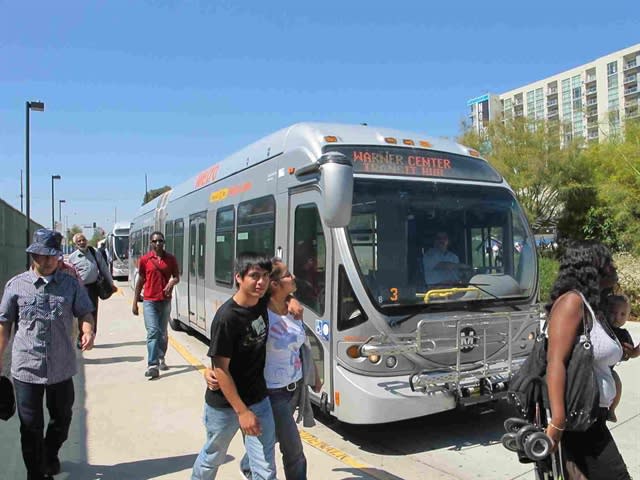
The Los Angeles County Metropolitan Transportation Authority's Orange Line opened on October 29, 2005.
Photo: Los Angeles County Metropolitan Transportation Authority
The report was funded by a grant from the Rockefeller Foundation.
More Bus

New York MTA Plans Largest Bus Fleet Upgrade in More Than a Decade
The agency is seeking manufacturers for 650 new CNG buses to replace aging vehicles, improve reliability, and advance its broader fleet modernization strategy.
Read More →
Building a Flexible Path to Transit Electrification
John Hroncich discusses BAE Systems’ modular and scalable approach, lessons learned from decades of real-world operations, and how agencies can identify electrification strategies that fit their fleets.
Read More →
Bus Tech Talk: Keeping Transit Technicians Ahead of the Technology Curve
LA Metro’s Obed Mejia discusses technician training, evolving maintenance technology, fleet replacement, and strategies for getting the most out of today’s transit fleets.
Read More →
Biz Briefs: RIPTA Unveils New Frontrunners, Clevland RTA Adds New Siemens, and More
In METRO's latest installment, we take a look at recent news from Siemens, Prevost, Dodge, and more partnerships making headlines across the transportation sector.
Read More →
People Movement: Holly Arnold Joins Transdev and More
In this edition, we also cover recent appointments and announcements at Pace, CamTran, MCI, and more, showcasing the individuals helping to shape the future of transportation.
Read More →
The High Cost of Transit Buses: Industry Leaders Look to Procurement Reform
Transit leaders and policymakers examine how standardized bus designs, streamlined procurement, and predictable funding could help agencies stretch budgets and deliver better service.
Read More →
The Business Voice Behind Public Transportation
As chair of APTA’s Business Members Board of Governors, Ray Melleady explains how more than 850 business members are partnering with transit agencies to advance funding, innovation, and industry-wide collaboration.
Read More →
From Surviving to Thriving: Building Stronger Transportation Organizations
Bus Business Consultants founder Brian Dickson shares lessons on leadership, organizational health, and creating options for long-term success in a changing transportation industry.
Read More →
Finding the ‘Happy Medium’: Optimizing Maintenance Without Sacrificing Reliability
The key to maintenance optimization isn’t doing less work—it’s doing the right work at the right time on the right assets.
Read More →
LA Metro, City of West Hollywood, and Partners Advance Smarter Bus Lane Enforcement
The award-winning partnership combines AI-powered detection with human oversight to improve bus reliability, accessibility, and enforcement efficiency.
Read More →