




RELATED: 'Bus Only' traffic signals coming to 6 D.C. intersections
Calif. city launches new 'smart' signal priority system for mass transit
Reduces traffic signal delays, and uses AI to anticipate users’ arrivals at signalized intersections and then request priority.
July 8, 2019
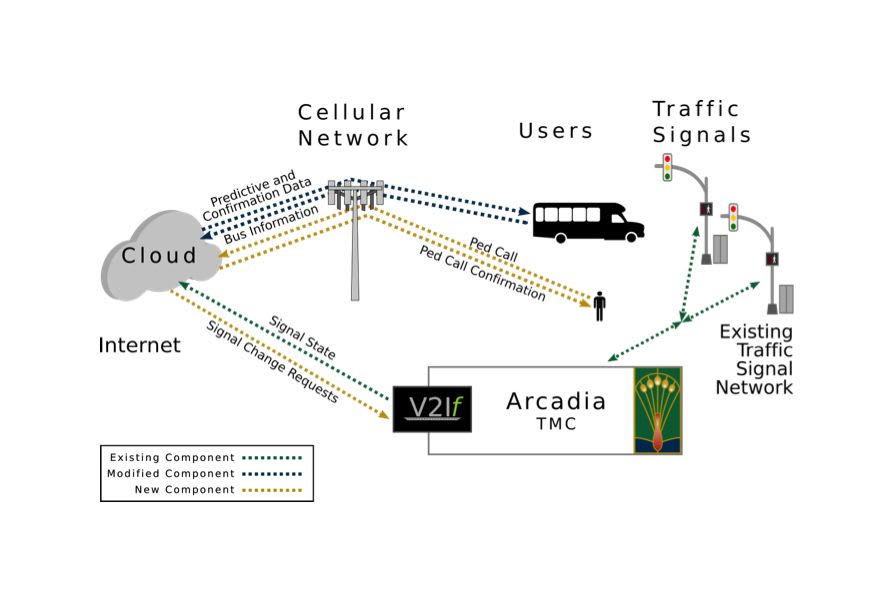
Connected Signals is providing Arcadia, Calif., with a proprietary, cloud-based Transit Signal Priority (TSP) solution.
Connected Signals
2 min to read
Connected Signals is providing Arcadia, Calif., with a proprietary, cloud-based Transit Signal Priority (TSP) solution.
Connected Signals
The City of Arcadia, Calif.and Connected Signals Inc. announced the introduction of new “smart” signal priority systems for the city’s mass transit system. The program integrates Arcadia’s existing systems and incorporates Connected Signals’ patent pending vehicle-to-infrastructure (V2I) technology to improve mobility. The technology reduces traffic signal delays, and uses artificial intelligence to anticipate users’ arrivals at signalized intersections and then request priority, thereby providing more efficiency and a smoother transit experience.
Connected Signals is providing Arcadia with a proprietary, cloud-based solution, Transit Signal Priority (TSP). TSP works on hardware already outfitted in the buses, and it operates along the city’s fixed-bus routes to reduce trip time by improving a bus’ ability to get in the “green wave,” either by extending a green light or by having a signal return to green more quickly.
Arcadia had specific parameters for the project. In order to eliminate the need for capital outlays and to minimize maintenance expenses going forward, the city preferred a software-only solution. The city also wanted to address what Los Angeles Metro calls first/last mile, providing and facilitating safety and experiential improvements for the first/last mile of a commuter’s journey as they approach or depart a station.
Traditional approaches to TSP require the installation of new hardware at every supported intersection, usually at significant cost in time and money. Connected Signals’ system uses only existing infrastructure, including the cellular network and cloud computing, to provide services at much lower cost and with much shorter lead times.
The company’s approach is also expansible to a wide range of other services, including pedestrian priority, EMS preemption, cyclist detection and prioritization, and HOVE prioritization. All of these features can be provided by deploying new software, without requiring hardware installation or changes. Finally, the fact that no new hardware is installed means that long-term maintenance costs are significantly lower than for traditional systems, according to the company.
The collaboration began in June 2018 and was supported by a grant from Los Angeles Metro Net Toll Grants program.
More Technology

From Hardware to Digital Partner: Luminator Charts Its Next Chapter
CEO Magnus Friberg discusses Luminator’s shift toward becoming a digital partner, the growing importance of software and interoperability, and how AI can help agencies improve operations and passenger experience.
Read More →
Beyond the Checklist: A Structured Approach to Transit Maintenance
Reliability-Centered Maintenance helps transit agencies move beyond routine checklists to focus limited resources on the assets and failures that have the greatest impact on safety, reliability, and service.
Read More →
NJ TRANSIT Advances Bus Technology Upgrades Across Statewide Fleet
More than 1,500 buses now feature upgraded technology designed to improve arrival predictions and provide free Wi-Fi, with deployment expected to reach nearly 2,000 buses by the end of 2026.
Read More →

Building a Flexible Path to Transit Electrification
John Hroncich discusses BAE Systems’ modular and scalable approach, lessons learned from decades of real-world operations, and how agencies can identify electrification strategies that fit their fleets.
Read More →
Biz Briefs: Alstom Lands Canadian Contract, LYT to Supply California TSP, and More
In METRO's latest installment, we take a look at recent news from Complete Coach Works, Beep, FlixBus, and more partnerships making headlines across the transportation sector.
Read More →
Sponsored•September 8, 2026
From Legacy Silos to Conversational Intelligence
What if transit leaders could ask any operational question and get a trusted answer in seconds? Conversational AI is transforming how agencies use their data.
Read More →
USDOT Announces Rail Vehicle Replacement Grants, Chattanooga AV Shuttle Funding
More than $191 million in federal funding will help three transit agencies replace aging rail vehicles and support a new autonomous shuttle service in Chattanooga.
Read More →
Bus Tech Talk: Keeping Transit Technicians Ahead of the Technology Curve
LA Metro’s Obed Mejia discusses technician training, evolving maintenance technology, fleet replacement, and strategies for getting the most out of today’s transit fleets.
Read More →
Biz Briefs: RIPTA Unveils New Frontrunners, Clevland RTA Adds New Siemens, and More
In METRO's latest installment, we take a look at recent news from Siemens, Prevost, Dodge, and more partnerships making headlines across the transportation sector.
Read More →
Why Simulating Pedestrian Movement Has Become Essential for Modern Rail Stations
Pedestrian microsimulation is helping rail planners identify bottlenecks, test station designs, and prepare complex transit hubs for growing passenger volumes.
Read More →